

Key takeaways
- For the widest usable slabs: choose a 24-inch roller such as the Bailey DRD or North Star 24-inch model. The extra four inches over a 20-inch roller is significant when making large platters or multiple tiles from one slab.
- For a general home pottery studio: the Brent SR-20 is a sensible middle ground. It offers more room than a compact 16-inch machine without requiring the full footprint and weight of a large studio roller.
- For a small or shared workspace: the Shimpo SRM-1624 or another compact roller is easier to position and move. It is a better choice when a larger machine would permanently block a walkway or workbench.
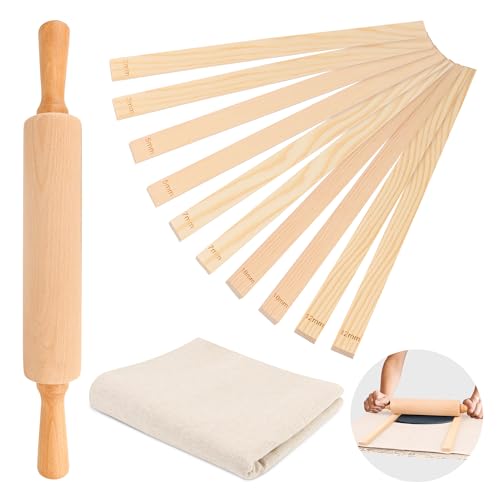
- For occasional use and the lowest initial cost: a tabletop roller with spacer boards can work, provided the workbench is rigid and large enough. It demands more technique and usually produces less consistent thickness.
- For classes or frequent production: prioritize a rigid frame, replaceable canvas, accessible adjustment hardware, and a standing-height table. Saving money on these features often becomes expensive in lost setup time and repairs.
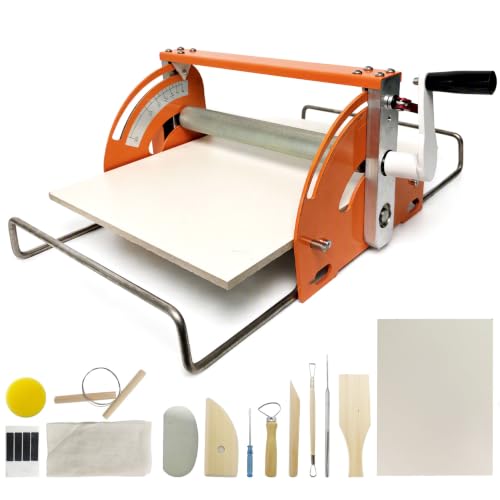
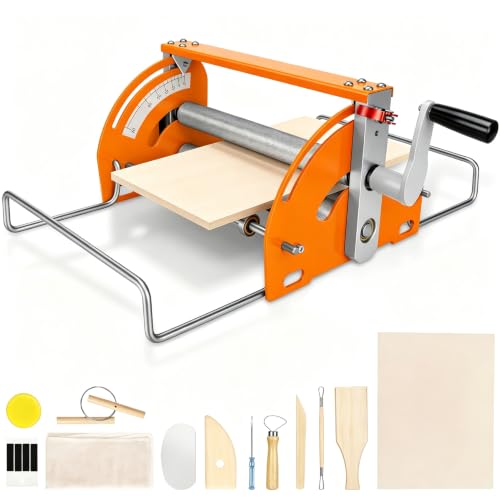
The best slab rollers for pottery are the Bailey DRD for a serious shared studio, the North Star 24-inch roller for maximum working width, the Brent SR-20 for a durable mid-size table, and the Shimpo SRM-1624 when floor space matters more than capacity.
Our top picks

As an Amazon Associate we earn from qualifying purchases at no extra cost to you. Ratings are shown as listed on Amazon.
Best slab rollers at a glance
A slab roller is worth choosing by more than its advertised roller width. The usable table area, thickness adjustment, frame stiffness, storage footprint, and method of moving the clay all affect whether the machine is pleasant to use week after week.
| Model or type | Working width | Typical table length | Thickness control | Approximate weight | Best suited to |
|---|---|---|---|---|---|
| Bailey DRD slab roller | 24 inches | 36 inches | Adjustable rolling height, commonly about 1/8 to 1 inch | About 150–170 lb | Frequent use and teaching studios |
| North Star 24-inch slab roller | 24 inches | About 36 inches | Multiple preset or indexed thickness positions, depending on configuration | About 140–170 lb | Large plates, tiles, and wide architectural slabs |
| Brent SR-20 | 20 inches | About 32–36 inches | Adjustable rolling gap using thickness settings | About 100–130 lb | Home studios and general production |
| Shimpo SRM-1624 | 16 inches | About 24 inches | Adjustable gap, commonly used for thin to medium slabs | About 55–75 lb | Small rooms, classrooms, and occasional users |
| Tabletop guide-and-pin roller | 12–20 inches | Depends on workbench | Removable guide boards or spacer rails | About 10–35 lb | Low budgets and limited storage |
Dimensions and weights can vary by revision, stand, and included accessories, so confirm the current manufacturer specification before ordering. The table is intended for comparing the practical class of each option rather than replacing the product manual.
Best choices by situation
- For the widest usable slabs: choose a 24-inch roller such as the Bailey DRD or North Star 24-inch model. The extra four inches over a 20-inch roller is significant when making large platters or multiple tiles from one slab.
- For a general home pottery studio: the Brent SR-20 is a sensible middle ground. It offers more room than a compact 16-inch machine without requiring the full footprint and weight of a large studio roller.
- For a small or shared workspace: the Shimpo SRM-1624 or another compact roller is easier to position and move. It is a better choice when a larger machine would permanently block a walkway or workbench.
- For occasional use and the lowest initial cost: a tabletop roller with spacer boards can work, provided the workbench is rigid and large enough. It demands more technique and usually produces less consistent thickness.
- For classes or frequent production: prioritize a rigid frame, replaceable canvas, accessible adjustment hardware, and a standing-height table. Saving money on these features often becomes expensive in lost setup time and repairs.
Head-to-head: what separates the leading designs
Bailey DRD versus North Star 24-inch
These are both aimed at studios that regularly make substantial slabs. Their 24-inch width accommodates large plates, trays, wall pieces, and tile panels with fewer joins. The important distinction is not simply the width; it is how easily the thickness can be changed and read.
The Bailey DRD is attractive when repeatability and quick adjustment are priorities. Its robust roller-table construction is suited to repeated passes, and the DRD configuration is commonly selected by studios that need a substantial working surface without moving the clay onto a separate table. North Star machines are known for heavy construction and straightforward, durable mechanisms. They make particular sense when the roller will remain in one place and be used for large, repeated batches.
Allow roughly 5 feet of clear length for a 36-inch table, plus room at the operating side for the operator and clay. A 24-inch roller can require a footprint close to 30 inches wide by 5 feet long after allowing for handles and access. Measure doorways, stairs, and the final route into the studio before choosing one.
Brent SR-20 versus Shimpo SRM-1624
The Brent SR-20 gives a useful compromise: a 20-inch slab is broad enough for most domestic pottery, but the machine is less imposing than a 24-inch studio roller. Its main advantage is capacity without requiring a dedicated production room.
The Shimpo SRM-1624 is easier to accommodate when the available table or floor area is restricted. A 16-inch slab is sufficient for mugs, small serving dishes, tiles, handles, and many sculptural components. Its limitation is not quality; it is the practical ceiling on slab width. A 16-inch roller will not efficiently replace a 24-inch machine for large platters or architectural work.
Thickness control matters more than the maximum slab size
A roller should make it easy to produce a repeatable thickness, not merely offer a wide range. Look for positive stops, clearly marked settings, or a mechanism that adjusts both sides evenly. If the two sides are set differently, the slab can emerge tapered, even when its surface looks smooth.
For many pottery projects, useful target thicknesses are:
- 1/8 inch for small tiles or delicate components, when the clay body and drying method permit it.
- 1/4 inch for mugs, small plates, appliqué work, and general handbuilding.
- 3/8 inch for larger plates, trays, and pieces needing additional stiffness before forming.
- 1/2 inch or more for substantial sculptural or architectural elements, followed by careful compression and controlled drying.
Do not judge thickness by the roller setting alone. Canvas, clay moisture, compression, and the number of passes affect the result. Measure a finished test slab with calipers at several points. If a 1/4-inch setting produces readings ranging from 0.20 to 0.30 inch, the problem may be uneven clay preparation or frame flex rather than the nominal adjustment range.
Construction, portability, and workspace requirements
Heavy steel or cast-metal frames resist movement and flexing, which helps maintain even slabs. Powder-coated steel is common on durable studio machines because it tolerates clay dust and repeated cleaning. Wood-framed or tabletop designs can work well, but they depend more heavily on the rigidity of the supporting bench.
Portability has a trade-off. A 55-pound compact machine may be movable by one person with care, while a 150-pound roller generally needs two people or a cart. A folding stand saves storage space but does not eliminate the operating footprint. Allow clearance for the clay board, canvas, rolling handle, and the operator’s elbows—not just the dimensions of the frame.
As a practical fit calculation, suppose a machine is 36 inches long and you need 18 inches of working clearance at each end for boards and handling. The minimum useful length is 72 inches, or 6 feet. Add approximately 30 inches of width for the machine and operator access, and a dedicated area of about 15 square feet becomes the realistic minimum. This is why a nominally compact machine can still be awkward in a crowded room.
Ownership realities: what wears first
- Canvas: canvas collects clay dust and can stretch, fray, or develop hard ridges. Keep a spare piece cut to the correct size and replace it when it no longer lies flat.
- Adjustment threads and pins: clay particles can make them stiff. Brush or vacuum dry debris away before changing settings; do not force a jammed handle.
- Roller surfaces: dried clay can create bumps that transfer to every slab. Remove deposits with a plastic scraper or stiff brush rather than a metal tool that may score the surface.
- Table fasteners: vibration and repeated loading can loosen bolts. Check them periodically, especially on machines that are moved or folded.
- Spacer boards and guides: these are consumable workshop parts. Keep several thicknesses available and replace warped boards, since a bowed guide produces inconsistent slabs.
Never roll clay containing hard grog or debris without checking the table and canvas afterward. Avoid leaving wet clay on the machine overnight: it can bond to canvas, increase cleanup time, and encourage uneven drying. Clean with a brush or low-moisture method rather than flooding the mechanism with water.
How to choose without overbuying
Start with the largest slab you make regularly, not the occasional project you might attempt. If most work is under 16 inches wide, a compact roller may deliver the best value. If you routinely join slabs because your roller is too narrow, moving to 20 or 24 inches can save more time than a faster adjustment mechanism.
For a rough cost-per-use comparison, a $900 machine used twice a month for five years provides about 120 sessions, or $7.50 per session before maintenance. A $300 tabletop roller used ten times in the same period costs $30 per session. The cheaper design is preferable only if it actually meets your needs; an undersized roller that leads to replacement after a year is not the economical choice.
Final recommendation
For most dedicated home potters, the Brent SR-20 is the balanced choice: substantial enough for everyday handbuilding, but less demanding than a full 24-inch studio machine. Choose the Shimpo SRM-1624 when storage and maneuverability dominate. Choose the Bailey DRD or North Star 24-inch when large slabs, repeatable production, and long service life justify a permanent workspace. If your use is occasional, begin with a quality tabletop design and a rigid workbench rather than paying for capacity that will remain unused.

Write Your Review
No reviews yet. Be the first to share your experience!