

Key takeaways
- A fitted cutting board that covers part or all of the bowl.
- A colander or perforated basket for rinsing vegetables and draining pasta.
- A roll-up drying rack rated for the sink’s width.
- A bottom grid that protects the finish and keeps dishes above standing water.
- A drain cover or strainer that matches the sink’s drain opening.
Best Workstation Kitchen Sinks for Busy Kitchens
The best workstation kitchen sinks for a busy kitchen are deep, 30–33-inch stainless-steel models with a genuinely usable ledge system, rear-set drains, and enough cabinet clearance for the included accessories. For most households, a 16- or 18-gauge sink with a 9-inch-deep single bowl offers the best balance of capacity, noise control, installation flexibility, and long-term durability.
Our picks by kitchen situation
| Kitchen situation | Best sink type | Recommended specification | Why it fits |
|---|---|---|---|
| Frequent cooking and large cookware | Single-bowl workstation | 30–33 inches wide, 9–10 inches deep, 16-gauge stainless steel | Accommodates roasting pans, stockpots, cutting boards, and soaking |
| Limited counter space | Compact workstation | 24–27 inches wide, 8–9 inches deep, roll-up rack or small cutting board | Adds prep capacity without consuming a full-size counter section |
| Separating washing from rinsing | Double-bowl workstation | 33–36 inches wide, bowls of approximately 9 and 11 inches | Provides two work zones, though each bowl is less flexible |
| Replacing an existing sink | Top-mount or equal-size undermount | Match the existing cutout and cabinet width before shopping | Reduces countertop modification and cabinet-fit problems |
| Heavy daily use on a controlled budget | 16- or 18-gauge single bowl | 27–30 inches wide, sound-dampening pads, rear drain | Prioritizes useful capacity over decorative extras |
Best overall: a 30- to 33-inch single-bowl workstation sink
A large single bowl is usually the strongest choice for a busy kitchen because it lets you wash a baking sheet, Dutch oven, colander, and several plates without arranging them around a center divider. A 30-inch bowl suits many 36-inch sink cabinets, while a 33-inch model generally needs a 36-inch cabinet and more countertop clearance.
Our top picks


As an Amazon Associate we earn from qualifying purchases at no extra cost to you. Ratings are shown as listed on Amazon.
Established lines such as the Kraus Kore, Ruvati workstation sinks, and Elkay Crosstown workstation models illustrate the main design options available in this category. Exact dimensions, accessories, corner radii, and drain locations vary by model, so the manufacturer’s technical drawing matters more than the product family name.
Look for a basin approximately 28–31 inches from side to side inside, 16–19 inches front to back, and 9–10 inches deep. That combination is large enough for oversized cookware without making the sink so deep that shorter users must lean uncomfortably. A deep bowl is useful, but depth beyond about 10 inches can make the bottom difficult to reach and can reduce usable space below the sink.
Best for small kitchens: a 24- to 27-inch workstation sink
A compact sink can still provide the workstation benefit if its accessories are designed efficiently. A 24- to 27-inch model with a fitted cutting board, stainless-steel colander, and roll-up drying rack can create a temporary prep surface over the bowl. It will not replace a 33-inch sink for washing large roasting pans, but it can make a narrow galley kitchen more practical.
Choose the smallest size that accepts your largest regularly used pan. Measure that pan diagonally and across its handles, then compare it with the sink’s internal length rather than its advertised exterior width. A nominal 27-inch sink may have an interior bowl only about 24 inches long once the rim and corner radius are excluded.
Compact workstation sinks are also more sensitive to accessory storage. A thick cutting board may occupy the entire bowl, leaving nowhere to place dirty dishes. Prefer a model with a slim roll-up rack or a cutting board that can stand vertically inside the cabinet.
Workstation accessories: useful equipment or clutter?
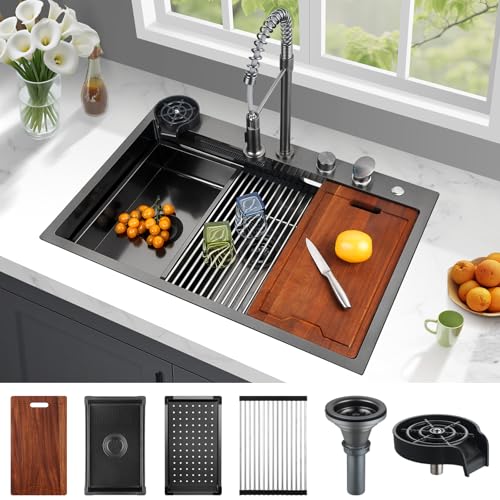
The defining feature is a stepped ledge inside the front and rear walls. Accessories slide or rest on those ledges, allowing food preparation, rinsing, and draining to happen over the basin. The most useful set normally includes:
- A fitted cutting board that covers part or all of the bowl.
- A colander or perforated basket for rinsing vegetables and draining pasta.
- A roll-up drying rack rated for the sink’s width.
- A bottom grid that protects the finish and keeps dishes above standing water.
- A drain cover or strainer that matches the sink’s drain opening.
Accessories are not interchangeable as reliably as standard kitchen tools. Check whether the board is food-safe and dishwasher-compatible, whether the colander has stable feet, and whether the rack supports at least 50–70 pounds if you plan to place a heavy pot on it. Thin boards can warp, and wire racks with unsealed end caps can trap moisture.
A workstation ledge also reduces the bowl’s effective width. If the ledge projects 1 inch on each side, a nominally 30-inch sink may provide a 28-inch working span at the accessory level. This is one reason internal dimensions are more informative than the outside measurement.
16 gauge versus 18 gauge stainless steel
Gauge refers to sheet thickness, and a lower number is thicker. A typical 16-gauge sink uses stainless steel around 1.5 mm thick, while an 18-gauge sink is approximately 1.2 mm thick. Both can be suitable for home use when properly supported, but thicker steel generally feels more solid and resists denting better.
| Feature | 16 gauge | 18 gauge | What it means in practice |
|---|---|---|---|
| Approximate sheet thickness | 1.5 mm | 1.2 mm | 16 gauge offers a modest rigidity advantage |
| Typical market range | $350–$900 | $180–$600 | Finish, size, accessories, and brand affect price substantially |
| Noise potential | Lower when fully insulated | Can be louder if lightly damped | Look for underside pads and coating, not gauge alone |
| Best use | Frequent heavy cookware and long ownership | Normal daily use and tighter budgets | Either can last if installed and maintained correctly |
Steel grade matters too. Type 304 stainless steel is common and well suited to kitchen use. A brushed or satin finish hides light scratches better than a mirror finish. No stainless sink is scratch-proof: sliding cast iron, ceramic, or gritty cookware across the base will eventually mark it.
Drain placement can matter more than an extra two inches of width
A rear drain preserves usable floor space inside the bowl and leaves more room in the cabinet for plumbing, a garbage disposal, or a filtration system. It also places the drain closer to the backsplash, which can be helpful when washing large items in front of it. The trade-off is that food debris may collect at the rear if the sink does not slope effectively.
A center drain is easier to align with existing plumbing and may simplify replacement. However, it divides the lower area around the drain and can place the disposal directly beneath the busiest part of the bowl. Before choosing a rear-drain model, check the manufacturer’s plumbing diagram and the location of your existing waste pipe.
Measure the drain opening as well as the drain position. Most kitchen sinks use a standard-sized opening, but the included strainer, disposal flange, and drain cover must still be compatible. A workstation sink that includes an unusual drain basket can create replacement-cost or fit issues later.
Undermount, top-mount, or farmhouse installation?
Undermount
An undermount sink creates a clean countertop edge and allows crumbs to be swept directly into the bowl. It requires a correctly sized, professionally finished countertop cutout and does not work with every laminate surface. The cabinet must also accommodate the sink’s depth, ledges, clips, plumbing, and disposal.
Top-mount
A top-mount sink rests on the countertop and is usually the easiest replacement option. Its rim can hide a less-than-perfect cutout, making it useful for renovations on a budget. The exposed rim slightly reduces counter continuity, and the work ledge may sit higher than the surrounding work surface.
Farmhouse or apron-front
An apron-front workstation sink makes the front of the bowl visible and can provide a deep, generous basin. It normally requires cabinet modification, a support frame, and careful alignment with the countertop. Do not assume a standard 36-inch sink cabinet will accept one without carpentry work.
Cabinet sizing: the measurement that prevents an expensive mistake
Sink width is not the same as minimum cabinet width. A 33-inch workstation sink commonly requires a 36-inch cabinet, while many 30-inch sinks require a 33- or 36-inch cabinet depending on the bowl shape and mounting style. Some 27-inch models fit a 30-inch cabinet, but only if the manufacturer specifies that minimum.
Use this fitting process:
- Measure the cabinet’s inside width between the side walls, not the outside cabinet width.
- Check the sink’s published minimum cabinet size and required cutout dimensions.
- Measure from the countertop underside to the plumbing, disposal, and any rear support rails.
- Allow room for the sink clips, faucet hoses, water filter, and drain assembly.
- Confirm that the countertop material supports the chosen mounting method.
For example, suppose a sink requires a 36-inch cabinet and your cabinet measures 35 1/2 inches inside. The half-inch shortage is not solved by choosing a smaller cutout: the sink walls and mounting ledges still need physical clearance. Replacing the sink with a model specified for a 33-inch cabinet is safer than forcing the installation.
Ownership realities and maintenance
The first parts likely to show wear are the bottom grid feet, rubber accessories, drain strainer gasket, and cutting-board edges. Keep a spare set of silicone feet or protective bumpers if the sink uses a removable grid. Replace cracked rubber rather than allowing metal to scrape the bowl.
Rinse away salt, acidic food residue, and abrasive particles after use. Clean with mild dish soap and a soft sponge, moving with the grain of the brushed finish. Avoid steel wool, chlorine bleach left on the surface, and cleaners containing abrasive grit. Drying the sink after cleaning reduces water spots and mineral buildup.
Do not leave wet cast iron, carbon-steel cookware, or steel cans in the bowl overnight. Rust marks on stainless steel are often surface contamination rather than failure of the sink itself, but they become harder to remove when repeatedly exposed to moisture. Never use the cutting board as a chopping surface if it has begun to swell, split, or rock on the ledges.
Final buying recommendation
Choose a 30-inch or 33-inch single-bowl workstation sink in 16 or 18 gauge stainless steel if your cabinet permits it. Prioritize the internal bowl dimensions, rear or offset drain, sound-dampening treatment, and replaceable accessories over the number of items in the box. For a small kitchen, a 24- to 27-inch model with a well-fitting cutting board and roll-up rack is more useful than an oversized sink that leaves no counter or cabinet clearance. The best model is the one whose basin, drain, mounting style, and accessories fit your kitchen’s actual measurements—not simply the one with the longest accessory list.

Write Your Review
No reviews yet. Be the first to share your experience!