

Key takeaways
- Fill the bag with approximately the documents you intend to store, rather than testing it empty.
- Close the zipper without forcing it around an overpacked corner.
- Lift the loaded bag by its handle or base and check whether the zipper separates or the stitching stretches.
- Turn it upside down for 30 seconds. Passports and cash should not slide through gaps at the corners.
- Run a finger along the entire closure to confirm that the protective flap lies flat over the zipper.
Best Fireproof Document Bags for Cash and Passports
The best fireproof document bags for cash and passports are layered fiberglass pouches with a silicone-coated outer shell, a full-length zipper, and a published fire-resistance rating of at least 30 minutes; for irreplaceable papers, a fire-rated safe is a better primary defence than any portable bag.
A document bag is useful because it is inexpensive, portable, and easy to keep inside a home safe or grab during an evacuation. It is not, however, automatically fireproof just because the listing uses the words “fireproof” or “fire resistant.” The meaningful buying questions are how the heat rating was established, whether the zipper is protected, how many layers separate the contents from the flames, and whether the bag remains closed when carried.
Our top picks


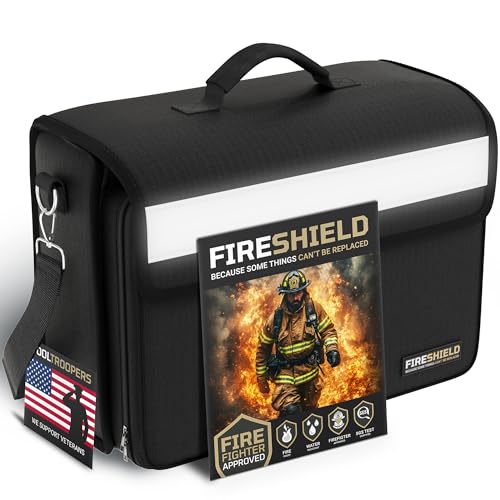
As an Amazon Associate we earn from qualifying purchases at no extra cost to you. Ratings are shown as listed on Amazon.
Quick comparison: which type fits your situation?
| Bag type | Typical construction | Useful capacity | Typical heat claim | Best for | Main limitation |
|---|---|---|---|---|---|
| Single-layer fiberglass pouch | Fiberglass fabric, stitched seams, basic zipper | 1–3 litres | About 15–30 minutes | Small emergency cash, spare cards, copies | More vulnerable at seams and around the zipper |
| Layered fiberglass document bag | Two or more fiberglass layers, inner lining, zipper flap | 3–8 litres | About 30–60 minutes | Passports, certificates, compact paper files | Bulkier and usually less flexible |
| Silicone-coated fiberglass bag | Fiberglass core with silicone-coated exterior | 3–10 litres | About 30–60 minutes, depending on construction | Frequent handling and storage in dusty areas | Coating can crack, peel, or become sticky with age |
| Fire-resistant pouch inside a fire-rated safe | Bag used as an inner organiser within an insulated safe | Depends on safe size | Uses the safe’s certified rating | Long-term storage of irreplaceable documents | Higher cost; bag alone adds little certified protection |
These are market-level construction ranges, not guarantees for every product. A manufacturer’s test standard and certification matter more than the number printed on the packaging.
What heat rating should a cash and passport bag have?
Look for a clearly stated temperature and duration, not only “fireproof.” A useful specification might state that the contents are protected for 30 minutes at a particular test temperature. Some bags use a paper-protection temperature such as 350°F (177°C), while others quote a higher external flame temperature. Those figures are not interchangeable: the relevant question is the temperature reached inside the pouch, and whether the test included a zipper, seams, and a realistic load of paper.
For passports and cash, a 30-minute claim is a sensible minimum for a portable bag. Choose 60 minutes when the bag will be stored in a garage, near a kitchen, or in a location where firefighters may need more time to reach it. If the documents are legally difficult to replace—property deeds, immigration records, wills, or original certificates—use a certified fire-rated safe or off-site storage as the primary measure. Put the bag inside the safe only as an organiser and secondary layer.
Do not assume a water-resistant bag is waterproof during firefighting. Some fire-resistant bags have a coated exterior and overlapping flap that help against light water exposure, but zipper tracks and seams remain weak points. Store passports in a sealed inner sleeve if water damage would be especially costly.
Fiberglass versus silicone: the material decision
Layered fiberglass
Fiberglass is the insulating core in many affordable fire-resistant bags. Multiple layers create trapped air spaces and slow heat transfer. More layers generally improve protection, but stitching holes, folded corners, handles, and the zipper opening can undermine the benefit. A thick bag with a poorly protected opening may perform worse than a thinner bag with an overlapping flap and well-sealed seams.
Fiberglass can shed small fibres after abrasion or repeated folding. Keep the pouch away from children and avoid cutting, puncturing, or washing it aggressively. If the fabric becomes frayed or the inner lining exposes loose fibres, replacement is prudent.
Silicone-coated fiberglass
Silicone coating gives fiberglass a smoother, more durable exterior. It can reduce fibre shedding, repel splashes, and tolerate regular handling better than untreated cloth. The coating does not make the bag immune to fire, and it is not the same as a certified high-temperature silicone seal. Look for an actual fiberglass layer beneath the coating, a full closure flap, and a stated heat test.
Inspect silicone-coated bags periodically for tackiness, cracks, hardening, or peeling. Heat, sunlight, and storage beside solvents can accelerate deterioration. A coating that looks intact but has separated from the fabric around the zipper is a reason to replace the bag.
Zipper strength matters more than many listings admit
A zipper is both a mechanical failure point and a gap through which hot air can enter. Prefer metal or heavy-duty coil zippers with a wide fabric or silicone flap covering the closed track. Two zipper sliders can make opening easier but do not automatically improve fire protection.
Perform a simple closure check before buying or immediately after delivery:
- Fill the bag with approximately the documents you intend to store, rather than testing it empty.
- Close the zipper without forcing it around an overpacked corner.
- Lift the loaded bag by its handle or base and check whether the zipper separates or the stitching stretches.
- Turn it upside down for 30 seconds. Passports and cash should not slide through gaps at the corners.
- Run a finger along the entire closure to confirm that the protective flap lies flat over the zipper.
This is a usability and construction check, not a fire test. Never test a household bag with an open flame: the result will be uncontrolled, may release irritating smoke, and will not reproduce a certified laboratory method.
Size the bag before choosing the “largest” model
Measure the documents as a stack. A passport is approximately 5.0 by 3.5 inches (12.7 by 8.9 cm), while letter-size papers are 11 by 8.5 inches (27.9 by 21.6 cm). Add at least 1 inch (2.5 cm) to each dimension so the zipper does not press against folded corners.
For example, suppose you have four passports, two credit-card wallets, an envelope of cash, and ten sheets of letter paper. The paper stack may be only 0.15 inch thick, but the wallets and passports create a rigid bundle roughly 1.5 inches thick. A pouch advertised as 2 inches deep may become difficult to close once the zipper’s corner radius is considered. A practical target is an internal depth of 2.5–3 inches and an internal footprint of at least 12 by 9 inches for this collection.
Capacity also affects fire performance. Empty space is not harmful, but overfilling can hold the zipper open, compress insulating layers, and prevent the flap from overlapping. Choose the smallest bag that closes easily around the complete contents.
Decision matrix for common buyers
| Your situation | Recommended choice | Why |
|---|---|---|
| Budget under about $40 and only a few papers | Small, layered fiberglass pouch with a covered zipper | Provides basic separation from heat without paying for excess capacity |
| Several passports, cash, and letter-size records | 3–8 litre silicone-coated, multi-layer bag | Better handling durability and room to avoid overpacking |
| Documents accessed weekly | Heavy-duty zipper, reinforced handle, coated exterior | Frequent opening is likely to wear the zipper and seam first |
| Documents stored in a garage or near cooking equipment | 60-minute-rated bag, preferably inside a certified fire-rated safe | Provides more time and reduces exposure to direct heat |
| Irreplaceable originals | Certified fire-rated safe plus digital and off-site copies | A portable bag is not a substitute for tested structural insulation |
Ownership details that affect real protection
Keep the bag flat or loosely folded in a cool, dry, shaded cupboard. Do not store it directly on a concrete garage floor, where moisture can attack paper and metal zipper components. Avoid placing heavy boxes on top of it, since permanent creases can stress the insulation and closure.
Review the contents every six to twelve months. Remove expired cards, replace cash that has been moved, and check passports for moisture or mould. Clean the exterior with a lightly damp cloth only if the manufacturer permits it; soaking can damage the inner layers. Do not machine-wash, bleach, iron, or dry-clean a fire-resistant pouch unless its instructions specifically allow that treatment.
The zipper and handle usually wear before the main fabric. Replace the bag if the zipper teeth skip, the slider no longer closes the track, the handle stitching loosens, the coating peels, or the insulation is visibly crushed. Fire exposure is also a replacement event even when the contents appear undamaged, because heat may have weakened adhesives and stitching.
Bottom line
For most households, the best fireproof document bags combine two or more fiberglass layers, a silicone-coated exterior, a covered heavy-duty zipper, and a clearly stated 30- or 60-minute heat rating. Select the capacity from your actual document stack, leave room for the closure to lie flat, and treat the bag as portable backup protection—not as equivalent to a certified fire-rated safe. For passports and emergency cash, that combination offers a practical balance of price, handling durability, and protection when correctly stored and maintained.


Write Your Review
No reviews yet. Be the first to share your experience!