

Key takeaways
- Independent temperature adjustment: At least three settings are usable; six or more allow finer control. A numbered display is easier to repeat than vague “low, medium, and high” labels.
- Automatic shutoff: A 30-, 60-, or 90-minute timer is preferable to a pad that remains on indefinitely. A longer 120- or 180-minute option can be useful while awake, but it should not encourage overnight use.
- Overheat protection: Look for an explicit temperature sensor or overheat shutoff, not only a claim that the pad is “safe.”
- Controller placement: A detachable controller is easier to replace or clean around. Controls should remain visible and reachable without putting the controller under the body.
- Insulated wiring and strain relief: The cable should enter the pad through a reinforced connection. This is one of the areas most likely to fail through repeated bending.
- Low-temperature mode: Important for long, comfortable sessions and for people who find high heat irritating.
- Cleanable cover: A removable machine-washable cover is useful, but the electrical insert should never be immersed unless the manufacturer specifically states that it is washable.
Best Infrared Heating Pads for Targeted Relief
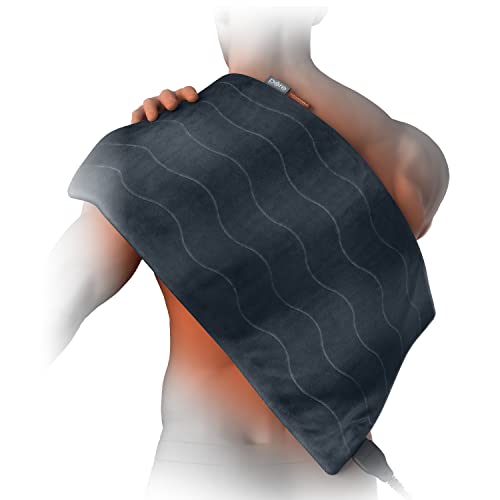
The best infrared heating pad for most people is a flexible, adjustable pad with at least three heat levels, a 30- to 60-minute timer, washable or wipe-clean materials, and enough coverage for the body area you actually want to warm. Large carbon-fiber or far-infrared pads suit the back and abdomen, while smaller wraparound designs are easier to position on the neck, shoulder, knee, or wrist.
“Infrared” usually describes the heating element or the way a product markets its heat delivery. In practical buying terms, temperature range, evenness, fit, controls, and automatic shutoff matter more than the label alone. Infrared heating pads are not a substitute for diagnosis or treatment; stop using one if it causes pain, dizziness, skin irritation, or excessive heat, and ask a healthcare professional if you have reduced sensation, circulation problems, diabetes, or a condition affected by heat.
Our top picks



As an Amazon Associate we earn from qualifying purchases at no extra cost to you.
Quick comparison: which format fits your situation?
| Pad type | Typical size | Typical power | Heat levels | Timer range | Best use |
|---|---|---|---|---|---|
| Compact flexible pad | 12 x 24 inches | 45–75 watts | 3–6 | 30–120 minutes | Neck, shoulder, arm, or one knee |
| Standard back pad | 24 x 33 inches | 80–120 watts | 4–9 | 30–120 minutes | Lower back, hips, or abdomen |
| Extra-large full-back pad | 24 x 36 to 27 x 33 inches | 100–150 watts | 4–10 | 30–180 minutes | Back and shoulders together |
| Wrap or belt-style pad | 8 x 20 to 12 x 24 inches | 40–80 watts | 3–6 | 30–120 minutes | Hands-free use around the waist, shoulder, or knee |
| Portable rechargeable pad | 8 x 12 to 12 x 20 inches | 10–30 watts | 3–5 | 30–90 minutes | Travel or areas without a nearby outlet |
These are useful market specifications rather than universal standards. A claimed infrared wavelength or maximum temperature does not tell you how evenly the surface heats, how quickly it warms, or whether the controller provides meaningful low-temperature adjustment.
Best choices by body area
For the lower back and hips: choose broad, flexible coverage
A pad around 24 x 33 inches is usually the best balance for the lower back. It can cover the lumbar area and part of the hips without becoming difficult to store. Look for multiple heating zones or an element pattern that reaches close to the edges. A narrow central heating strip can leave the sides noticeably cooler.
For occasional use, a standard pad with a wired controller is usually more practical than a rigid infrared mat. If you want to use it while seated, select a soft construction with a long power cord, a removable controller, and a strap or wrap that prevents the pad from sliding.
For the neck and shoulders: prioritize shape over maximum size
A contoured shoulder wrap or a compact pad is easier to keep in contact with the trapezius muscles than a flat full-body pad. Flexible construction is particularly important here: stiff panels can create hot spots when draped over the shoulders. A controller with a low setting is also valuable because neck skin is close to the heating element and can become uncomfortable before the rest of the pad feels warm.
For a knee, elbow, or wrist: buy a wrap, not an oversized blanket
Small joints benefit from a pad that stays in place. Look for adjustable hook-and-loop closures, elastic straps, or a shaped sleeve, while avoiding designs that require tight compression. A 12 x 24-inch flexible pad can work for a knee or elbow, but a purpose-built wrap usually delivers more consistent contact and uses less electricity.
For the abdomen: seek even, moderate heat
A standard rectangular pad can cover the abdomen, but a belt-style model is more convenient if you need to remain upright. Choose a low minimum temperature and a timer that can be set for 30 minutes. Avoid sleeping with the pad in place, even when the product advertises an extended timer.
Head-to-head: flexible carbon-fiber pads versus rigid infrared mats
Flexible carbon-fiber pads are generally the better everyday choice. Carbon-fiber elements can be distributed across a soft surface, allowing the pad to bend around the body and pack into a drawer. They are also typically lighter, often about 1.5 to 3.5 pounds for a standard pad. Their main weaknesses are folding stress, controller wear, and possible uneven heating after years of use.
Rigid infrared mats often use stone, ceramic, or mineral layers over heating elements. They may feel stable beneath the back, but they are heavier—commonly 8 to 20 pounds depending on size—and less suitable for the neck, shoulder, or knee. They need a permanent storage location and should not be bent. If you want a stationary pad for a bed or floor, the firm construction can be an advantage; for targeted, changing use, flexibility wins.
Do not select a rigid mat solely because it contains stones or minerals. Those materials may affect weight, surface feel, and marketing claims, but they do not replace basic safety features or prove a superior result for every user.
Controls and safety features that matter
- Independent temperature adjustment: At least three settings are usable; six or more allow finer control. A numbered display is easier to repeat than vague “low, medium, and high” labels.
- Automatic shutoff: A 30-, 60-, or 90-minute timer is preferable to a pad that remains on indefinitely. A longer 120- or 180-minute option can be useful while awake, but it should not encourage overnight use.
- Overheat protection: Look for an explicit temperature sensor or overheat shutoff, not only a claim that the pad is “safe.”
- Controller placement: A detachable controller is easier to replace or clean around. Controls should remain visible and reachable without putting the controller under the body.
- Insulated wiring and strain relief: The cable should enter the pad through a reinforced connection. This is one of the areas most likely to fail through repeated bending.
- Low-temperature mode: Important for long, comfortable sessions and for people who find high heat irritating.
- Cleanable cover: A removable machine-washable cover is useful, but the electrical insert should never be immersed unless the manufacturer specifically states that it is washable.
Power use: a small difference per session, a larger difference over time
A heating pad is usually inexpensive to operate, but wattage and session length still help compare models. For example, a 100-watt pad used for 45 minutes consumes:
0.100 kilowatts × 0.75 hours = 0.075 kilowatt-hours per session.
At an electricity rate of $0.20 per kilowatt-hour, that is about 1.5 cents per session. Used once daily for 30 days, the electricity cost would be approximately $0.45. A 150-watt pad used for the same time would consume 0.1125 kilowatt-hours, or about 2.3 cents at that rate.
Portable rechargeable pads avoid a nearby outlet but trade sustained heat for battery limits. A 20-watt battery-powered pad with a 40-watt-hour battery has a theoretical runtime of two hours, before accounting for controller losses and cycling. In real use, expect less at the highest setting. Choose mains power for frequent home sessions and rechargeable power for mobility.
Durability and ownership realities
The fabric is not usually the first part to fail. Repeated folding can fatigue internal heating elements, while pulling the controller cable can damage the connection. Store a flexible pad loosely rolled or flat rather than sharply creased. Do not sit on a pad unless it is designed for that purpose, and never place heavy objects on it.
Keep the surface dry and follow the care label. If the cover is removable, wash it separately and allow it to dry completely before reinstalling. Do not use pins, clips, or safety fasteners to attach a pad to clothing. Inspect the cable before each use for fraying, exposed wire, a hot plug, or intermittent power; discontinue use if any appear.
How to choose without overspending
- Lowest-cost sensible option: A 12 x 24-inch flexible pad with three to six heat levels, a 30- or 60-minute timer, and overheat protection.
- Best all-purpose option: A 24 x 33-inch pad with edge-to-edge heating, a washable cover, at least six settings, and a detachable controller.
- Best for frequent use: A durable carbon-fiber pad with reinforced cable entry, independent sensor protection, and replacement-controller availability.
- Best for mobility: A rechargeable wrap with a documented battery capacity, low-temperature setting, and a secure but nonrestrictive strap.
- Best for a fixed relaxation space: A rigid mat, provided its weight, storage requirements, and cleaning method suit the room.
For general targeted use in 2026, a medium flexible pad remains the most versatile choice. Match its dimensions to the body area, confirm the timer and low-heat controls, and treat infrared claims as secondary to even heating, automatic shutoff, and dependable construction.





Write Your Review
No reviews yet. Be the first to share your experience!