

Key takeaways
- Best Overall: BN-LINK Outdoor 7-Day Programmable Timer, 2 outlets, eight programs.
- Best Automatic Dusk-to-Dawn: TiFFCOFiO Outdoor Timer Outlet with light sensor, 2 grounded outlets.
- Best Value Mechanical: HBN Outdoor 24 Hour Mechanical Timer, simple dial.
- Best Sensor with Countdown: BN-LINK Outdoor Light Timer with dusk-to-dawn sensor.
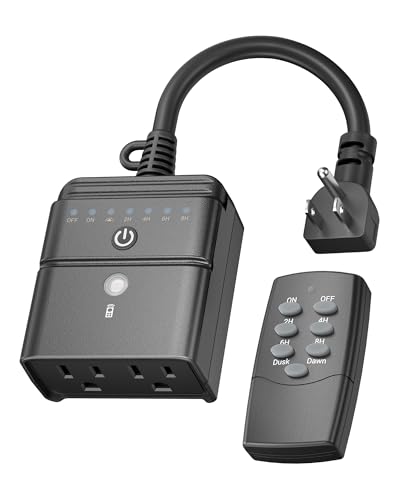
- Best Remote Control: DEWENWILS Outdoor Timer with 100 ft remote.
- Best Power Stake with Remote: TiFFCOFiO Outdoor Power Stake Timer, 100 ft remote.
- Best for Many Strings: DEWENWILS Outdoor Power Strip Timer with photocell, 6 outlets.
The BN-LINK Outdoor 7-Day Programmable Timer is the best weatherproof outdoor timer for Christmas lights if you want exact on and off times you can change by day of the week, with eight programs and random mode for a lived-in look. The TiFFCOFiO Outdoor Timer with a dusk-to-dawn light sensor is the runner-up for people who want the lights to follow the sun automatically without touching a dial. Both are low-cost, plug into an existing outdoor outlet and require no Wi-Fi.
For a home security site, a holiday timer is not just about convenience. A house that is lit at predictable evening hours and dark at 11 p.m. looks occupied, and a timer keeps that routine going when you are traveling for the holidays. The best outdoor timers also protect the outlet itself: a weatherproof housing, a sturdy cord and a clear load rating keep a wet December night from turning into a tripped breaker or worse. This guide compares seven models, explains the difference between mechanical, digital and light-sensing timers, and shows how to size a timer to your display.
Our top picks


As an Amazon Associate we earn from qualifying purchases at no extra cost to you.
Top Picks at a Glance
- Best Overall: BN-LINK Outdoor 7-Day Programmable Timer, 2 outlets, eight programs.
- Best Automatic Dusk-to-Dawn: TiFFCOFiO Outdoor Timer Outlet with light sensor, 2 grounded outlets.
- Best Value Mechanical: HBN Outdoor 24 Hour Mechanical Timer, simple dial.
- Best Sensor with Countdown: BN-LINK Outdoor Light Timer with dusk-to-dawn sensor.
- Best Remote Control: DEWENWILS Outdoor Timer with 100 ft remote.
- Best Power Stake with Remote: TiFFCOFiO Outdoor Power Stake Timer, 100 ft remote.
- Best for Many Strings: DEWENWILS Outdoor Power Strip Timer with photocell, 6 outlets.
Comparison Table
| Product | Best for | Key specs | Watch for | Price tier |
|---|---|---|---|---|
| BN-LINK 7-Day Programmable Timer | Exact schedules by day | 2 outlets, 8 on/off programs, random and DST modes, 15A / 1875W | Both outlets switch together | Budget |
| TiFFCOFiO Dusk to Dawn Timer Outlet | Automatic sunset start | 2 grounded outlets, light sensor, 15A / 1/2 HP | Mount it where it can see daylight | Budget |
| HBN 24 Hour Mechanical Timer | No-fuss dial timing | 2 grounded outlets, 24-hour dial, weatherproof housing | Fixed daily schedule, no weekday settings | Budget |
| BN-LINK Dusk-to-Dawn Sensor Timer | Dusk start, off after set hours | Photocell, 2/4/6/8 hour countdown, weatherproof outlets, 15A / 1/2 HP | Mount about 2 ft above ground | Budget to Mid-range |
| DEWENWILS Timer with 100 ft Remote | Switching from indoors | 2 outlets, RF remote, 2/4/6/8 hour countdown, 125V 15A | Remote battery and line-of-sight range | Budget |
| TiFFCOFiO Power Stake Timer, Remote | Yard displays on a stake | Multi-outlet stake, 100 ft remote, 6 ft cord, dusk to dawn | Check outlet count on the listing | Mid-range |
| DEWENWILS Power Strip Timer, Photocell | Six strings on one timer | 6 outlets, 10 ft cord, photocell, countdown | All outlets share one schedule | Mid-range |
1. BN-LINK Outdoor 7-Day Programmable Timer: Best Overall
- Two grounded outlets, controlled together.
- Eight on/off programs, down to one-minute settings, with a 7-day schedule.
- Random vacation mode and a daylight-saving mode.
- Rated 125V, 60Hz, 15A, 1875W resistive, 8A tungsten, 1/2 HP; ETL listed.
- Digital display for programming.
Best for: homeowners who want precise start and stop times, and a different pattern on weekends. Skip if: you want the lights to track sunset automatically.
The strength of a true 7-day digital timer is control. You can set lights on from 5:00 p.m. to 10:30 p.m. on weekdays and extend to midnight on Friday and Saturday, with the same program repeating every week. The random mode shifts the on and off times by a small amount each day, which looks more like a person using the lights than a perfectly repeating schedule, a feature home-security guides often recommend when you are away. Daylight-saving mode saves you from resetting the clock twice a year.
Setup takes a few minutes: set the clock, set the day, and add each program. The downside is that the schedule is fixed to clock time. In December, sunset drifts later or earlier as you move through the month, so a 5 p.m. start will be a little early at the start of the season and perfectly timed by Christmas. If that matters to you, choose a light-sensor model. Both outlets run on the same program, which is fine if you are powering a single display but not if you want independent circuits.
Pros: precise day-by-day scheduling; random mode; DST mode; low cost tier; high load rating. Cons: both outlets switch together; clock-based rather than sunset-based; programming takes patience.
2. TiFFCOFiO Outdoor Timer Outlet (Dusk to Dawn): Best Automatic Sunset Start
- Two grounded outlets.
- Built-in light sensor turns outputs on at dusk.
- Countdown options from the listing family include off after several hours.
- Rated 15A / 1/2 HP; ETL listed per the listings.
- Weatherproof housing; mount vertically and away from artificial light.
Best for: set-and-forget lighting that follows the sun. Skip if: your outlet sits under a bright porch light, which can confuse the sensor.
A photocell timer skips the clock entirely. When daylight fades, the sensor switches the outlets on; depending on the mode, they stay on until dawn or turn off after a set number of hours. That is the easiest way to get the lights starting at the right time through a long December without touching the timer. Listings across the TiFFCOFiO family describe modes such as always on, always off, dusk to dawn, and on at dusk then off after two, four, five, six or eight hours, but exact modes vary by model, so read the listing for the version you pick.
Placement is the one thing to get right. The sensor needs to see real daylight. If it points at a lit window, a porch lamp or its own string of lights, it may think it is still day, or toggle on and off. Mount it vertically on an outlet where it faces open sky, about two feet above the ground or higher so snow does not bury it.
Pros: follows sunset automatically; several countdown modes; low cost tier. Cons: sensor can be fooled by nearby lights; no day-of-week control; modes vary by listing version.
3. HBN Outdoor Timer Outlet (24 Hour Mechanical): Best Simple Mechanical Timer
- Two grounded outlets with a weatherproof cover.
- 24-hour mechanical dial with pins or tabs for on and off segments.
- No batteries, no display and no Wi-Fi.
- Designed for outdoor use with lights and decorations.
Best for: people who want the cheapest and simplest option and are happy with the same schedule every night. Skip if: you want weekday settings or a screen.
A mechanical timer is a clock face with movable tabs. Push the tabs to the time you want the lights on, and the dial rotates once every 24 hours. There is nothing to program and nothing to break if a battery dies, because there is no battery. For a plain holiday display, it works every night. The limits are precision (you set segments rather than minutes) and flexibility: the schedule is the same every day, and after a power outage the dial keeps turning from where it stopped, so the lights may run at the wrong time until you reset it.
Pros: very low cost tier; no programming; no battery; simple. Cons: same schedule daily; time resets after outages; less precise than digital.
4. BN-LINK Outdoor Light Timer with Dusk-to-Dawn Sensor: Best Sensor with Countdown
- Built-in photocell for dusk-to-dawn operation.
- Countdown modes of 2, 4, 6 or 8 hours after dusk.
- Weatherproof dual grounded outlets; 15A / 1/2 HP; ETL listed.
- Outlets work together.
- Mount about 2 ft above the ground for weather protection, per the maker.
Best for: lights that start at sunset and end after a few hours, saving electricity. Skip if: you want a different schedule on weekends.
This timer combines the best two ideas: start at dusk, stop after a set number of hours. Choose six hours in December and the lights come on when it gets dark and switch off around the time you go to bed, without any manual clock work. That is a good balance between curb appeal and energy use. As with other sensors, the main care point is placement away from other light sources and at least two feet above the ground, which the manufacturer also recommends for weather protection.
Pros: sunset start; flexible hours; weatherproof; well-known brand. Cons: no weekday programs; sensor placement matters; variants with different outlet counts exist.
5. DEWENWILS Outdoor Timer with 100 ft Remote: Best Remote Control
- Two outlets controlled by an RF remote with a listed 100 ft line-of-sight range.
- Modes: on, off, dusk to dawn, and on at dusk then off after 2, 4, 6 or 8 hours.
- Rated 125VAC, 60Hz, 1875W resistive, 1000W tungsten, 1/2 HP.
- Remote uses a CR2032 battery.
Best for: switching your lights from the couch or the driveway without walking out in the cold. Skip if: the outlet is far from your living space or behind thick walls.
A remote makes a basic timer much friendlier in winter. You can flip the lights on early for a party, off for a late movie, or test the setup right after plugging in a new string. Because the remote uses radio, not Wi-Fi, it works even if your internet is down. The 100 ft figure is line of sight; walls cut the range, so think of it as half that through a house. Keep a spare CR2032 battery handy because a dead remote is the usual complaint with this style of timer.
Pros: handy remote; sun-following modes; solid load rating; no Wi-Fi. Cons: remote battery; range depends on walls; two outlets share the same setting.
6. TiFFCOFiO Outdoor Power Stake Timer with Remote: Best Power Stake with Remote
- Power stake design with a 6 ft extension cord.
- 100 ft remote and dusk-to-dawn operation.
- Weatherproof design for yard use.
- Outlet count: check the listing for the version you choose.
Best for: yards where decorations are away from the house wall and need an outlet near the ground. Skip if: the display sits right next to a normal outdoor outlet.
A power stake lets you place a timer in the middle of the lawn, with the outlets held above the ground on a spike. Combined with a remote and a dusk-to-dawn mode, it is a convenient way to power pathway lights, a lit tree and inflatables. As with every stake, keep the cord’s connection to the house outlet off wet ground, use a cover on that connection, and avoid running the cord across walkways where it can be a trip hazard.
Pros: stake mounting; remote control; dusk-to-dawn mode. Cons: mid-range tier; cord and connection exposed to the yard; verify outlet count on the listing.
7. DEWENWILS Outdoor Power Strip Timer with Photocell: Best for Many Strings
- Six outlets on a 10 ft cord.
- Photocell for dusk-to-dawn operation, plus countdown modes.
- Waterproof design intended for outdoor use.
- All outlets share one schedule.
Best for: big displays with many strings and pathway lights on the same schedule. Skip if: you need to control outlets separately.
Six outlets on one timer simplify a large display: plug everything in once, set the schedule once. The 10 ft cord gives you flexibility in placing the strip near the focus of the display, and the photocell handles sunset. Remember that the total load is still limited: even with six outlets, you are drawing from one cord, one outdoor outlet and one breaker.
Pros: six outlets; sunset start; long cord. Cons: shared schedule; larger footprint; mid-range tier.
Also Consider
Brightown Outdoor Light Timer, 24 Hours Plug-in
A weatherproof outdoor timer with 2, 4, 6 or 8 hour countdown modes and a dusk-to-dawn function, listed with three grounded outlets. A good alternative if you want sensor modes in a three-outlet layout.
G-Homa 24 Hour Mechanical Outdoor Timer
A basic dial timer with two grounded outlets, rated 15A / 1/2 HP. Comparable to the HBN dial timer for users who prefer a mechanical design.
Smart Wi-Fi Outdoor Plugs
If you want app control, schedules that follow sunset and voice commands, a smart outdoor plug from brands such as Kasa or Tapo does the same job as a timer with more flexibility, at the cost of needing Wi-Fi at the outlet. We cover that approach in a separate smart-plug guide.
How We Chose
This is a research-based guide. We did not physically test any timer here, and we make no lab claims. We started from outdoor timers currently sold in our product store, then read manufacturer product pages, user manuals and spec listings for BN-LINK, TiFFCOFiO, DEWENWILS, HBN, Brightown and G-Homa. We preferred models that list a clear load rating, ETL or UL listing, a weatherproof housing and a stated mounting height. Because brands sell many look-alike variants with different outlet counts and modes, we describe the features common to each model family and tell you to confirm details on the exact listing. We do not quote prices; tier words only.
Buying Guide
Timer type: mechanical, digital or light-sensing
Mechanical timers use a rotating dial. They are the cheapest and simplest, but they only repeat a 24-hour pattern. Digital 7-day timers add weekday programs, random mode and minute-level accuracy. Light-sensing timers track dusk, so you never have to adjust for shorter days. Choose digital if you want exact control, sensing if you want automation, and mechanical if you want the lowest cost and effort.
Load rating and the 80 percent rule
Most outdoor timers are rated 15A and 1875W for resistive loads, with a lower figure for tungsten lamps (for example 1000W). Add up the watts on the labels of every string. As a cautious rule, keep continuous load below 80 percent of the rating, about 1500W on a 1875W timer. Ten LED strings at 24W each is 240W; five incandescent strings at 200W each is 1000W, which is already two thirds of the limit.
Weather protection and mounting
Look for a weatherproof cover over the receptacles and a plug-in design with a gasket. Mount the timer vertically so water runs off the body, and follow the maker’s guidance, which is often at least two feet above ground. Use an in-use outlet cover that closes over the cord. Never leave a timer lying on wet ground.
Sensor placement and remotes
Photocell timers must face open sky. Keep them away from porch lights, windows and your own decorations. For remotes, check the line-of-sight range and whether the remote uses a replaceable coin battery.
Outlet count and spacing
Two outlets suit most porch displays. If you need more, use a power stake or strip, and avoid daisy-chaining cheap extension cords with a timer on the end. Fewer connections outside means fewer failure points when it rains or snows.
Security Lighting Tips for the Holidays
A lit house is a cue that someone is home, and timers help keep that cue consistent. Use random mode on a digital timer so the on and off times vary slightly. Put at least one light on a separate timer from the decorative display so that an entry light stays on even if you shut the show off early. Aim string lights away from camera lenses to avoid glare and lens flare, and keep ladders and cords out of walkways. If you have outdoor cameras, power them from a separate circuit or a continuous outlet rather than the timer, so they never switch off with the decorations.
Common Mistakes to Avoid
- Plugging a timer into a wet ground-level outlet without a cover.
- Putting a light-sensing timer where its own lights shine on the sensor.
- Exceeding the tungsten rating with older incandescent strings.
- Forgetting to reset a mechanical dial after a power outage.
- Powering a security camera from a timed outlet.
Worked Example: Sizing a Timer for a Typical Front Yard
Suppose your display has a 100 ft roofline of LED mini lights at 40W, two LED net lights at 30W each, a lit wreath at 20W, and an older incandescent inflatable that pulls 150W. The total is 40 + 60 + 20 + 150 = 270W, far below the 1500W comfort limit of a 1875W timer, and the 150W inflatable is also well under the roughly 1000W tungsten rating that some models list. One two-outlet timer handles all of it, and you could even add more LED strings without trouble.
Now compare running costs. If the display runs from sunset to 11 p.m., call it six hours a night. Over 35 nights that is 210 hours. At 270W, the display uses about 57 kWh for the season. With an electricity rate of 15 cents per kWh, the cost is a little under nine dollars, and your own rate in the same formula will give a better figure. Cutting the schedule by one hour a night saves roughly one sixth of that. A countdown mode of four hours after dusk instead of six would trim the season cost by a third.
Finally, think about the failure modes. If the timer’s clock drifts, the lights will start late; a sensor model avoids this. If the outlet is shared with a freezer or a garage door opener, do not put the timer on that circuit. If the outlet trips on wet days, the GFCI is doing its job: dry the connection, add a cover and reset. A quick walk around the house at dusk during the first week, to confirm everything switches on as planned, is the best insurance for the rest of the season.
Frequently Asked Questions
What is the best outdoor timer for Christmas lights?
For precise control, the BN-LINK 7-Day Programmable Timer is a strong all-rounder. For automatic sunset starts, a dusk-to-dawn timer such as the TiFFCOFiO or BN-LINK sensor models is easier to live with.
Are outdoor timers actually weatherproof?
They are designed for outdoor use, but protection varies. Check the product page for the stated rating and mounting instructions, and use an in-use outlet cover. A timer is not meant to sit in standing water.
How many lights can I plug into one timer?
Add the watts printed on each string and keep the total below about 80 percent of the timer’s rating. On a 1875W timer, that is about 1500W for continuous use.
Do I need Wi-Fi for these timers?
No. All seven picks work without Wi-Fi. Remote models use a radio remote with a limited range.
Should I choose a timer or a smart plug?
A timer is cheaper and works without a network. A smart plug adds app control and automatic sunset schedules, but needs a Wi-Fi signal at the outlet.
How high should I mount a dusk-to-dawn timer?
Manufacturers commonly recommend at least two feet above the ground and mounting vertically. Read the instructions for your specific model.
Can timers help deter burglars?
They help make the home look occupied by switching lights on at regular hours, especially with a random mode. They work best together with cameras, locks and neighbors who notice unusual activity.
Which One Should You Buy?
Choose the BN-LINK 7-Day Programmable Timer if you want exact times and a random mode. Choose the TiFFCOFiO dusk-to-dawn timer or the BN-LINK sensor timer if you want the lights to follow sunset automatically. Pick the HBN mechanical timer for the simplest, cheapest setup. Pick the DEWENWILS remote model if you want to switch the lights from inside. Use the TiFFCOFiO stake or the DEWENWILS six-outlet strip for large yard displays. Always confirm the outlet count and mode list on the exact listing, since each family has several versions.
Sources
- BN-LINK outdoor timer product pages and manuals (BN-LINK)
- TiFFCOFiO outdoor light timer product pages and manual
- DEWENWILS outdoor timer and power stake product pages
- HBN outdoor timer product listing
- Manufacturer load and mounting guidance for outdoor timers (ETL / UL listing notes)
Last updated: October 2026





Write Your Review
No reviews yet. Be the first to share your experience!