

Key takeaways
- Worth paying for: taped seams, UV treatment, soft lining, reinforced stress points, multiple vents, adjustable straps, and a heat-resistant panel with a clear rating.
- Useful but situational: reflective panels, a storage bag, color-coded front and rear labels, and a clear windscreen area.
- Usually less important: extreme fabric thickness when the motorcycle is kept under a roof, decorative logos, and oversized dimensions marketed as universal fit.
Best Motorcycle Covers for Reliable Weather Protection
The best motorcycle covers combine a waterproof, UV-resistant outer fabric with a breathable inner layer, heat-safe exhaust clearance, a close fit, and secure tie-down points; for most riders, a two-layer polyester cover in the correct size is the strongest all-weather choice.
Quick picks by riding situation
| Rider situation | Best cover type | Why it fits | Typical 2026 price range |
|---|---|---|---|
| Daily street rider | Medium-weight polyester, breathable, with soft lining | Fast enough to remove and reinstall, while protecting against rain, dust, and sunlight | $35–$80 |
| Outdoor storage year-round | Heavy-duty 300D–600D polyester with taped seams and UV treatment | Better abrasion resistance and longer service life in wind and strong sun | $70–$160 |
| Hot motorcycle parked soon after riding | Heat-resistant lower panels or a heat shield, with a stated temperature rating | Reduces melting and fabric adhesion around the exhaust and engine | $50–$130 |
| Apartment balcony or compact storage | Lightweight half-cover or compact full cover with compression bag | Uses less storage space and is easier to handle in a confined area | $25–$75 |
| Frequent touring | Lightweight waterproof cover with elastic hem and integrated storage pouch | Low packed volume matters more than maximum fabric thickness | $30–$90 |
What separates the best motorcycle covers
Waterproof material and seam construction
Most quality motorcycle covers use polyester rather than cotton because polyester absorbs less water and dries faster. Fabric weight is commonly expressed in denier: 210D is relatively light, 300D is a useful middle ground, and 600D is heavier and generally more resistant to abrasion. Denier alone does not prove waterproof performance, however. A 300D cover with a polyurethane coating and sealed seams can outperform a heavier fabric with unprotected stitching.
Our top picks
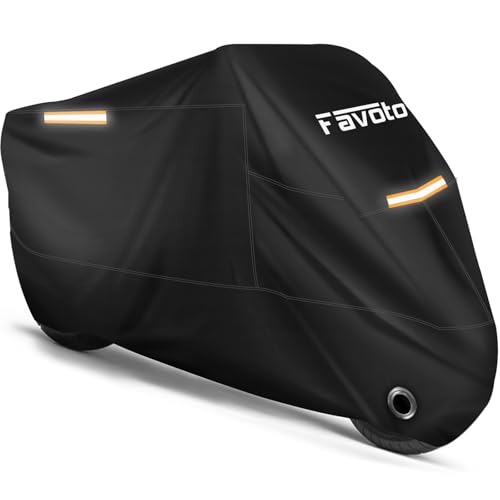


As an Amazon Associate we earn from qualifying purchases at no extra cost to you.
Look for a waterproof coating, double-stitched stress points, and taped or bound seams. “Water-resistant” is a weaker description than “waterproof,” particularly where rain can remain pooled on a motorcycle. A cover should also have a soft inner surface or a separate lining around the windscreen and painted panels. Grit trapped under an unlined cover can create fine scratches as the fabric moves.
Correct sizing is more important than extra thickness
A cover that is too short leaves the wheels, mirrors, or lower engine exposed. One that is too large can balloon in the wind, flap against the paint, and collect water. Measure the motorcycle from the front-most point to the rear-most point, including accessories that remain installed. Measure the highest point as well, then compare those measurements with the manufacturer’s size chart rather than choosing by engine displacement.
As a practical allowance, choose a cover length approximately 5–15 cm longer than the motorcycle’s measured length. More than that can create excess fabric around the wheels. Tall touring screens, top cases, panniers, crash bars, and backrests may require the next size up. A cover intended for a standard naked motorcycle may not fit a touring or adventure model even when both have similar engine sizes.
Heat resistance: a safety feature, not a marketing extra
Many covers should not touch a hot exhaust. If you need to cover the motorcycle immediately after parking, select a model with a documented heat-resistant panel or a stated heat-contact temperature limit. Heat-resistant fabric is often concentrated around the muffler rather than used throughout the cover, which keeps the product lighter and less expensive.
Never assume that a silver outer surface means the entire cover is heat-safe. If the product does not state a rating or identify a heat-resistant section, allow the exhaust and catalytic converter to cool before covering the motorcycle. This is especially important for high-mounted exhausts and enclosed covers that can rest directly on hot components.
Ventilation prevents condensation
Waterproof fabric without airflow can trap humidity underneath. That moisture encourages corrosion on fasteners, chains, brake components, and electrical connectors. Look for two or more mesh vents placed high on the cover, usually near the upper sides or rear. Vents should be covered so rain cannot easily enter, while still allowing warm, damp air to escape.
Ventilation does not make a cover suitable for wet storage. Dry the motorcycle when possible, and do not cover a visibly wet bike for several days. On a damp morning, removing the cover for an hour can be more valuable than choosing a thicker fabric.
UV protection and color choice
Sunlight gradually weakens fabric coatings, elastic, stitching, and motorcycle plastics. A cover with UV-resistant treatment or a reflective top layer is preferable for outdoor parking. Silver and light-colored covers generally absorb less solar heat than black covers, although the coating and fabric construction matter more than color alone.
Expect the outer coating and elastic hem to age before the main fabric. In strong sun, inspect the cover every few months for a brittle surface, fading, cracking, or water soaking into the fabric instead of beading. Those signs indicate that replacement may be more sensible than relying on an old cover for heavy rain.
Head-to-head comparison of cover types
| Cover type | Typical fabric | Packed weight | Water protection | Best use | Main compromise |
|---|---|---|---|---|---|
| Compact travel cover | 190D–210D polyester | 0.6–1.2 kg | Light to moderate rain | Touring and occasional overnight stops | Less abrasion and wind resistance |
| All-weather midweight cover | 300D polyester with PU coating | 1.2–2.2 kg | Regular rain and dust | Most daily riders | Needs correct fitting in strong wind |
| Heavy-duty outdoor cover | 600D polyester or equivalent | 2.0–3.8 kg | Frequent rain and sun | Long-term outdoor storage | Bulkier and slower to dry |
| Half-cover | 190D–300D polyester | 0.4–1.0 kg | Controls seat, tank, and cockpit exposure | Covered parking or short stops | Leaves wheels and lower components exposed |
Wind security and lock-hole design
An elastic hem helps the cover follow the motorcycle’s shape, but it is not enough for exposed parking. The most useful combination is a front and rear buckle strap, a lower belly strap, and reinforced lock holes near the front wheel. A strap should sit under the motorcycle without touching a hot exhaust, chain, or brake rotor.
Lock holes are useful for passing a cable or chain through the cover and wheel, but they are not theft protection by themselves. Metal or reinforced-rim openings last longer than plain fabric slits. Check that the holes are large enough for your existing lock and positioned low enough to discourage the cover from lifting.
For a windy location, attach the cover before gusts begin, remove loose accessories from the motorcycle, and use the belly strap even when the hem feels tight. Do not allow unfastened straps to drag on the ground; they can fray and may catch on moving parts when the motorcycle is moved.
Features worth paying for—and those that are not
- Worth paying for: taped seams, UV treatment, soft lining, reinforced stress points, multiple vents, adjustable straps, and a heat-resistant panel with a clear rating.
- Useful but situational: reflective panels, a storage bag, color-coded front and rear labels, and a clear windscreen area.
- Usually less important: extreme fabric thickness when the motorcycle is kept under a roof, decorative logos, and oversized dimensions marketed as universal fit.
Brands such as Dowco Guardian, Nelson-Rigg, Oxford, and Covercraft offer motorcycle-cover lines in different weights and sizes. Compare the specifications of the individual model rather than assuming every cover from a brand has the same waterproofing, heat protection, or warranty.
How to install and maintain a motorcycle cover
- Clean the motorcycle first. Remove grit from the seat, tank, and fairings so particles cannot rub under the cover.
- Let hot parts cool unless the cover is specifically rated for heat. The exhaust and catalytic converter can remain hot after the engine is switched off.
- Orient the cover correctly. Fit the marked front over the mirrors and windscreen, then pull the rear section down evenly.
- Secure the lower strap and lock holes. Keep buckles away from painted surfaces and moving components.
- Dry the cover before folding it. Folding a wet cover traps moisture and can create mildew or a stale odor.
- Wash according to the label. Usually, mild soap and cool water are safer than bleach, solvents, strong detergents, or machine drying, which can damage waterproof coatings.
A simple ownership calculation helps explain why durability matters. A $45 cover used twice a week for one year provides about 104 uses, or approximately $0.43 per use. A $110 cover lasting three years with the same schedule provides about 312 uses, or approximately $0.35 per use. The more expensive option is not automatically better, but stronger seams and UV protection can be economical when the motorcycle remains outdoors.
Final buying recommendation
Choose a correctly measured 300D–600D polyester cover with waterproof coating, taped seams, UV protection, at least two vents, a soft lining, reinforced lock holes, and front-and-rear straps. Move toward a lightweight 190D–210D cover for frequent travel, or a heavier 600D design for permanent outdoor storage. If you routinely cover the motorcycle immediately after riding, make a stated heat-resistant panel the deciding feature; otherwise, cooling the motorcycle before covering it remains the safer choice.





Write Your Review
No reviews yet. Be the first to share your experience!