

Key takeaways
- Small petrol cars: 600–1,000 peak amps is commonly adequate if the pack is fresh and fully charged.
- Mid-size petrol vehicles: choose roughly 1,000–1,500 peak amps.
- Large petrol engines and most diesel cars: 1,500–2,000 peak amps offers more margin.
- Diesel pickups, vans, motorhomes, and agricultural equipment: consider 2,000–3,000 amps, heavy cables, and an explicit diesel rating.
The best portable jump starters for most drivers are lithium-ion packs rated from 1,000 to 2,000 peak amps, with protected smart clamps, a USB-C recharge port, and enough capacity for at least several starting attempts; the right choice depends more on your engine size, storage space, and frequency of use than on the largest amp number.
Our top picks


As an Amazon Associate we earn from qualifying purchases at no extra cost to you.
Quick picks by situation
| Situation | Best fit | What to look for | Typical market range |
|---|---|---|---|
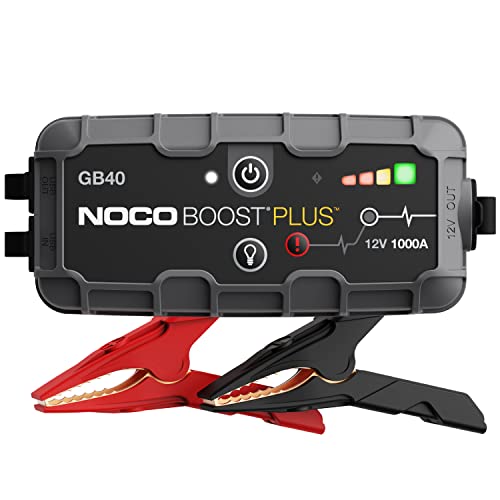
| Small car, compact storage, occasional emergency | NOCO Boost Plus GB40 | 1,000 peak amps, 12V output, compact lithium pack, reverse-polarity protection | $70–$110 |
| Family SUV, pickup, or larger petrol engine | NOCO Boost HD GB70 | 2,000 peak amps, heavier-duty clamps, more reserve capacity | $130–$190 |
| Frequent workshop or roadside use | Clore Automotive Jump-N-Carry JNC550 | 12V lead-acid design, long cables, high surge output, built for repeated service | $180–$280 |
| Lowest purchase cost for a basic backup | 1,000–1,500A lithium jump starter | Smart clamps, clear charge indicator, USB-C input, published engine limits | $50–$100 |
| Diesel truck, van, or cold-weather starting | 2,000–3,000A lithium or heavy-duty lead-acid unit | Thick cables, full-size clamps, high cold-start reserve, strong warranty | $150–$350 |
Best portable jump starters: the head-to-head factors
Peak amps are useful, but not the whole story
Peak amperage describes the maximum current a pack can deliver for a short burst. It is not the same as continuous current, battery capacity, or a standardized cold-cranking-amp rating. A well-designed 1,000A pack can start a small four-cylinder engine more reliably than a poorly built 2,000A pack with thin cables and a weak internal battery.
For a petrol engine up to about 3.0 litres, a reputable 1,000A to 1,500A unit is usually a sensible starting point. Large petrol engines, diesel engines, high-compression engines, and vehicles parked outdoors in freezing weather justify 2,000A or more. Always compare the manufacturer’s stated engine compatibility rather than assuming the peak number applies to every vehicle.
Battery capacity determines repeat attempts
Capacity may be shown in watt-hours, amp-hours, or occasionally only as “number of starts.” Watt-hours are the clearest comparison. A 12V, 10Ah battery stores approximately 120Wh before conversion losses, although only part of that energy is available at the high current needed for engine cranking.
As a practical example, suppose a jump starter stores 100Wh and each starting attempt consumes roughly 8Wh after allowing for electronics and cable losses. The theoretical result is 12.5 attempts, but temperature, battery age, and voltage drop make that unrealistic. Planning on four to six useful attempts is safer. A cold, deeply discharged vehicle battery can consume more energy than a warm battery that is merely low.
Engine compatibility should be treated conservatively
- Small petrol cars: 600–1,000 peak amps is commonly adequate if the pack is fresh and fully charged.
- Mid-size petrol vehicles: choose roughly 1,000–1,500 peak amps.
- Large petrol engines and most diesel cars: 1,500–2,000 peak amps offers more margin.
- Diesel pickups, vans, motorhomes, and agricultural equipment: consider 2,000–3,000 amps, heavy cables, and an explicit diesel rating.
Some vehicles require the jump point under the bonnet rather than direct access to the battery. Others have sensitive electronics, auxiliary batteries, or manufacturer-specific connection procedures. Check the vehicle handbook before buying or connecting a pack.
Comparison of representative designs
| Model or design | Published output | Battery and size characteristics | Engine guidance | Recharge and extra features |
|---|---|---|---|---|
| NOCO Boost Plus GB40 | 1,000 peak amps | About 2.4 lb; compact lithium-ion format | Up to 6.0L petrol or 3.0L diesel, according to manufacturer guidance | USB recharge, USB output, LED light, spark-proof and reverse-polarity protection |
| NOCO Boost HD GB70 | 2,000 peak amps | About 5 lb; larger lithium-ion format | Up to 8.0L petrol or 6.0L diesel, according to manufacturer guidance | USB output, LED light, protected clamps, recharge from a supplied 12V or USB-compatible source depending on package |
| Clore Automotive JNC550 | 1,100 peak amps | About 16 lb; sealed lead-acid construction with a larger physical footprint | Designed for 12V cars, trucks, vans, and service use | Built-in charger, 12V accessory outlet, long cables, analog or digital status indication depending on version |
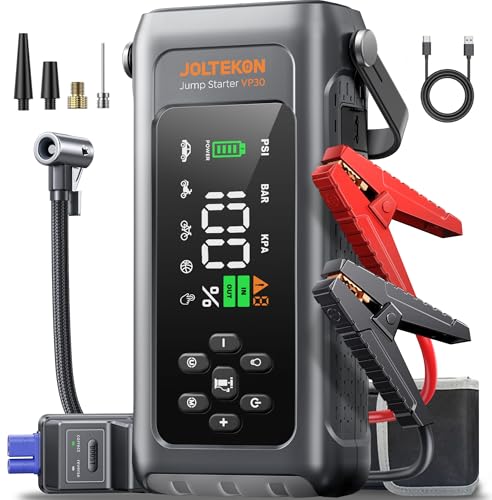
| Typical 2,000A lithium pack | 1,500–2,000 peak amps | Usually 3–5 lb; commonly 70–120Wh claimed capacity | Often marketed for large petrol engines and smaller diesels; verify the exact limit | USB-C input, USB-A output, LED lamp, sometimes an air compressor |
Specifications can differ by revision and regional package, so confirm the label and manual before purchase. The table illustrates the trade-off: lithium packs are easier to store and carry, while lead-acid units are larger but often offer long cables, substantial clamps, and a service-oriented design.
Clamps, cables, and safety protections matter most during the jump
Look for insulated, spring-loaded clamps with broad copper contact surfaces rather than small plated jaws that barely grip a terminal. Full-size clamps are easier to attach to a recessed or corroded battery post. Cables should remain flexible in cold weather and be long enough to reach the battery without placing the jump starter on a hot engine component.
Smart clamp modules should provide reverse-polarity protection, short-circuit protection, over-temperature protection, and a warning when the connection is incorrect. Spark-proof operation is useful, but it does not make careless connection safe. If the battery is severely damaged, leaking, swollen, frozen, or physically cracked, do not attempt a jump.
A manual override or “force start” mode can help when a battery is too depleted for the pack to detect it. It also disables some automatic safeguards on certain designs. Use it only when the polarity is confirmed and the manual specifically permits it.
Recharge options and ownership costs
USB-C is the most convenient recharge method because it can use a modern vehicle adapter, laptop charger, or power bank. Older packs may use micro-USB and can take many hours to refill. A 12V vehicle charging lead is valuable for keeping the pack topped up during a journey, while a mains adapter is more convenient at home.
Recharge the unit after every jump, even if the engine started immediately. Lithium packs typically lose charge slowly in storage but should be checked every three to six months. Lead-acid models can suffer permanent capacity loss if left discharged. Store either type away from direct heat; a hot glovebox or vehicle cabin can shorten battery life.
For an occasional driver, a $100 lithium unit used once every five years costs about $20 per emergency use before replacement. A $200 heavy-duty pack used ten times per year over four years costs about $1 per use, but it earns that lower cost only if its larger size, charging routine, and maintenance suit the owner.
How to use a portable jump starter safely
- Switch off lights, radio, climate controls, and ignition. Place the vehicle in park or neutral and apply the parking brake.
- Confirm that the vehicle and jump starter use the same voltage, normally 12V for cars.
- Connect the red clamp to the positive battery terminal or the vehicle’s marked positive jump point.
- Connect the black clamp to the negative terminal or an approved unpainted chassis ground, following the vehicle manual.
- Turn on the jump starter and wait for its ready indication. If it reports a fault, disconnect and correct the connection rather than repeatedly overriding it.
- Crank for no more than about five seconds at a time, then wait at least 30 seconds before another attempt. Three or four failed attempts suggest a fault beyond a flat battery.
- Once the engine starts, leave it running briefly, then switch off the jump starter and remove the clamps in reverse order: black first, red second.
Do not use a jump starter as a substitute for diagnosing a recurring no-start problem. A failed alternator, damaged starter motor, poor ground connection, or battery at the end of its service life can drain even a powerful pack.
What wears out first
The internal battery is usually the limiting component. Expect capacity to decline after years of heat exposure, deep discharges, or long periods without charging. Clamp springs can weaken, cable insulation can split, and contact surfaces can corrode. Wipe clamps clean and dry after use, keep the cable from being sharply folded, and replace a pack with a swollen case, cracked insulation, burnt smell, or abnormal heat.
For most owners, the best portable jump starters are not the ones with the highest headline number. Choose a compact 1,000A-class lithium pack for a small petrol car, step up to 2,000A or more for large engines and diesels, and choose a heavy lead-acid service unit when repeated professional use, long cables, and rugged clamps matter more than portability.







Write Your Review
No reviews yet. Be the first to share your experience!