

Key takeaways
- Write the install date on the alarm and note the manufacture date from the back.
- Test monthly with the test button. A sealed battery does not remove the need for testing.
- Do not remove the battery to silence a nuisance alarm; use the hush button and move the alarm farther from the kitchen.
- Vacuum dust off the vents gently every few months.
- When an alarm chirps in a sealed unit, the end-of-life signal usually means replace it.
The best 10-year smoke alarms in 2026 use a sealed lithium battery that lasts the full life of the alarm, with the First Alert SM210 and Kidde 20SD10 leading the photoelectric standalone options and the X-Sense SC07-W leading for wireless interconnected smoke and CO protection. A 10-year alarm means no battery changes for a decade, but you still need to test it monthly and replace the whole unit at the end of its life.
Our top picks


As an Amazon Associate we earn from qualifying purchases at no extra cost to you.
Quick Comparison of 10-Year Smoke Alarms
| Pick | Best for | Sensor | Power | Interconnect | Price range |
|---|---|---|---|---|---|
| First Alert SM210 | Best standalone photoelectric | Photoelectric | Sealed 10-year lithium | None | Budget to mid-range |
| Kidde 20SD10 | Value photoelectric | Photoelectric | Sealed 10-year lithium | None | Budget to mid-range |
| Kidde P9010 | Lowest-cost sealed alarm | Check current spec | Sealed 10-year battery | None | Budget |
| Kidde 20SA10 | Hardwired with sealed backup | Photoelectric | Hardwired plus sealed 10-year backup | Hardwired | Mid-range |
| X-Sense SC07-W | Wireless interconnected smoke and CO | Photoelectric smoke plus CO | Sealed 10-year lithium | Up to 18 alarms, no Wi-Fi | Mid-range |
| First Alert SCO7CN | Voice-alert combo | Smoke plus CO | Sealed lithium | None | Mid-range |
Details come from manufacturers’ spec sheets and 2026 smoke-detector roundups. Sensor types and battery ratings can vary between production runs, so confirm them on the current product page.
What “10-Year” Actually Means
A 10-year smoke alarm has a sealed lithium battery designed to power the alarm for about a decade. You cannot replace the battery, and you should replace the whole alarm at the end of its life. The 10 years starts at the manufacture date printed on the back, not the date you installed it. Some hardwired alarms advertise “10-year” for their warranty or backup battery, which is a different thing, so read the spec.
Best Standalone Photoelectric: First Alert SM210
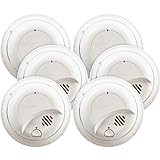
The First Alert SM210 combines photoelectric sensing with a sealed 10-year battery, and several 2026 roundups rank it as the best battery smoke detector for most homes. Photoelectric sensors respond well to smoldering fires and are less likely to false-alarm from cooking, so it suits bedrooms and hallways.
Main trade-off: It is a standalone alarm, so it does not wirelessly warn the rest of the house.
Best Value: Kidde 20SD10
The Kidde 20SD10 is a photoelectric alarm with a sealed 10-year battery and is commonly named a best-value pick. It does the core job without extra features, which makes it good for outfitting many rooms on a budget.
Main trade-off: No interconnect and no carbon monoxide detection.
Best Budget: Kidde P9010
The Kidde P9010 offers sealed 10-year battery reliability at an entry-level price, according to roundups. It suits rental properties, garages with adjoining living space and anyone who needs to reach basic code compliance for each room.
Main trade-off: Check the sensor type on the label, since cheaper alarms may use ionization, which is more prone to cooking false alarms.
Best Hardwired with Sealed Backup: Kidde 20SA10
The Kidde 20SA10 is a hardwired, interconnected photoelectric alarm with a sealed 10-year backup battery. It combines the reliability of house wiring with the convenience of a backup you never need to replace. This is a strong choice for new construction or renovations.
Main trade-off: It needs ceiling wiring, so unless a junction box exists, you may need an electrician.
Best Wireless Interconnected Combo: X-Sense SC07-W
The X-Sense SC07-W is a wireless interconnected version of a photoelectric smoke and electrochemical CO alarm with a sealed 10-year battery. Up to 18 X-Sense alarms can join one network, so when one sounds, they all do. It has no Wi-Fi, so it sends no phone notifications.
Main trade-off: Interconnection only works with compatible X-Sense units, and the CO sensor may not last as long as the 10-year battery claim.
Best Voice-Alert Combo: First Alert SCO7CN
The First Alert SCO7CN pairs smoke and CO detection with a sealed lithium battery and spoken alerts that name the hazard. Voice warnings help children and older adults react correctly.
Main trade-off: Standalone only, and combination alarms need replacement when the CO sensor expires.
Decision Matrix: Which Sealed Alarm Should You Buy?
| Situation | Choose | Reason |
|---|---|---|
| Bedrooms and hallways, no wiring | SM210 | Photoelectric, sealed battery |
| Outfitting many rooms cheaply | Kidde 20SD10 or P9010 | Lowest cost per alarm |
| New build or major renovation | Kidde 20SA10 | Wired interconnect with sealed backup |
| Want all alarms to sound together without wiring | X-Sense SC07-W | Wireless network up to 18 alarms |
| Children or elderly occupants | SCO7CN | Voice alerts |
How to Choose a 10-Year Smoke Alarm
Check the sensor type
Photoelectric alarms are better for smoldering fires, and ionization alarms are better for fast flames. Dual-sensor alarms cover both. NFPA suggests having both technologies, and photoelectric is the better default for bedrooms.
Decide on interconnection
Most standard sealed alarms do not interconnect. If you want all alarms to sound together, choose a wireless interconnected system or hardwired models. NFPA 72 recommends interconnection in a home.
Consider combo units carefully
Combination smoke and CO alarms save space but expire when the CO sensor does, typically earlier than the smoke sensor. Read the end-of-life date on the label.
Count your rooms
You need one alarm in each bedroom, one outside each sleeping area and one on every level. A three-bedroom, two-story home with a basement needs six alarms, so cost per alarm matters. Six alarms at a mid-range price cost about as much as one smart alarm at a premium price.
Worked example: lifetime cost
A standard alarm using 9V batteries needs about ten battery changes in a decade. With six alarms, that is 60 batteries and 60 chances to forget. Sealed 10-year alarms remove those tasks entirely, which makes the higher purchase price easy to justify.
Ownership Realities and Common Mistakes
- Write the install date on the alarm and note the manufacture date from the back.
- Test monthly with the test button. A sealed battery does not remove the need for testing.
- Do not remove the battery to silence a nuisance alarm; use the hush button and move the alarm farther from the kitchen.
- Vacuum dust off the vents gently every few months.
- When an alarm chirps in a sealed unit, the end-of-life signal usually means replace it.
Sealed 10-Year vs Replaceable Battery vs Hardwired
| Feature | Sealed 10-year | Replaceable 9V or AA | Hardwired with backup |
|---|---|---|---|
| Battery changes in 10 years | None | About 10 or more | Backup changes unless sealed |
| Installation | Screw to ceiling, no wiring | Screw to ceiling | Needs wiring, often an electrician |
| Interconnect | Usually none, some wireless models | Usually none | Wired, all sound together |
| Risk of dead battery | Low | Higher, relies on you | Low |
| End of life | Replace the whole unit | Replace unit at about 10 years | Replace unit at about 10 years |
Fire-safety guidance generally treats a dead or missing battery as a leading reason alarms fail, which is why sealed batteries and hardwired power are recommended over relying on memory.
Frequently Asked Questions
Do 10-year smoke alarms really last 10 years?
The sealed battery is designed to last about a decade, and the alarm itself should be replaced after about 10 years from its manufacture date. Dust, humidity and nuisance alarms can shorten battery life.
Can I replace the battery in a 10-year alarm?
No, the battery is sealed and not designed to be replaced. When it runs low or the alarm reaches end of life, the whole unit should be replaced.
Are 10-year smoke alarms interconnected?
Most standard models are not, but wireless systems like the X-Sense SC07-W and hardwired alarms like the Kidde 20SA10 can interconnect. Check the packaging for compatibility.
Should I choose photoelectric or ionization?
Photoelectric is a good choice for bedrooms and near kitchens because it responds well to smoldering fires and creates fewer cooking false alarms. Having both technologies in a home is recommended by fire authorities.
Is Nest Protect still an option?
Google’s Nest Protect has been discontinued according to 2026 roundups, and the First Alert SC5 has been named as its replacement. If you want a smart alarm, look at current First Alert and similar models.
Write Your Review
No reviews yet. Be the first to share your experience!