

Key takeaways
- Looking for the best window alarm sensors? Compare six door and window alarm packs by sound level, battery life and hub needs to match your home.
For most homes, the UltraPro Personal Security Window and Door Alarm 6 Pack is the best window alarm sensor to start with: a two-piece magnetic contact alarm that sounds a loud siren when a sash or door is opened, needs no hub, and mounts with tape in a couple of minutes. Households already invested in a smart-home system should look at the Ring contact sensors instead, which report to an app rather than shouting on the spot. A window alarm sensor is simply a magnet and a detector that notice when the gap between them opens. Everything below helps you match the pack size and style to your windows.
Quick List
- UltraPro 6 Pack – best for a typical home that wants loud, hub-free coverage
- UltraPro 12 Pack – best for large houses, rentals and multi-floor coverage
- HIIXHC 10 Pack – best for covering many openings with a mid-size bundle
- 90dB Door Window Alarm – best for child-safety and household-awareness chimes
- Ring Alarm Contact Sensor 6-Pack (2nd Gen) – best for existing Ring Alarm owners who want app alerts
- Philips 4 Pack – best for a small apartment or a few ground-floor windows
Which One Is Right for You?
| If you… | Choose |
|---|---|
| already use a Ring Alarm base station and want phone notifications | Ring Alarm Contact Sensor 6-Pack (2nd Gen) |
| want a loud local siren with no subscription or hub for an average house | UltraPro 6 Pack |
| have more than ten windows and doors to cover, or several floors | UltraPro 12 Pack |
| need a mid-size bundle for ground-floor windows and a garage door | HIIXHC 10 Pack |
| live in a small apartment with only a handful of openings | Philips 4 Pack |
| mainly want a household chime for kids or wandering relatives | 90dB Door Window Alarm |
Standalone magnetic alarms are the simplest route: they work out of the box and cost nothing to run beyond batteries. Smart contact sensors only make sense when a compatible system is already installed or planned. If you cannot decide, buy one small pack, try the sound level in your own hallway, and expand later.
All 6 Picks in Detail
1. UltraPro 6 Pack – Best for the Typical Home
As an Amazon Associate we earn from qualifying purchases at no extra cost to you.

This is the straightforward answer for a three-bedroom house that wants every ground-floor window covered. Each unit is a two-part magnetic alarm: a small alarm body goes on the frame and a magnet goes on the moving sash or door. When the two separate, the alarm sounds. The manufacturer describes a selectable siren or chime, which means you can leave the loud setting on at night and switch to a gentle chime during the day to know when the back door opens.
- Pack of six wireless alarms, each a self-contained sensor and siren
- Selectable siren or chime mode with an off position, according to the manufacturer
- Siren output described by the manufacturer as 120 dB; chime mode is quieter
- Button-cell batteries included; an LED signals low power
- Tape mounting for indoor use, with no wiring or drilling
In day-to-day use, the practical strength of this pack is how little there is to learn. Stick one alarm body and one magnet on each opening, slide the switch to the siren position at bedtime, and move it back to chime or off when the house is awake. Households with teenagers or night-shift workers often settle on a routine of arming only the bedroom-level and ground-floor windows overnight, which keeps false alarms down while still covering the easiest points of entry. Keep a spare set of batteries in a drawer so a low-power warning never leaves a window unprotected for long.
Pros
- No hub, app or account needed
- Siren is loud enough to be heard throughout a small house
- Simple on-off switch is easy for every family member to use
Cons
- No phone alerts, so you have to be within earshot
- Button batteries need periodic replacement
Compared with the 12 Pack from the same line, this is the right size for most homes, while the larger bundle only makes sense when you truly have a dozen openings to protect.
2. UltraPro 12 Pack – Best for Large Houses and Rentals

The 12 Pack uses the same style of alarm as the 6 Pack, only with more units in the box. It suits a two-story home, a family that wants both windows and interior doors protected, or a landlord who wants to equip several units with the same product. Buying one larger bundle also keeps every alarm identical, so replacement batteries and the on-off switch behave the same everywhere in the house.
- Pack of twelve wireless magnetic alarms
- Chime and siren settings per unit, per the manufacturer’s description
- Tape mounting, designed for indoor surfaces
- Same product family as the 6 Pack, so the user experience matches
- Battery type and count per unit: confirm on listing
A bundle this large rewards a little planning. Before you open the box, walk the house with a notepad and list every opening by room: bedroom windows, living-room sliders, basement egress windows, the front door, the garage entry and perhaps a medicine cabinet or liquor cabinet. Mark which ones need a siren and which only need a chime. Numbering the units with a small sticker and noting the room on a list also makes it far easier to find the one that is chirping for a new battery months later, a detail that matters more when there are a dozen alarms in the house.
Pros
- Enough units for windows, patio doors and a few cabinets
- Consistent hardware across the entire property
Cons
- Surplus units if you only need a handful
- Twelve separate sirens can be a lot to arm and disarm every day
Choose this over the 6 Pack only if you counted more than eight or nine openings; otherwise the smaller pack leaves less to manage.
3. HIIXHC 10 Pack – Best for Mid-Size Coverage

The HIIXHC bundle sits between the small and large UltraPro packs. The listing calls it a personal security window and door alarm bell with a wireless sensor, and it ships as ten units. It is a reasonable choice for a house with a mix of bedroom windows, a sliding door and a garage entry, especially for someone who prefers to buy from a smaller brand.
- Pack of ten wireless sensor alarms
- Marketed as a burglar alarm bell for doors and windows
- Magnetic two-part design typical of this category
- Decibel output and battery type: confirm on listing
- Mounting method: confirm on listing, though adhesive mounting is typical
Because the listing offers fewer details than the larger brands, treat this as a product to verify before you commit. Read the full specification fields on the product page for sound output, battery type and whether the alarm has a chime-only mode. If the sound is as loud as the description suggests, try one in a hallway to hear how far it carries before you install every unit, then position the units on the openings where a loud signal matters most. Buyers who like to keep a few units spare for cabinets, a workshop door or a garden shed will appreciate the extra count in a ten-unit bundle.
Pros
- Ten units cover most medium-sized homes
- Simple concept with no hub or subscription
Cons
- Less published detail on volume and batteries than the better-known packs
- Brand support and replacement parts may be harder to find
Compared with the UltraPro 12 Pack, it offers fewer units and less manufacturer documentation, so it is best for buyers who value the mid-size count over a recognized name.
4. 90dB Door Window Alarm – Best for Child Safety and Awareness

The listing positions this alarm toward kids’ safety and pool-area doors, and it advertises a 90 dB sound level. That is quieter than a full 120 dB siren, which can actually be a benefit in a family home where the goal is to know when a toddler or wandering relative opens a door, not to wake the neighborhood. Treat it as an awareness tool rather than a burglar deterrent.
- 90 dB alert level stated in the listing name
- Door and window alarm in a magnetic sensor format
- Marketed for kids’ safety and pool-adjacent doors
- Pack count and battery type: confirm on listing
- Intended for indoor placement; check the product page for any outdoor rating
The kid-safety angle is where this alarm earns its place. Parents of toddlers often worry about the door that leads to a deck, a garage or a pool area, and a 90 dB alert gives enough warning to reach a child without startling the whole street. It also works for relatives who wander at night, or for teenagers sneaking out. Place the sensor high on the door frame, out of a small child’s reach, and keep the magnet aligned so that a slightly open door still triggers the alert. Combine it with proper latches or a high-mounted lock for a layered approach.
Pros
- Lower volume is easier on a household that triggers it regularly
- Useful as a second layer on the doors a young child could reach
Cons
- Less alarming to an intruder than a 120 dB siren
- Not a replacement for pool fencing, self-latching gates or adult supervision
Next to the UltraPro 6 Pack, it trades siren power for a milder sound, so choose it for family awareness, and choose the UltraPro for deterrence.
5. Ring Alarm Contact Sensor 6-Pack (2nd Gen) – Best for Ring Alarm Owners
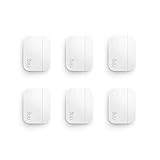
This one is different from the other five: it is not a standalone siren. The Ring contact sensor is a slim Z-Wave sensor that reports to a Ring Alarm base station, which then sends alerts and can trigger its siren. Without that base station, the sensors do nothing, so this pack is only for people who already own, or plan to buy, the Ring Alarm system.
- Pack of six contact sensors for windows or doors
- Connects to a Ring Alarm base station; it does not work on its own
- Battery life described as approximately three years by the manufacturer
- Slim profile that disappears into a window frame
- Indoor use with a limited operating temperature range, per the manufacturer
The Ring pack makes the most sense as an expansion order. If you have a Ring base station and a keypad already, six more sensors let you cover windows that previously relied on only the front door and a motion detector. The sensors report open and closed states, so you can use them for routines such as a reminder that the back door was left open. Because there is no built-in siren in each sensor, a bedroom window alert comes from the base station or app, which is a plus for apartment dwellers who do not want a loud local siren.
Pros
- Phone notifications and integration with the rest of the system
- Long battery life means less maintenance
- Discreet design that suits visible windows
Cons
- Requires a base station and, for monitoring features, possibly a subscription; confirm current terms
- No built-in siren in each sensor
Against the UltraPro 6 Pack, it is the smarter but less self-sufficient option: better for app alerts, worse if you have no compatible hub.
6. Philips 4 Pack – Best for Small Apartments
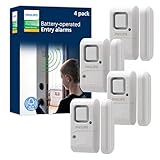
The Philips four-pack follows the same wireless chime and magnetic design as the UltraPro alarms and is sized for a small apartment, a dorm room or a few vulnerable ground-floor windows. If your count of openings is four or fewer, there is little reason to buy more units than you will install.
- Pack of four wireless window and door alarms
- Described as DIY protection with easy installation
- Wireless chime feature named in the listing
- Sound level and battery type: confirm on listing
- Indoor, tape-style mounting is typical of this style
This pack suits renters who need a quick, removable setup. Stick the four alarms on the bedroom window, the balcony door, the front door and one more opening that worries you, and the job takes minutes. The format is familiar from other Philips and UltraPro products, and it is a good gift for a student heading to a first apartment. If your needs grow, you can add another pack later; because the alarms are independent, mixing different bundles in one home does not cause any compatibility problem.
Pros
- Right-sized for a one-bedroom or studio
- Quick to install with no tools
Cons
- Runs out quickly once you add interior doors
- Siren details are less explicit in the listing name
Compared with the UltraPro 6 Pack, it is a smaller bundle in a similar format, so pick it when four units truly cover your plan.
Specs Compared
| Product | Units in pack | Type | Sound | Power | Hub needed |
|---|---|---|---|---|---|
| UltraPro 6 Pack | 6 | Standalone magnetic alarm | Siren and chime modes; siren listed by the maker as 120 dB | Button cells | No |
| UltraPro 12 Pack | 12 | Standalone magnetic alarm | Siren and chime modes; confirm on listing | Button cells | No |
| HIIXHC 10 Pack | 10 | Standalone magnetic alarm | Confirm on listing | Confirm on listing | No |
| 90dB Door Window Alarm | Confirm on listing | Standalone magnetic alarm | 90 dB | Confirm on listing | No |
| Ring Alarm Contact Sensor 6-Pack | 6 | Smart contact sensor | None built in; system siren | About 3 years per maker | Yes, Ring Alarm base station |
| Philips 4 Pack | 4 | Standalone magnetic alarm | Chime named; confirm siren level on listing | Confirm on listing | No |
How We Chose These
This guide is a research-based comparison of the six products in the current catalog, not a report of personal use. We read the manufacturer pages and listing specification fields, then grouped the products by the way they work: standalone sirens versus system-linked sensors. We weighed pack size against typical home layouts, stated sound levels, battery approach, installation method and whether a hub is required. Where a listing did not state a value, such as battery type or pack count, we flagged it as something to confirm on the product page rather than guessing. We also used general home-security guidance from fire and safety organizations to frame the advice on placement and layered protection.
What to Look For
Standalone alarm versus smart sensor
The first decision is architecture. A standalone alarm contains its own siren and battery, so it works the moment you stick it on the frame. A smart contact sensor has no siren; it sends a short radio message to a hub, and the hub decides whether to sound a siren, push a notification or ignore the event because the system is disarmed. Standalone units are cheaper to run and easier to understand, but they are only useful if someone is home to hear them. Smart sensors tell you about an open window while you are away, which matters for second homes and travel. Many households use both: smart sensors on the main entry points and plain alarms on bedroom windows.
Sound level and what the numbers mean
Decibels are logarithmic, so a 120 dB alarm is far more intense than a 90 dB one even though the gap looks small. As a rule of thumb, every 10 dB feels roughly twice as loud, and sounds around 85 dB and above can harm hearing with long exposure. A 120 dB siren at close range is painful, which is the point for deterrence, but it is not something to trigger by accident beside a sleeping child. A 90 dB chime or alarm is better for awareness. Check whether the listing quotes siren output, chime output or both; they are often very different. Also remember that distance and walls cut the apparent loudness considerably.
Fit, gap size and mounting
Magnetic contact alarms rely on a short gap between the sensor and the magnet, commonly in the range of half an inch to an inch when closed. Sliding windows and double-hung sashes are easy; casement windows with heavy frames and sliding patio doors with wide tracks need more care. Mount the sensor on the fixed frame and the magnet on the moving part, aligning the marks on the housings. Clean the surface with isopropyl alcohol first so the tape grips, and avoid mounting on textured or freshly painted trim. If a window is rarely opened, you can also place the sensor on the inside of the sash so the tape is not visible from outside.
Batteries and maintenance
Button cells in budget alarms usually last about a year with normal use, while low-power radio sensors can reach about three years. A worked example: if you protect 10 openings with alarms that need new batteries every 12 months, you will replace 10 sets once per year; with sensors on a three-year cycle, that drops to roughly three sets per year across the house. Pick a fixed date, such as the clock change in spring, to check all units. Never mix old and new cells in the same alarm, and recycle used batteries according to local rules.
Pack size and the cost of coverage
Count openings before choosing a pack. A simple rule of thumb is one alarm per accessible window and exterior door, plus one for any interior door you want to monitor. A typical two-story home with eight windows on the ground floor, two exterior doors and a garage entry needs about 11 units, which points toward a 12-unit bundle, while a one-bedroom apartment with two windows and a balcony door needs only three or four. Buy slightly more than you count so you have a spare for a cabinet or a basement hatch, but do not stretch packs to cover windows you can only reach with a ladder; focus on the points that are easiest for a person to reach in seconds.
Placement and layered security
Prioritize ground-floor windows, basement windows, patio doors and any window hidden from the street. Add the interior door between the garage and the house. Remember that a window alarm only tells you the opening was moved; it cannot detect broken glass if the pane is shattered without moving the sash, so combine alarms with motion detection, lighting and good locks. Never block an emergency exit with a locked or armed device in a way that could slow escape in a fire; every sleeping area needs an easy way out.
Questions
Do window alarm sensors work on sliding windows?
Yes, as long as the sensor and magnet line up when the window is closed and the gap stays small. Mount the sensor on the fixed frame and the magnet on the moving part, close to the leading edge. If the track is deep, use the spacer or shim the manufacturer provides.
Will a window alarm work without Wi-Fi?
Standalone magnetic alarms do not use Wi-Fi at all, because the siren is built into each unit. Smart sensors such as the Ring contacts talk to a base station, and that base station typically needs a home internet connection for phone alerts. Confirm the details of your chosen system before relying on it.
How loud should a window alarm be?
For deterrence, a siren in the 100 to 120 dB range is common. For household awareness, a softer chime near 90 dB is often enough. Pick based on whether you want to scare off a person or simply learn that a door opened.
Can I use these as pool or child-safety alarms?
They can add a layer by alerting you when a door to a pool area or a child’s bedroom opens. They are not a substitute for fencing, self-latching gates, pool covers or adult supervision. If water safety is the concern, ask a local safety authority which barrier devices your area requires.
How long do the batteries last?
Budget alarms using button cells often last about a year with regular use, though sirens used heavily will drain them faster. The Ring sensors are rated by the manufacturer at about three years. Use the low-battery indicator where provided and replace cells before the alarm fails.
Can I take them with me when I move?
Mostly yes, because they stick on with tape and need no wiring. Peel the tape slowly or warm it with a hair dryer to avoid damaging paint, and replace the adhesive pad before reinstalling.
Update History
- October 20, 2026 – Initial publication; product set drawn from current catalog listings.
- Check the product page for current specifications and availability before buying.
Sources
- Manufacturer product and specification pages for UltraPro (Jasco) and Ring
- Retailer listing titles and specification fields for the six products
- General home-safety guidance on layered security and sound exposure




Write Your Review
No reviews yet. Be the first to share your experience!