

Key takeaways
- Find the best motion sensor lights for outdoors: six solar and wired picks compared by brightness, coverage, weather rating and pack size.
The Tuffenough 3-head solar motion sensor light with remote control is the best overall pick for most yards, driveways and side gates because it needs no wiring, spreads light across three adjustable heads and lets you change modes from a remote. A motion sensor light for outdoors is a fixture that stays dark or dim until a passive infrared sensor detects body heat in motion, then switches to full brightness. If you want the brightest possible output and have a power source available, the wired LUTEC flood is the stronger option, while multi-packs such as the Aootek six-pack suit fences, steps and wall lines.
Quick List
- Tuffenough 210 LED Solar Lights, 3 Heads, Remote – best for wide yard and driveway coverage without wiring
- daphino 2500LM Solar Lights, 3-Head, 2 Pack – best for covering the front and back of a house with matching units
- HMCITY 120 LED Solar Wall Lights (newer listing) – best for patios, gates and garden walls
- HMCITY 120 LED Solar Wall Lights (older listing) – best as a near-twin alternative to the newer HMCITY
- LUTEC 72W 7500LM LED Security Floodlight – best for maximum brightness from a wired connection
- Aootek 120 LED Solar Lights, 6 Pack – best for lining steps, fences and walls across a whole property
Which One Is Right for You?
| If you… | Choose |
|---|---|
| have a dark side yard or driveway and no outlet nearby | Tuffenough 3-Head Solar Light |
| want one pack that covers two doors at once | daphino 2-Pack 3-Head Solar Light |
| need to light a garden wall, patio or gate | HMCITY 120 LED Solar Wall Light |
| have a junction box or a licensed electrician available and want the most light | LUTEC 72W Wired Floodlight |
| want to cover a long fence line, steps and a few corners | Aootek 6 Pack |
| prefer a simpler single wall fixture with three modes | HMCITY 120 LED (either listing) |
Start with the power source. Solar fixtures are quick to mount and have no wiring risk, but they depend on direct sun. A wired flood light is more consistent through winter and cloudy stretches but must be connected to the house circuit properly. After that, pick by coverage: heads that swivel suit open ground, while wall-mounted wide-angle panels suit narrow spaces.
All 6 Picks in Detail
1. Tuffenough 210 LED Solar Security Lights, 3 Heads – Best for Wide Yard Coverage
As an Amazon Associate we earn from qualifying purchases at no extra cost to you.

This model puts three motion-activated heads on one mount, which means a single install can light a driveway, a walkway and a corner of the yard at once. The listing name highlights 2500 lumens, 210 LEDs, a remote control, an IP65 waterproof rating and a 270-degree wide-angle sensing claim. The remote is a practical convenience because it lets you adjust modes without climbing a ladder. It is also the model to consider if you want to compare different mount heights before committing, since you can retune behavior from the ground.
- Light output: 2500 lumens as stated in the listing; treat it as a peak claim
- LEDs: 210 across three heads
- Control: remote control included per the listing
- Weather rating: IP65
- Coverage: 270-degree wide-angle detection claim; confirm sensing distance on the listing
Pros
- Three adjustable heads allow aiming at different zones
- Remote makes mode changes simple
Cons
- The solar panel needs several hours of direct sun, so shady mounting spots reduce runtime
- Rated lumens on solar units are often a short-burst figure
It offers more control than the daphino pack, while the daphino offers two matching units instead of one.
2. daphino 2500LM Solar Lights, 3-Head, 2 Pack – Best for Front and Back Doors

The daphino listing is built around value in quantity: two three-head solar units that each claim 2500 lumens, a 270-degree wide-angle field and an IP65 waterproof rating. Two lights make sense for houses that need a fixture at both the front and the rear, or for a long driveway where one light would leave a gap. Mount them where the panel gets direct sun for the best battery performance. A sensible layout is one unit above the garage or front entry and the second near the back door or a side yard, which gives overlapping coverage across the places people most often approach.
- Pack: two units per the listing name
- Light output: 2500 lumens claimed per listing
- Heads: three on each unit
- Weather rating: IP65
- Coverage: described as street and area lighting at 270 degrees; confirm range
Pros
- Two matching lights in one purchase
- Wide detection angle suits open areas
Cons
- The listing name does not mention a remote, so confirm control options
- Each solar panel needs its own sunny spot
Compared with the Tuffenough, you gain a second unit but may give up remote adjustment.
3. HMCITY 120 LED Solar Wall Lights with 3 Modes – Best for Patios and Garden Walls

This is a simpler wall-style fixture with 120 LEDs, three lighting modes, an IP65 waterproof rating and a wide light spread aimed at gardens, patios and yards. Fixtures like this generally suit a shed, a fence post or a wall beside a gate, where a compact light is better than a bulky three-head floodlight. Because the panel is part of the fixture, placement is mostly about finding a wall that still catches sun for several hours a day, and a south or west facing wall usually works best.
- LEDs: 120 per the listing
- Modes: three lighting modes listed in the name; confirm the behavior of each
- Weather rating: IP65
- Power: solar
- Mount: wall or fence mounting
Pros
- Compact form fits narrow areas
- Multiple modes allow dimmer standby settings
Cons
- Fewer LEDs than the larger multi-head units
- Output is better for local lighting than for a large lawn
It is a smaller step down from the Tuffenough in brightness and a step up in neatness.
4. HMCITY 120 LED Solar Lights, Older Listing – Best as a Near-Twin Alternative
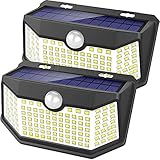
This listing has nearly the same name as the previous entry: 120 LEDs, three lighting modes, a motion sensor, an IP65 rating and solar power for gardens, patios and yards. The two listings may be different generations of the same design, so treat them as close relatives and confirm the sensor range, battery size and included hardware on each page before choosing. If one page shows clearer specifications or more recent buyer questions answered by the seller, that is a fair tiebreaker between them.
- LEDs: 120 per the listing
- Modes: three lighting modes in the name
- Weather rating: IP65
- Power: solar with a wall-mounted panel layout
- Differences from the newer listing: confirm on the product page
Pros
- A familiar format with the same basic mode options
- Suits small wall and fence locations
Cons
- Overlaps heavily with the other HMCITY listing
- Specific battery and sensor details are not shown in the listing name
It is nearly interchangeable with the other HMCITY, so choose whichever listing shows the specs you prefer.
5. LUTEC 72W 7500LM LED Security Floodlight – Best for Maximum Brightness

The LUTEC is the only wired fixture in the group and the brightest on paper. The listing describes a 72-watt, 7500-lumen LED output, 5000K daylight color, an IP65 waterproof rating, a dusk-to-dawn feature and three adjustable motion-detecting heads. It suits garages, loading areas and large yards where you want strong, consistent light all year, but it must be wired into a household circuit. Heads that swivel let you aim one at the driveway, one at the door and one along a side wall, which is a flexible arrangement for a corner mount.
- Output: 7500 lumens claimed at 72W
- Color: 5000K daylight
- Heads: three with motion detection
- Weather rating: IP65
- Power: wired; confirm the voltage and mounting box requirements on the listing
Pros
- Much higher claimed output than the solar options
- No dependence on sunshine or battery condition
Cons
- Installation involves mains wiring; turn off the circuit at the breaker and hire a licensed electrician if you are not experienced
- Strong beams can bother neighbors if aimed carelessly
It trades the easy mounting of the Tuffenough for a much higher light output and steady power.
6. Aootek Solar Motion Sensor Lights, 120 LEDs, 6 Pack – Best for Steps, Fences and Walls

The Aootek multi-pack gives you six matching wall lights, each with 120 LEDs, a reflector, a 270-degree wide-angle claim and an IP65 rating. The format suits a property with many small dark spots: stair landings, fence panels, a gate, a garage side wall and a back patio. Because each fixture is small, treat them as local lights rather than yard floodlights. They work well as a layered system: one light at each step landing means anyone walking the path triggers a sequence of lights, which both helps safe footing and signals that the property is watched.
- Pack: six lights per the listing name
- LEDs: 120 per fixture
- Finish: black, per the listing
- Weather rating: IP65
- Coverage: 270-degree wide-angle claim; confirm sensing distance
Pros
- Plenty of units to light a whole perimeter
- Small black fixtures blend into walls and fences
Cons
- Each light needs its own sun exposure
- Individual fixtures are less powerful than the large three-head floods
It covers more locations than the HMCITY single fixtures, but with less punch per spot than the LUTEC.
Specs Compared
| Product | Power | Light output (per listing) | LEDs / heads | Weather rating | Pack / extras |
|---|---|---|---|---|---|
| Tuffenough 3-Head Solar Light | Solar | 2500 lumens | 210 LEDs, 3 heads | IP65 | Remote control, 270-degree claim |
| daphino 3-Head Solar Light | Solar | 2500 lumens | 3 heads; LED count confirm on listing | IP65 | 2 pack, 270-degree claim |
| HMCITY 120 LED Solar Wall Light (newer listing) | Solar | Confirm on listing | 120 LEDs | IP65 | 3 lighting modes |
| HMCITY 120 LED Solar Light (older listing) | Solar | Confirm on listing | 120 LEDs | IP65 | 3 lighting modes |
| LUTEC 72W Security Floodlight | Wired | 7500 lumens, 72W | 3 heads; LED count confirm on listing | IP65 | 5000K, dusk to dawn |
| Aootek Solar Motion Light 6 Pack | Solar | Confirm on listing | 120 LEDs each | IP65 | 6 pack, reflector, 270-degree claim |
How We Chose These
We worked from the product set provided for this guide and compared each listing on power source, light output claims, number of heads or LEDs, weather rating, motion coverage and pack size. We gave extra weight to products whose listings spell out those details and treated high lumen claims on solar fixtures cautiously because they are often peak values. Where a listing does not state a specification, we mark it for confirmation instead of guessing. This is a research-based guide built from manufacturer information and retailer listings, not a lab ranking, and it should be read alongside the current product pages.
What to Look For
Solar or Wired: The First Decision
Solar fixtures mount with screws and need no electrician, which makes them ideal for fences, sheds and detached garages. Their limits are battery capacity and sun: a panel in shade, or short winter days with a low sun angle, can leave the light dim or dead after a few nights. Wired fixtures draw steady power and can deliver far more light, but they must be connected to a house circuit, ideally through a weatherproof box and a ground-fault-protected circuit. Always switch off the breaker and verify the wires are dead with a non-contact voltage detector before touching them, and use a licensed electrician if you have any doubt. Never rely on a wall switch alone to isolate wiring.
Lumens, Color Temperature and Realistic Brightness
Lumens measure total light output. A porch fixture often runs 600 to 1,000 lumens, while a driveway or yard light commonly lands between 1,500 and 3,000 lumens, and large flood fixtures go higher. Remember that the headline number on a solar fixture may combine all LEDs at their peak, and the real output in a long-running mode is usually lower. Color temperature also matters: around 3000K looks warm and soft, while 5000K reads as bright daylight and tends to emphasize detail for security viewing. Pick a fixture aimed down and shielded so it lights your property instead of your neighbor’s windows.
Motion Sensor Range, Angle and Placement
Most outdoor passive infrared sensors are used at heights of roughly 6 to 10 feet and detect motion across the sensor’s cone rather than directly in front of it. Movement that crosses the field of view triggers more reliably than someone walking straight toward the sensor. A 270-degree claim describes the angle; the distance, often in the range of 15 to 40 feet, is listed separately on good product pages. Aim the sensor away from busy sidewalks, tree branches and heat sources such as dryer vents, since they cause false triggers. If pets roam the yard, lower the sensitivity or choose a model with adjustable settings.
Weather Ratings, Modes and Rule of Thumb
IP65 means the housing is dust-tight and resists low-pressure water jets, so rain is fine but it is not meant for submersion. Modes typically combine a dim standby light, a motion-only mode and an always-on mode; a dim standby plus bright on motion is the most useful for security. As a rule of thumb, plan one light for every entry point, with an overlap of about 10 feet so that someone approaching the door passes through two coverage zones. For example, a house with a front door, a back door and a side gate calls for three lights, so a six-pack can cover those plus a driveway corner and a set of steps.
Battery, Panel and Maintenance for Solar Units
Most solar fixtures use a rechargeable lithium or nickel-metal-hydride cell that wears out after a few hundred charge cycles, often in two to four years. Keep the panel clean by wiping it with a damp cloth a few times a year, because dust, pollen and bird droppings can noticeably cut charging. Switch the fixture on and allow a full day of sunlight before judging its night performance. If the light dims much earlier than it used to, a battery that can be replaced is a big advantage, so check the listing or manual for a user-serviceable compartment. Also confirm that the fixture can operate in cold weather; some cells charge poorly below freezing.
Aiming Light Without Annoying the Neighbors
Point heads downward at the area you want to protect and avoid aiming at windows, roads or the neighbor’s yard. Strong lights that spill across property lines can cause disputes and, in some places, may conflict with local lighting ordinances. A shield or a lower brightness mode often solves the problem. For wired floods, a 5000K light is very harsh; consider a warmer option if the beam will be visible from bedrooms. Also think about wildlife: a bright light that triggers all night can disturb birds and nocturnal animals, so a shorter timer is a courteous setting.
Building a Simple Lighting Plan
Walk the property after dark with a phone flashlight and note every spot where someone could approach unseen: doors, windows at ground level, gates, garage corners and the end of the driveway. Mark where you already have power, since a single wired flood can cover a lot, then fill the remaining gaps with solar units. Layer your lighting so the approach has dim path lights, the entry points have a brighter motion fixture, and the most exposed side has the strongest light. Finally, revisit the plan after a week and move any fixture that triggers too often or too rarely. Small adjustments to height, angle and sensitivity often matter more than buying a brighter light.
Questions
Do solar motion sensor lights work in winter?
They work, but runtime drops when days are short and the sun sits low. Mount the panel facing south with no tree shadow, wipe off snow and dust, and expect fewer minutes of bright output per night. For harsh climates, a wired fixture is more dependable.
How high should I mount a motion sensor light?
Most manufacturers suggest about 6 to 10 feet above the ground. Mounting too high shortens the effective range, and mounting too low can pick up small animals and passing traffic. Check the instructions on the product page for the exact recommendation.
Why does my light turn on for no reason?
Wind-blown branches, small animals and heat from vents or sunlit surfaces can trigger passive infrared sensors. Reduce the sensitivity, re-aim the head, or trim nearby plants. If you have a wired light, check that it is not sharing a circuit with a switch that flickers.
Is 2500 lumens enough for a driveway?
For many driveways, 2000 to 3000 lumens is enough to see clearly, especially with two fixtures overlapping. A very long or wide space may need more units or a brighter wired fixture. Remember that solar lumen claims are often peak figures.
Do I need an electrician to install a wired flood light?
If you are comfortable with home wiring and local code, you may handle a simple replacement, but a licensed electrician is the safer path when adding a new fixture or box. Always cut power at the breaker first and use a weatherproof enclosure. When in doubt, hire a professional.
Can I use more than one solar light on the same wall?
Yes, and many people do. Space them apart so the sensor zones overlap slightly, and make sure each panel has its own sun exposure. Lights next to each other can also trigger one another if they are placed too closely together.
Update History
- October 20, 2026 – Initial publication; product set drawn from current catalog listings.
- Check the product page for current specifications and availability before buying.
Sources
- Retailer listing titles and specification fields for each product
- Manufacturer product pages where available for the brands listed
- General ingress protection (IP) rating definitions from the IEC 60529 standard




Write Your Review
No reviews yet. Be the first to share your experience!