

Key takeaways
- Test every alarm monthly and replace smoke alarms after about 10 years.
- Replace CO and combination alarms on the schedule the manufacturer states, usually five to seven years.
- Do not disable an alarm that sounds during cooking. Use the hush button and relocate it if it happens often.
- Do not mix wireless systems from different brands and assume they interconnect.
- Practice a home escape plan with two exits from each room and a meeting place outside.
The best fire alarm setup for a home is an interconnected system with an alarm in every bedroom, outside each sleeping area and on every level, using photoelectric or dual-sensor units. For most households, that means the First Alert SM210 for basic coverage, the Kidde 20SA10 for hardwired homes, the X-Sense SC07-W for wireless interconnection and the First Alert SC5 for smart phone alerts.
Our top picks


As an Amazon Associate we earn from qualifying purchases at no extra cost to you.
Quick Comparison of Home Fire Alarms
| Pick | Best for | Type | Power | Interconnect | Price range |
|---|---|---|---|---|---|
| First Alert SM210 | Basic bedroom coverage | Photoelectric smoke | Sealed 10-year battery | None | Budget to mid-range |
| Kidde 20SA10 | Hardwired homes | Photoelectric smoke | 120V with sealed 10-year backup | Hardwired | Mid-range |
| First Alert BRK 3120B or successor | Dual-sensor coverage | Photoelectric plus ionization | 120V with backup | Hardwired | Mid-range |
| X-Sense SC07-W | Wireless interconnect, no wiring | Photoelectric smoke plus CO | Sealed 10-year lithium | Up to 18 alarms | Mid-range |
| First Alert SC5 | Smart alerts and voice | Smoke plus CO | Check current spec | Wi-Fi and app | Upper-mid |
| First Alert SCO7CN | Voice-alert combo | Smoke plus CO | Sealed lithium | None | Mid-range |
Specs follow manufacturers’ published data and 2026 smoke-detector roundups. Always check the label for sensor type, power source and end-of-life date, and confirm local code requirements.
How Many Fire Alarms Does a Home Need?
NFPA guidance calls for an alarm inside every bedroom, outside each sleeping area and on every level of the home, including the basement. NFPA 72 recommends interconnecting all alarms so that when one sounds, all sound.
| Home layout | Alarms needed | Breakdown |
|---|---|---|
| Studio or one-bedroom apartment | 2 to 3 | Bedroom, living area, hallway if present |
| Two-bedroom, one level | 3 to 4 | Two bedrooms, hallway, living area |
| Three-bedroom, two levels | 5 to 6 | Three bedrooms, upstairs hallway, ground floor, basement |
| Four-bedroom, two levels plus basement | 7 to 8 | Four bedrooms, two hallways, ground floor, basement |
Add carbon monoxide alarms on each level and near sleeping areas, either as separate units or as smoke and CO combos.
Best for Basic Coverage: First Alert SM210
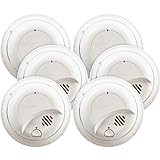
The First Alert SM210 is a photoelectric smoke alarm with a sealed 10-year battery and is named the best photoelectric smoke detector for most homes in several 2026 roundups. It installs in minutes with no wiring, which suits bedrooms, hallways and rentals.
Main trade-off: It is a standalone unit, so it does not trigger other alarms in the house.
Best Hardwired: Kidde 20SA10
The Kidde 20SA10 is a hardwired, interconnected photoelectric alarm with a sealed 10-year backup battery. House-wired alarms are favored by fire departments because interconnected alarms sound throughout the home. Cited NFPA data says hardwired interconnected alarms operate correctly about 94 percent of the time, compared with 85 percent for standalone battery alarms.
Main trade-off: It requires ceiling wiring and ideally an electrician for new installations.
Best Dual-Sensor: First Alert BRK 3120B or Its Successor
The 3120B pairs photoelectric and ionization sensors for coverage of both smoldering and flaming fires. One roundup lists the 3120B as discontinued and names the SM300-AC as its replacement, so check what is currently available before buying.
Main trade-off: It costs more than single-sensor alarms and requires hardwiring.
Best Wireless Interconnect: X-Sense SC07-W
The X-Sense SC07-W is a photoelectric smoke and CO alarm with a sealed 10-year battery that connects wirelessly to as many as 18 X-Sense alarms. It has no Wi-Fi, so it does not send phone notifications, but it solves the interconnection problem for homes without ceiling wires.
Main trade-off: It only interconnects with compatible X-Sense units.
Best Smart Alarm: First Alert SC5
With Google Nest Protect discontinued, the First Alert SC5 is described as its official replacement, offering smoke and CO detection, voice alerts and phone notifications. Reports say it uses the same baseplate as the Nest Protect, so owners can swap units as old ones expire.
Main trade-off: It costs more than non-smart alarms and depends on Wi-Fi for alerts.
Decision Matrix: Choosing Fire Alarms for Your Home
| Situation | Choose | Reason |
|---|---|---|
| Renter or no ceiling wiring | SM210 or X-Sense SC07-W | No wiring, sealed battery |
| New build or renovation | Kidde 20SA10 | Hardwired interconnect |
| Want phone alerts when away | First Alert SC5 | Smart notifications |
| Want both sensor types | Dual-sensor alarm or mix of types | Covers smoldering and flaming fires |
| Older relatives or children | Voice-alert alarms | Spoken warnings |
How to Choose Fire Alarms
Sensor type
Photoelectric alarms detect smoldering fires early, and ionization alarms detect fast flaming fires early. NFPA and the US Fire Administration recommend both technologies in a home. The newer UL 217 standard uses realistic fire tests, which narrows the gap for new alarms, but older units remain biased toward one type.
Power source
Hardwired alarms with backup are reliable and interconnect over wires. Sealed 10-year battery alarms are simple to install. Avoid standard 9V models you may forget to change.
Placement
Mount alarms on ceilings or high on walls, at least 10 feet from cooking appliances where possible, and away from bathroom steam, air vents and fans. Put alarms in the center of the room, or at least 4 inches from where the wall meets the ceiling.
Worked example: budget for a three-bedroom home
For six alarms, a mix of three bedroom alarms, one hallway combo and two level alarms costs roughly the same as one premium smart alarm. If you cannot fund everything at once, start with bedrooms and hallways, which matter most for night-time fires.
Maintenance and Common Mistakes
- Test every alarm monthly and replace smoke alarms after about 10 years.
- Replace CO and combination alarms on the schedule the manufacturer states, usually five to seven years.
- Do not disable an alarm that sounds during cooking. Use the hush button and relocate it if it happens often.
- Do not mix wireless systems from different brands and assume they interconnect.
- Practice a home escape plan with two exits from each room and a meeting place outside.
Room-by-Room Placement Guide
| Location | Alarm type | Placement tip |
|---|---|---|
| Bedrooms | Photoelectric smoke | Ceiling, near the center of the room |
| Hallway outside bedrooms | Smoke and CO combo | Within reach of all sleeping doors |
| Top of basement stairs | Smoke alarm | Ceiling at the top of the stairs, not in the stairwell dead air |
| Living room | Photoelectric smoke | Away from fireplaces and vents |
| Kitchen area | Photoelectric or heat alarm | Keep several feet from the stove, or choose a heat alarm to cut nuisance alerts |
| Furnace or garage-adjacent area | CO alarm | Follow the manufacturer’s height guidance |
Ceiling corners create dead air where smoke may not reach quickly, so keep ceiling alarms at least 4 inches from the nearest wall. On a sloped ceiling, mount the alarm near the peak but within the distance the manufacturer allows.
Why Interconnection Matters
In a two-level home, a fire in the basement may not wake someone on the top floor if only the basement alarm sounds. Interconnected alarms sound together, which buys occupants extra seconds to exit. Hardwired systems connect through a wire, and wireless systems such as the X-Sense SC07-W use radio. Both approaches work, but both need alarms from the same compatible family. Test interconnection by pressing the test button on one alarm and confirming the others sound.
Frequently Asked Questions
What is the best type of fire alarm for a home?
An interconnected set of photoelectric or dual-sensor alarms with sealed or backed-up power is the best setup. Interconnection warns everyone in the house, even if the fire is far from where they are.
Are smoke alarms and fire alarms the same?
In a home, people use the terms interchangeably. A smoke alarm detects smoke and sounds locally, while a commercial fire alarm system may include pull stations and monitoring.
How often should I replace fire alarms?
Replace smoke alarms about every 10 years, and carbon monoxide or combination alarms according to the label, typically five to seven years.
Do I need a smart fire alarm?
You do not need one, but smart alarms send phone alerts when you are away and can identify the hazard by voice. They cost more and depend on Wi-Fi.
Where should I not put a smoke alarm?
Avoid placing alarms near kitchens, bathrooms, vents and windows, and in very dusty, humid or hot spaces such as unfinished attics, as these conditions can cause false alarms or damage.

Write Your Review
No reviews yet. Be the first to share your experience!