
Our Short List of 3

- Technology: IPL with SkinPro 2.0 (SensoAdapt) skin tone sensing
- Flash rate: up to 125 flashes per minute, as printed
- Modes: 3 comfort modes (normal, gentle, extra gentle)
- Heads: standard head plus precision head; Venus razor and soft pouch included
- Technology: IPL with SmartPulse; SenseIQ with SmartSkin sensor
- Light settings: 5 adjustable settings
- Attachments: 2 (body and face)
- Safety design: integrated UV filter; skin contact sensors; goggles not required, per listing
- Technology: IPL with dual lights and SHR mode
- Comfort feature: ice-cooling contact surface
- Sensor: skin sensor
- Model name: UI20 DB
All 4 Picks at a Glance
| Product | Specs | Action |
|---|---|---|
| Braun Silk Expert Pro 5, IPL5157 |
| Check price on Amazon |
| Philips Lumea 8000 Series, BRI932/03 |
| Check price on Amazon |
| Ulike Air 10 IPL Hair Removal Device |
| Check price on Amazon |
 INNZA IPL Hair Removal with Ice Cooling |
| Check price on Amazon |
Key takeaways
- Laser hair removal devices in IPL and diode builds for home use, compared by flash count, energy levels and skin tone fit for smooth skin at home.
As an Amazon Associate we earn from qualifying purchases.
Home light-based hair removal comes in two builds. Four of the five devices below use IPL, short for intense pulsed light, which fires broad-spectrum flashes at the hair root. One, the Tria 4X, uses a true diode laser instead. Both approaches aim at the same pigment target, and both ask for patience: every maker here describes repeated sessions over several weeks, followed by occasional touch-ups, rather than a single pass.
The five picks below cover the main ways these devices differ. Two read your skin tone with a sensor and set each flash for you. One is cordless and battery powered. One prints a very large flash count and nine manual levels, and one pairs its lamp with an ice-cooling contact surface. Flash counts, level counts and suitability wording are quoted as each listing prints them, and where a listing prints no figure, none is claimed. Listings change over time, so confirm the live page before ordering.
Disclosure: This article may contain affiliate links. If you buy through these links, we may earn a small commission from Amazon.
Braun Silk Expert Pro 5, IPL5157
- Technology: IPL with SkinPro 2.0 (SensoAdapt) skin tone sensing
- Flash rate: up to 125 flashes per minute, as printed
- Modes: 3 comfort modes (normal, gentle, extra gentle)
- Heads: standard head plus precision head; Venus razor and soft pouch included
Braun’s Silk Expert Pro 5 is an IPL device built around automatic adjustment. Its SkinPro 2.0 technology, which Braun also calls SensoAdapt, reads your skin tone and optimizes the power of every flash as you move, so you do not pick a level yourself. The listing gives a flash rate of up to 125 flashes per minute, which suits long glide passes over legs and arms, and three comfort modes at the touch of a button: normal, gentle and extra gentle. Braun describes the gentle modes as the ones to use on the face, underarms and bikini area, and as a good fit for first-time users.
Two heads come in the box, a standard head and a smaller precision head, and the listing names legs, arms, face, underarms, bikini line, chest and back as treatment areas. The device runs on a cord, and the box also holds a Venus Extra Smooth Swirl razor and a soft pouch. Braun’s product description calls the device eye-safe and says no protective glasses are required. Its printed safety information is worth reading in full before a first session: it tells users to read the user guide completely, and it warns against use on photosensitive skin. This listing prints a flash rate rather than a total lamp flash count, so there is no printed lifetime figure to compare against the counted lamps below.
Tria Hair Removal Laser 4X
The Tria 4X is the one true laser in this group. Its listing says it is powered by the same diode laser technology used in professional offices, and its bullet points describe the device as FDA-cleared. Tria’s comparison text on the page claims its laser delivers over three times more hair-eliminating energy than IPL devices, aimed at each follicle at a deeper, more concentrated level. Because a laser treats a small spot at a time, this is the pick for people who work area by area and want the laser build rather than broad IPL flashes.
It is also the only cordless pick here, running on an internal rechargeable battery. A sensor under the device unlocks the laser, and the device counts the pulses in a single session to help you track coverage. The listing adds one practical note: the device must be activated by following the included directions before it will function. This listing is the fuchsia version.
Specs
- Technology: diode laser
- Regulatory wording on listing: FDA-cleared
- Power: cordless, rechargeable lithium ion battery (1 required, included)
- Item model number: 3724A
- Dimensions: 11.3 x 5.8 x 10.1 inches; 1.81 pounds
- Features: skin sensor unlock, per-session pulse counter
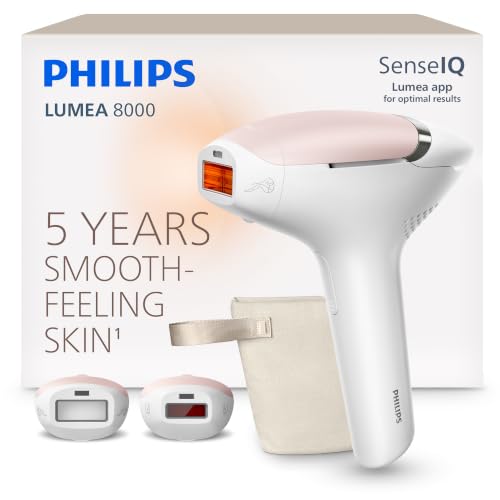
Philips Lumea 8000 Series, BRI932/03
- Technology: IPL with SmartPulse; SenseIQ with SmartSkin sensor
- Light settings: 5 adjustable settings
- Attachments: 2 (body and face)
- Safety design: integrated UV filter; skin contact sensors; goggles not required, per listing
The Philips Lumea 8000 is an IPL device with SenseIQ technology and a SmartSkin sensor that detects your skin tone and indicates the light setting the listing calls the most comfortable for your skin. You choose among five adjustable light settings, and the curved attachments adapt the treatment program to the area: this set includes two attachments, one for the body and a flat one for the face. Philips builds eye protection into the contact design rather than eyewear; its skin contact sensors see that the device flashes only in full skin contact, and the listing states that you do not need to wear goggles.
Philips prints the clearest suitability wording of the five listings: treatment is not effective on light blond, grey, red or white hair, and the device cannot be used on dark brown to dark skin tones. The listing also directs readers to the skin tone and hair color tables in the user manual. The printed schedule is one session every two weeks for an initial phase of four sessions, then a touch-up every four weeks, and a companion app offers a personal plan and reminders. The device is corded, with a 6.6 foot cord. The listing page read for this article carried no printed total flash count and showed no featured offers at crawl time, so check the live page for both.
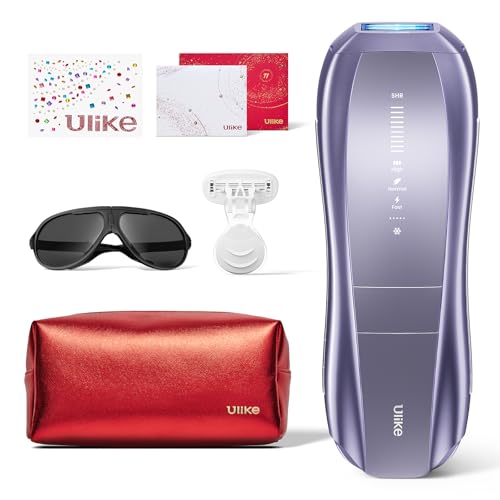
Ulike Air 10 IPL Hair Removal Device
- Technology: IPL with dual lights and SHR mode
- Comfort feature: ice-cooling contact surface
- Sensor: skin sensor
- Model name: UI20 DB
The Ulike Air 10 takes an IPL lamp and adds cooling. The listing describes an ice-cooling contact surface meant to keep skin comfortable during a session, dual lights, and an SHR mode, alongside a skin sensor. Ulike’s summary claims visible hair reduction in two weeks, with the asterisked wording the maker prints; as with every device here, results build over a full course of sessions, and the claim is the maker’s own.
One listing detail needs flagging rather than smoothing over: the amazon.com listing whose printed ASIN field could be verified for this device is the limited holiday set, so the box contents printed for it include extras a plain device listing would not, namely a storage bag, aloe vera gels and gem stickers next to the storage box. The device itself is the Air 10, model UI20 DB, in purple, at a printed weight of 0.9 pounds. Confirm on the live page which set contents the current listing includes, since bundle contents are exactly the kind of detail sellers revise.
INNZA IPL Hair Removal with Ice Cooling
- Technology: IPL; 600 nm wavelength, as printed
- Flash count: 999,999 flashes, as printed
- Energy: 5 J/cm², as printed
- Levels and modes: 9 adjustable intensity levels; auto and manual flash modes
The INNZA handset is the manual-control entry in this group. Its listing prints a flash count of 999,999 flashes, the only total lamp figure stated outright among these five listings, and nine adjustable intensity levels, the widest manual range here. Two flash modes split the work: an auto mode for larger areas such as legs, arms, chest and back, and a manual mode for smaller areas such as the upper lip, underarms and bikini line. The listing prints an energy figure of 5 J/cm² and a 600 nm wavelength, and an ice cooling care function that the maker says helps minimize redness during use.
The listing is equally direct about fit and routine. Its printed tips say IPL is most effective on light to medium skin tones with dark hair, and point readers to the skin tone and hair color chart for detailed guidance. Its printed schedule runs two to three sessions per week for weeks one to three, once a week for weeks four to six, then once a month to maintain. The device must be plugged in to operate, and the listing instructs users to use the original power adapter.
How to Choose
IPL or diode laser. IPL devices flash a broad band of light and cover skin quickly, which is why four of these five picks use it. The Tria 4X uses a diode laser that concentrates on a smaller spot with, per its listing, over three times the energy of IPL per pulse.
Skin tone and hair color fit comes first. Light-based devices work through pigment contrast, and every maker here limits the fit in print. Philips states that treatment is not effective on light blond, grey, red or white hair and that its device cannot be used on dark brown to dark skin tones. INNZA says its device is most effective on light to medium skin tones with dark hair. Before ordering any model, read the skin tone and hair color tables in its user manual, as the Philips listing directs, and read the full user guide before a first session, as the Braun safety information directs. Do the sensitivity check the manual describes on a small patch of skin first, and begin at a low setting. Braun also warns against use on photosensitive skin, and anyone taking medicine that lists photosensitivity as a side effect should follow that printed caution.
Sensors versus manual levels. Braun, Philips and Ulike read skin tone with a sensor and set or guide the flash for you, which removes guesswork. INNZA hands you nine levels to set yourself, and Tria’s laser unlocks only when its sensor reads skin.
Eye protection is built in, not added on. None of these five listings asks you to buy eyewear. Braun calls its device eye-safe with no protective glasses required, Philips relies on contact sensors that prevent a flash away from skin, and Tria’s sensor unlocks the laser only against skin. Follow each manual’s eye guidance exactly, and never fire a device toward the eyes.
Flash counts, cords and schedules. Compare only figures a listing actually prints: INNZA prints 999,999 flashes, Braun prints a rate of 125 flashes per minute, and the Philips listing read here prints no total. Tria runs on a rechargeable battery; the other four are corded, so an outlet needs to be within reach of your treatment spot. Finally, compare the printed routines: Philips asks for a session every two weeks, INNZA for several per week at the outset.
FAQ
Is IPL the same thing as a laser?
No. IPL is intense pulsed light, a broad band of light delivered in flashes. A diode laser, like the Tria 4X, emits a single concentrated wavelength. Both target pigment in the hair root, but they differ in spot size, energy per pulse and coverage speed.
How long before I see a difference?
Each maker prints its own timeline and schedule. Philips describes visible results after two sessions on its plan of one session every two weeks, while INNZA prints a denser early schedule of two to three sessions per week. Treated hairs shed over the following days and weeks, and all five makers describe touch-ups after the initial course.
Who should not use a light-based device?
Follow the printed limits for the model you choose. Philips states its device cannot be used on dark brown to dark skin tones and is not effective on light blond, grey, red or white hair. Braun warns against use on photosensitive skin. When a manual’s chart excludes your skin tone or hair color, treat that as the answer.
Do I need protective glasses with these devices?
The listings say no for these models. Braun calls the Silk Expert Pro 5 eye-safe with no protective glasses required, and Philips states that its contact sensors provide eye protection by flashing only in full skin contact, so goggles are not needed. Still follow the manual: keep the window flat on skin and never aim a flash at the eyes.
Conclusion
For most people, the Braun Silk Expert Pro 5 and Philips Lumea 8000 are the balanced picks: both read skin tone for you, cover body and face, and print clear suitability limits. Choose the Tria 4X if you want a diode laser and cordless work. The Ulike Air 10 adds an ice-cooling contact surface in a light handset, while the INNZA offers the widest manual level range and the only printed total flash count of the group. Whichever you pick, let the manual’s skin tone chart make the final call.
More from Amazon
Programs that pair well with the guide above. Offers and eligibility are set by Amazon and may change.
Free shipping on eligible items, Prime Video and more. Eligible new members can start with a free trial.
Start a Prime free trialAudiobooks and podcasts to listen to on the go. Eligible new members can start with a free trial.
Try Audible freeAd-free music streaming. Eligible new subscribers can start with a free trial.
Try Music Unlimited freeA free business account with business pricing and bulk-buying tools for work, shop or home office.
Create a business accountAs an Amazon Associate we earn from qualifying purchases.


Write Your Review
No reviews yet. Be the first to share your experience!