

Key takeaways
- Compare the best rotary hopper deposit safes with time delay locks for retail cash handling, with secure drops, multi-user codes, and sturdy steel bodies.
Retail cash handling creates a simple problem: staff need to put money away quickly during a shift, but the cash already stored should stay out of reach until an authorized person opens the safe. The best rotary hopper deposit safes with time delay locks for retail cash handling solve both halves of that problem. A rotary hopper lets an employee place cash or a deposit bag into a turning drum that drops the contents inside without opening the door, and a time delay lock makes anyone who opens the safe wait before the door releases. That waiting period discourages forced openings and gives staff a clear routine for deposits.
This guide compares deposit safes built around hopper deposits and time-delay locking, so you can match the deposit entry, the lock, and the size to the volume of cash your shop handles each day.
How to Choose
1. Rotary hopper design
A true rotary hopper is a turning drum at the top of the safe. Staff place a deposit inside, turn the drum, and the contents drop into the locked compartment. Look for anti-fish baffles that block anyone from pulling deposits back out through the hopper. Confirm the size of the packages the hopper accepts, since thick deposit bags and bulky envelopes need a larger opening.
2. Time delay settings
A time delay lock holds the door closed for a set period after a valid code is entered. Check the range of delay settings and whether the delay can be turned off by a manager code. A delay of a few minutes suits most shops, while longer delays suit higher-risk locations. Make sure managers understand how the delay works before the safe goes into daily use.
3. Multi-user codes and accountability
Retail safes are opened by more than one person. A lock that supports a manager code plus several user codes lets you give each supervisor their own code and change codes when staff leave. Some locks also offer dual-control mode, where two codes are needed to open the door. Write down who holds each code and keep that record away from the safe.
4. Steel construction and door strength
Deposit safes for retail use should be built from solid steel with a thick door and strong locking bolts. B-rate construction, a recessed door jamb, and a relocking device that guards against drilling all add resistance to forced entry. A heavier safe is harder to remove, which matters in a shop that closes overnight.
5. Capacity and deposit volume
Match the interior to the cash volume per shift. A compact safe near 1 cubic foot suits a small shop with one till, while a larger safe suits multiple tills and end-of-day deposits. If deposits pile up faster than collections, the safe will fill up, so plan a regular emptying routine with the person who holds the manager code.
6. Anchoring
A deposit safe should be bolted to the floor. Check for pre-drilled anchor holes and an included bolt-down kit. A safe that can be carried away defeats the purpose of the lock, so anchor it before the first deposit goes in.
7. Deposit entry and workflow
Think about where the safe will sit. A top-loading hopper suits a counter or back room where staff stand over the safe, while a front-loading deposit door suits a safe placed under a counter or against a wall. The deposit entry should be reachable without moving stock or blocking a walkway.
Top Picks
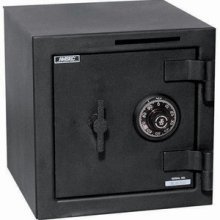
American Security DSF2014 ESL10XL Depository Safe
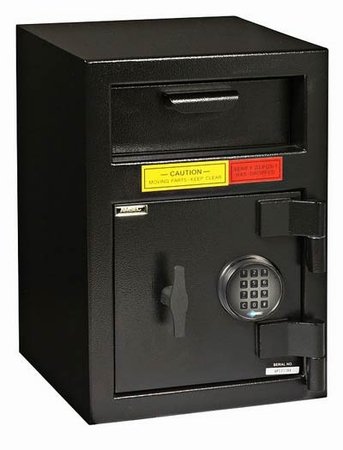
The AMSEC DSF2014 is built around the DS series design, which accepts deposits through a top-loading rotary hopper, a reverse hopper, or a front-loading deposit door. The exterior measures 20.25 by 14 by 14 inches, with 1,513 cubic inches of interior capacity, and the safe weighs 79 pounds. The body uses 11-gauge formed steel, the door is a half-inch solid steel plate, and dual anti-fish baffles guard the deposit entry. The ESL10XL electronic lock controls access.
- Capacity: 1,513 cubic inches
- Lock: ESL10XL electronic lock
- Deposit entry: Top-loading rotary hopper and front-loading deposit door
- Construction: 11-gauge steel body, half-inch steel plate door
- Exterior: 20.25 x 14 x 14 inches, 79 pounds
Best for: Retail shops that want a genuine rotary hopper deposit entry with the option of a front-loading door on the same unit.
Keep in mind: Time-delay capability on this series comes through the ESL20XL lock option, which adds that function. If a time delay is a firm requirement, confirm the lock option when ordering rather than assuming the base lock includes it.
SentrySafe DH-074E Front Loading Depository Safe

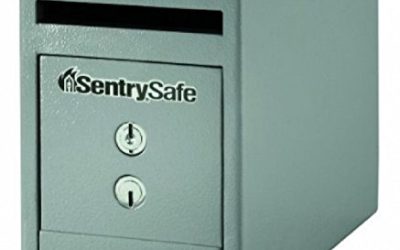
The SentrySafe DH-074E is a 0.94-cubic-foot depository safe with a programmable electronic lock that includes a time delay, plus an anti-fish hopper that blocks deposits from being pulled back out. Three live-locking bolts secure the door, and a bolt-down kit is included. The exterior measures 14 inches wide by 15.6 inches deep by 20 inches high.
- Capacity: 0.94 cubic feet
- Lock: Programmable electronic lock with time delay
- Deposit entry: Anti-fish hopper
- Door: Three live-locking bolts, anti-pry design
- Mounting: Bolt-down kit included
Best for: Small retail shops and counters that need a compact deposit safe with a time delay and a hopper entry.
Keep in mind: The hopper on this model is an anti-fish slot design rather than a turning rotary drum, so if your routine depends on a rotary drum for larger deposit bags, compare the package size it accepts before choosing.
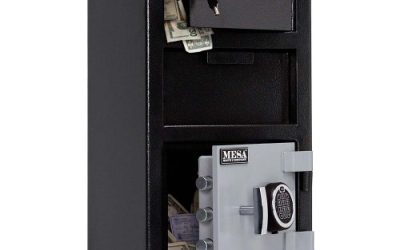
Mesa Safe MFL2014E Depository Safe

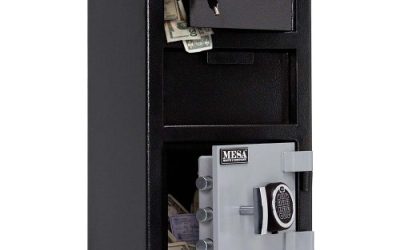
The Mesa MFL2014E pairs a front-loading deposit door with the MSL-500 electronic lock, which offers a programmable time delay from 0 to 59 minutes and supports 1 manager code plus 5 user codes. The exterior measures 20 by 14 by 14 inches, with 0.9 cubic feet of interior space. A wrong-code penalty locks the keypad after repeated incorrect entries, and the safe is built with B-rate steel construction.
- Capacity: 0.9 cubic feet interior
- Lock: MSL-500 electronic lock, programmable time delay from 0 to 59 minutes
- Codes: 1 manager code plus 5 user codes
- Deposit entry: Front-loading mailbox-style deposit door with anti-fish baffle
- Exterior: 20 x 14 x 14 inches
Best for: Retail locations that want a clearly programmable time delay and separate codes for a manager and several staff members.
Keep in mind: Its deposit entry is a front-loading door rather than a rotary drum. It earns its place here for its time-delay lock and multi-user codes, while the AMSEC pick above is the rotary hopper choice in this guide.
Comparison Table
| Model | Capacity | Lock and Time Delay | Deposit Entry | Construction |
|---|---|---|---|---|
| AMSEC DSF2014 ESL10XL | 1,513 cubic inches | ESL10XL electronic lock; time delay through ESL20XL lock option | Top-loading rotary hopper and front-loading door | 11-gauge steel body, half-inch steel door |
| SentrySafe DH-074E | 0.94 cubic feet | Programmable electronic lock with time delay | Anti-fish hopper | Solid steel, 3 live-locking bolts |
| Mesa MFL2014E | 0.9 cubic feet interior | MSL-500 electronic lock, time delay 0 to 59 minutes | Front-loading deposit door, anti-fish baffle | B-rate steel construction |
Which One Is Right for You?
Choose the AMSEC DSF2014 if a rotary hopper is the core requirement and you want both top-loading and front-loading deposit options on one unit, remembering to select the ESL20XL lock option for time-delay function. Choose the SentrySafe DH-074E if you run a small shop and want a compact safe with a built-in time delay and an anti-fish hopper. Choose the Mesa MFL2014E if you want a programmable time delay from 0 to 59 minutes with separate codes for a manager and five users, and a front-loading deposit door suits your counter layout.
Whichever model you choose, set the time delay before the safe enters daily service, train every person who will deposit cash, and fix the safe to the floor on day one.
Frequently Asked Questions
How does a rotary hopper deposit safe work?
Staff place cash or a deposit bag into a turning drum, rotate it, and the contents drop into the locked compartment below. The drum and internal baffles block the deposit from being pulled back out, and the main door stays locked throughout.
What does a time delay lock do?
After a valid code is entered, a time delay lock keeps the door locked for a set period before it releases. That waiting period discourages forced openings and gives staff a predictable routine for opening the safe.
How many user codes should a retail deposit safe support?
A manager code plus several user codes covers most shops, since it lets supervisors open the safe while cashiers only make deposits. Change codes promptly when a code holder leaves the business.
Where should a retail deposit safe be placed?
Place it where staff can reach the deposit entry without leaving the till unattended for long, yet out of easy reach of customers. Bolt it to the floor, keep the area around it clear, and make sure the door can open fully for emptying.
Disclosure: As an Amazon Associate, we may earn from qualifying purchases.
More from Amazon
Programs that pair well with the guide above. Offers and eligibility are set by Amazon and may change.
Free shipping on eligible items, Prime Video and more. Eligible new members can start with a free trial.
Start a Prime free trialAudiobooks and podcasts to listen to on the go. Eligible new members can start with a free trial.
Try Audible freeAd-free music streaming. Eligible new subscribers can start with a free trial.
Try Music Unlimited freeA free business account with business pricing and bulk-buying tools for work, shop or home office.
Create a business accountAs an Amazon Associate we earn from qualifying purchases.

Write Your Review
No reviews yet. Be the first to share your experience!