

Key takeaways
- Cable testers trace network, coax, and phone lines and flag wiring faults in homes and offices fast. Compare test modes, remote units, and tone probes.
As an Amazon Associate we earn from qualifying purchases.
Run a new Ethernet drop to a home office, move a router across the house, or sort out the bundle of coax lines behind a media console, and you quickly hit the same wall: the cable disappears into the wall, and its far end could be any one of a dozen jacks. A cable tester takes the guesswork out of that job. Plug one end into the tester and the other into a remote unit, and the tester reports whether every conductor lands on the right pin, whether a pair is crossed, and whether a wire is broken somewhere along the run.
Testers range from simple wiremap units that check one cable type to versatile voice, data, and video models that also measure length, identify many runs in one pass, and generate a tone you can follow with a probe. The five testers below cover the jobs home and small office wiring actually involves: verifying new terminations, mapping unlabeled runs, tracing a single cable through a bundle, and checking coax and phone lines alongside Ethernet. Each one earns its place by doing a defined set of tests well, with results shown on a screen or LED panel rather than left to guesswork.
Disclosure: This article may contain affiliate links. If you buy through these links, we may earn a small commission from Amazon.
Klein Tools Scout Pro 3 Cable Tester Kit (VDV501-851)
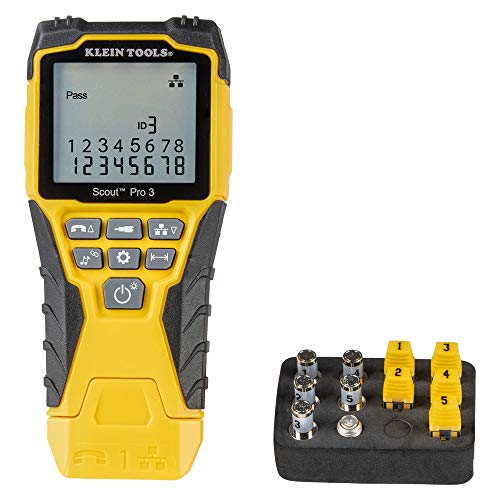
The Scout Pro 3 is the most versatile tester in this group, built for homes and offices where Ethernet, phone, and coax lines all meet in one wiring closet. It tests voice cables with RJ11 and RJ12 plugs, data cables with RJ45 plugs, and video coax terminated with F-connectors, so one tool covers the three cable families found in most buildings. Results appear on a backlit LCD that shows the wiremap, the cable ID, the measured length, and the test outcome in one view.
Fault finding is specific rather than vague: the tester reports open, short, miswire, and split-pair faults, and it measures cable length up to 2,000 feet. The kit includes five LanMap RJ45 locator remotes and five CoaxMap F-connector locator remotes, which let you identify up to ten runs in a single pass, plus a self-storing Test + Map remote for full wiremap checks. A hub blink mode helps pinpoint the switch port a run lands on, and the built-in tone generator works with an analog probe, sold separately, for tracing. A voltage warning and shield detection add protection against surprises on unfamiliar wiring.
Specs
- Cable types: RJ11/RJ12 voice, RJ45 data (Cat 3, 5e, 6, 6a, 7), F-connector coax (RG59, RG6, RG6Q)
- Length measurement: up to 2,000 feet (610 m)
- Display: backlit LCD with wiremap, cable ID, length, and results
- Remotes: 5 LanMap RJ45 and 5 CoaxMap F-connector locator remotes, plus self-storing Test + Map remote
- Power: 9V battery, included
- Dimensions: 6.9 x 3.2 x 1.5 inches; weight: 1 pound
Klein Tools LAN Scout Jr. 2 Cable Tester (VDV526-200)

The LAN Scout Jr. 2 narrows the focus to Ethernet only, and that focus makes it the simplest tester here to pick up and use. It tests installed or loose data cables terminated with RJ45 connectors, covering Cat 5e and Cat 6/6a cabling, and it maps all eight wires pin to pin on its backlit LCD. Instead of a plain pass light, the screen shows exactly which pins are wrong, so a swapped pair or a missed crimp is visible at a glance.
The tester detects opens, shorts, miswires, and split pairs, the last of which a basic continuity checker can miss entirely. It also checks the shield on shielded cable and recognizes crossover cables. A single remote is included for testing runs whose ends sit in different rooms, and the tester generates a tone for tracing a cable with a compatible probe. Power comes from two AAA batteries, which are included, so the unit is ready to work out of the box and easy to feed on site. For a home network with a patch panel and a handful of wall jacks, this level of testing covers nearly every fault you are likely to meet.
Specs
- Cable types: Cat 5e and Cat 6/6a data cables with RJ45 connectors
- Fault detection: opens, shorts, miswires, split pairs, and shield faults
- Display: backlit LCD with pin-to-pin wiremap
- Remote: 1 remote included
- Batteries: 2 AAA, included
- Extra function: tone generation for cable tracing with a probe
Fluke Networks MicroScanner2 Cable Verifier (MS2-100)

The MicroScanner2 is a trade-grade verifier for people who troubleshoot wiring often and want answers in seconds. It tests twisted pair, coax, and telephone wiring through RJ11, RJ45, and coax connections with no adapters to swap, and it runs continuity checks on all wires in a few seconds. The graphical display shows length, wiremap, cable ID, and distance to fault on a single screen, so you see what is wrong and how far down the cable the problem sits without cycling through modes.
That distance reading is the feature that sets this unit apart: when a cable is open, the MicroScanner2 reports which end the fault is nearest and how far away it is, which turns a wall full of cable into a short search. Built-in IntelliTone digital and analog toning lets you trace cables with a compatible probe, including on active networks. The verifier also identifies the services present on a jack, covering 10/100/1000Base-T Ethernet, POTS telephone service, and PoE, which helps when a dead outlet turns out to be a switch or power question rather than a wiring fault. The kit includes a wiremap adapter, two AA batteries, and a carrying case.
Specs
- Cable types: RJ11, RJ45, and coax, with no adapters needed
- Display: graphical wiremap, length, cable ID, and distance to fault on one screen
- Toning: built-in IntelliTone digital and analog tone generation
- Service detection: 10/100/1000Base-T Ethernet, POTS, and PoE
- Batteries: 2 AA, included
- Weight: 363 grams; included wiremap adapter and carrying case
Fluke Networks Pro3000 Tone Generator and Probe Kit (26000900)

This kit solves a different problem from wiremap testing: finding one specific cable inside a bundle, a wall, or a crowded patch panel. The Pro3000 tone generator injects a loud, clear tone onto a cable, and the unfiltered probe picks that tone up through walls and along the run so you can follow it to its far end. Fluke Networks states the tone carries up to 10 miles on most cables, far beyond any home or office run, so signal strength is never the limiting factor indoors.
SmartTone technology provides five distinct tones, and changing the tone at the generator by shorting the pair lets you confirm you have the exact pair you want rather than a neighbor carrying bleed-over signal. The generator connects directly to terminated RJ-type jacks with its male RJ-11 plug and also carries angled bed-of-nails clips for bare pairs, and it can check continuity and line polarity on phone wiring. The probe has a loud speaker that stays audible in noisy rooms, a 3.5 mm headphone jack for quiet spaces, and a replaceable tip. Both units run on 9V alkaline batteries, and a 9V battery is included in the kit.
Specs
- Tone technology: SmartTone with 5 distinct tones for exact pair identification
- Tone range: up to 10 miles (16 km) on most cables
- Connections: male RJ-11 plug for terminated jacks, angled bed-of-nails clips
- Tests: continuity and line polarity
- Probe: unfiltered probe with loud speaker, 3.5 mm headphone jack, replaceable tip
- Power: 9V alkaline batteries; 1 9V battery included
NOYAFA NF-8209 Network Cable Tester

The NF-8209 packs the widest list of functions in this group into a three-piece kit of emitter, receiver, and remote unit. For Cat 5 and Cat 6 RJ45 cabling it runs continuity tests that flag wiring faults, measures cable length, and checks crimp quality. The receiver works as a wire tracer, following the emitter signal along a run so you can find the far end of an unlabeled cable in a panel or ceiling space.
Two functions speak directly to powered network hardware. The PoE test identifies power present on a line before you plug in a camera or access point, and the port flashing function makes the connected switch port blink so you can match a wall jack to its port in seconds. An NCV function senses voltage without contact, a useful warning before working around unfamiliar wiring, and the kit also handles telephone line finding. Where the simpler testers above stop at a wiremap, this unit suits anyone setting up a small network with powered devices who wants tracing, length, and power checks in one kit rather than three separate tools.
Specs
- Cable types: Cat 5 and Cat 6 RJ45 network cables, telephone lines
- Test modes: continuity, length test, wire scanning, PoE, port flashing, QC crimp check, NCV
- Kit contents: emitter unit, receiver tracer, remote unit
- Tracing: digital signal receiver for locating cables and breakage points
- Power checks: PoE detection and non-contact voltage sensing
How to Choose
Start with the cable types in your building. If every run is Ethernet, an RJ45-only tester such as the LAN Scout Jr. 2 covers the work and keeps the interface simple. If phone lines and coax share the same closet, a voice, data, and video tester such as the Scout Pro 3 or the MicroScanner2 checks all three families with one tool, which matters in older homes where coax and telephone wiring are everywhere.
Next, decide what questions you need answered. A wiremap test confirms each pin lands correctly and flags opens, shorts, miswires, and split pairs. Length measurement tells you how much cable a run uses and, in the MicroScanner2, how far away a break sits, which is the difference between opening one wall plate and opening five. Remote units decide how fast you can map a panel: a single remote means one run at a time, while numbered locator remotes identify many runs in one trip.
Tracing is a separate job from testing. A tone generator and probe, like the Pro3000 kit, follows one cable through walls and bundles, and several testers here generate tone as a secondary function when paired with a probe. Finally, look at the display and power source. A backlit LCD wiremap is easier to read in a dark closet than LED codes, and common battery sizes, 9V, AA, or AAA, keep the tester working without a charger nearby.
FAQ
What faults can a cable tester actually find?
A wiremap tester checks each conductor end to end and reports opens, where a wire is broken or unconnected, shorts, where two wires touch, miswires and reversals, where pins land in the wrong order, and split pairs, where wires from two different pairs are mixed. Split pairs matter because a cable can pass a simple continuity check yet fail to carry data cleanly.
Can a cable tester tell me where a cable is broken?
Some can. Testers with length measurement, such as the Scout Pro 3 and the MicroScanner2, measure the run and report the distance to an open fault, and the MicroScanner2 also shows which end of the cable the fault is nearest to. Basic wiremap testers only confirm that a fault exists, not where it sits along the run.
Do I need a separate tone generator and probe?
Only if you need to trace cables. A tester verifies a cable you have already identified, while a tone generator and probe finds one cable among many by following its signal through walls and bundles. If your patch panel is unlabeled, a tone kit such as the Pro3000, or a tester with a built-in tone function, saves hours of trial and error.
Can I test a cable while it is plugged into a switch?
Wiremap and length tests are run on unpowered cable with the far end in a remote, so unplug both ends first. A verifier like the MicroScanner2 can also identify live services on a jack, including Ethernet speed and PoE, but that is a detection check, not a wiring test. The Scout Pro 3 adds a voltage warning to flag a line that is unexpectedly live.
Conclusion
For most home and small office wiring, the Klein Tools Scout Pro 3 covers the widest ground, testing Ethernet, phone, and coax with length measurement and a full set of locator remotes. Ethernet-only projects are well served by the LAN Scout Jr. 2, while the MicroScanner2 suits frequent troubleshooting where distance to fault and service detection save real time. Add the Pro3000 kit when unlabeled cables need tracing, or choose the NF-8209 when PoE checks and port flashing join the list. Match the tester to the cables in your walls, and every run can be verified instead of assumed.
More from Amazon
Programs that pair well with the guide above. Offers and eligibility are set by Amazon and may change.
Free shipping on eligible items, Prime Video and more. Eligible new members can start with a free trial.
Start a Prime free trialAudiobooks and podcasts to listen to on the go. Eligible new members can start with a free trial.
Try Audible freeAd-free music streaming. Eligible new subscribers can start with a free trial.
Try Music Unlimited freeA free business account with business pricing and bulk-buying tools for work, shop or home office.
Create a business accountAs an Amazon Associate we earn from qualifying purchases.






Write Your Review
No reviews yet. Be the first to share your experience!