

Key takeaways
- Telescopes bring planets, the moon, and deep sky sights closer for backyard viewing on clear nights. Compare apertures, mounts, eyepieces, and tripods.
As an Amazon Associate we earn from qualifying purchases.
A good backyard telescope turns an ordinary clear evening into a family event. The Moon stops being a flat, bright disc and becomes a landscape of craters, ridges, and long shadows along the terminator line. Saturn shows a clean ring system, Jupiter shows cloud bands and its four large moons, and faint smudges resolve into nebulae, galaxies, and dense clusters of suns. All it takes is a solid optical tube, a smooth mount, and a patch of yard with a dark view of the sky.
The five telescopes below cover the main designs a home observer is likely to meet: a computerized Schmidt-Cassegrain, two 130 millimeter Newtonian reflectors on very different mounts, a classic 8 inch Dobsonian, and a collapsible tabletop Dobsonian with built-in Wi-Fi. Aperture, stated in millimeters, decides how much light the optics gather: more light means fainter targets and finer detail. Focal length works with the eyepiece to set magnification, and the mount decides how you find targets and follow them as the Earth turns. Each pick is a complete kit with mount, tripod or base, and eyepieces included, so a family can observe on the first clear night.
Disclosure: This article may contain affiliate links. If you buy through these links, we may earn a small commission from Amazon.
Celestron NexStar 8SE Computerized Telescope

The NexStar 8SE packs a full 203 millimeters of aperture into a Schmidt-Cassegrain tube that stays short and manageable, because the folded light path fits a 2032 millimeter focal length into a compact body. That long focal length suits planetary and lunar observing, where higher magnification and fine detail matter most, and the StarBright XLT coatings help the optics make the most of the light they collect. It pairs a large aperture with the most automated mount in this group, a strong fit for a family wanting one telescope to grow with.
The single fork arm mount is fully computerized. After the SkyAlign routine, in which you center any three bright objects, the GoTo system points the telescope to targets from a database of more than 40,000 celestial objects, then tracks them as they drift across the sky. That tracking keeps Saturn or the Orion Nebula centered while everyone takes a turn at the eyepiece. The mount runs from a hand control on a sturdy steel tripod, and the setup breaks down into pieces that store in a closet or garage corner.
Specs
- Optical design: Schmidt-Cassegrain
- Aperture: 203 millimeters
- Focal length: 2032 millimeters, f/10 focal ratio
- Mount: computerized altazimuth fork arm with GoTo pointing and tracking
- Database: more than 40,000 celestial objects with SkyAlign alignment
- Coatings: StarBright XLT on the optical surfaces
- Included eyepiece: 25 millimeter Plössl
- Model number: 11069
Celestron StarSense Explorer DX 130AZ Telescope

The StarSense Explorer DX 130AZ takes a different route to finding targets. Instead of motors and a hand control, it uses the smartphone most families already carry. The phone sits in a dock on the optical tube, and the StarSense app analyzes the sky through the phone camera, works out where the telescope is pointing, and shows arrows on screen that guide you as you push the mount by hand until the target sits in the eyepiece. For beginners, that guidance removes the most frustrating part of a first observing session.
The optical tube is a 130 millimeter Newtonian reflector with a 650 millimeter focal length, a fast f/5 system that gives wide, bright views. Wide fields suit sprawling targets such as the Pleiades, the Andromeda Galaxy, and rich Milky Way fields, and the same aperture shows the Moon in sharp detail and Saturn’s rings cleanly. The mount is a manual altazimuth design on a full height tripod, moving in the directions that feel natural to a first-time user. Two eyepieces come in the box, giving 26x and 65x, plus a red dot finderscope for hunting targets the traditional way.
Specs
- Optical design: Newtonian reflector
- Aperture: 130 millimeters
- Focal length: 650 millimeters, f/5 focal ratio
- Mount: manual altazimuth with smartphone dock and app guidance
- Eyepieces included: 25 millimeter (26x) and 10 millimeter (65x)
- Finderscope: red dot type
- Compatibility: iPhone and Android phones
- Model number: 22461
Celestron AstroMaster 130EQ Newtonian Telescope

The AstroMaster 130EQ pairs the same 130 millimeter aperture class with the most traditional mount in this group, a manual German equatorial. An equatorial mount aligns one axis with the pole, so once a planet or the Moon is centered, you follow its drift by turning a single slow motion control knob instead of nudging two axes at once. Learning that motion is a genuine astronomy skill, and this telescope is a patient way to learn it, with tool-free setup and a pre-assembled tripod.
The optics are fully coated glass in a Newtonian reflector layout, with a 650 millimeter focal length at f/5. That is a versatile combination: low magnification views sweep up large nebulae and clusters, while the 10 millimeter eyepiece pushes closer on lunar craters and planets. The listing points to Saturn’s rings, Jupiter’s moons, and the Moon’s surface as typical targets, and the aperture reaches beyond the solar system on a dark night. Two eyepieces, 20 millimeter and 10 millimeter, come included along with a red dot finderscope, and Celestron adds a downloadable astronomy software package for planning sessions.
Specs
- Optical design: Newtonian reflector with fully coated glass optics
- Aperture: 130 millimeters
- Focal length: 650 millimeters, f/5 focal ratio
- Mount: manual German equatorial with slow motion control knobs
- Eyepieces included: 20 millimeter and 10 millimeter
- Finderscope: red dot type
- Tripod: full height, pre-assembled, 1.25 inch steel tube legs
- Model number: 31045
Orion SkyQuest XT8 Classic Dobsonian Telescope
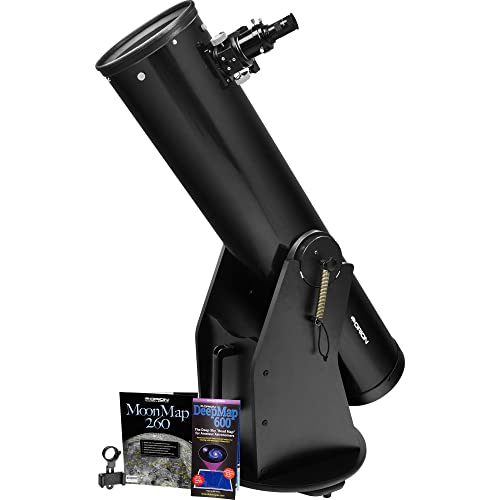
The SkyQuest XT8 is built around a simple idea: put as much aperture as possible on a mount that anyone can operate. Its parabolic primary mirror measures 205 millimeters across, the widest light bucket in this group, and Orion’s listing notes that an 8 inch mirror collects 78 percent more light than a 6 inch mirror. That extra light shows up in nebula dust lanes, resolved globular cluster cores, and faint galaxy structure that smaller apertures wash out. The 1219 millimeter focal length at f/5.9 also holds up well at the moderate to high magnifications that lunar and planetary observing demand.
The Dobsonian mount is a low, sturdy base that the enameled steel tube glides across with simple hand motions. There are no cables, no alignment routine, and nothing to charge; you carry it out, set it down, and point. A 2 inch Crayford focuser accepts both 2 inch and 1.25 inch eyepieces through the included adapter, and the supplied 25 millimeter Plössl gives 49x. A reflex sight finder helps you aim, and Orion includes a MoonMap 260 lunar map, a DeepMap 600 folding chart, and a smartphone photo adapter for Moon pictures through the eyepiece. It moves in two pieces, tube and base.
Specs
- Optical design: reflector with parabolic primary mirror
- Aperture: 205 millimeters
- Focal length: 1219 millimeters, f/5.9 focal ratio
- Mount: Dobsonian base, manual up-down and left-right motion
- Focuser: 2 inch Crayford with 1.25 inch adapter
- Eyepiece included: 25 millimeter Plössl, giving 49x
- Finder: reflex sight
- Weight, fully assembled: 39.1 pounds
- Model number: 8945
Sky-Watcher Virtuoso GTi 150P Collapsible Tabletop Dobsonian

The Virtuoso GTi 150P answers a storage problem. Its 150 millimeter Newtonian optical tube collapses down for transport and shelf space, then extends to its full 750 millimeter focal length on a patio table or sturdy stand. Despite the small footprint, the aperture is a genuine step up from entry tubes, and the fast f/5 focal ratio delivers bright, wide views of nebulae, galaxies, and clusters, with magnification in reserve for the Moon and planets.
What sets this model apart is the mount. The tabletop Dobsonian base is motorized and carries built-in Wi-Fi, so the telescope creates its own connection to a phone or tablet running the free SynScan app for iOS and Android. Through the app you get full GoTo pointing to a database of more than 10,000 objects, plus tracking that follows targets once centered. Sky-Watcher’s Radiant Aluminum Quartz coatings are applied to the optical surfaces for bright views, and the box includes a red dot finder and two eyepieces, 25 millimeter for 30x and 10 millimeter for 75x. The mount runs on 8 AA batteries or an external 12 volt DC supply, so it works at a campsite picnic table as easily as on the back deck.
Specs
- Optical design: Newtonian reflector, collapsible optical tube
- Aperture: 150 millimeters
- Focal length: 750 millimeters, f/5 focal ratio
- Mount: motorized tabletop Dobsonian, altazimuth, with built-in Wi-Fi
- Control: SynScan app for iOS and Android, database of more than 10,000 objects
- Eyepieces included: 25 millimeter (30x) and 10 millimeter (75x)
- Finder: red dot type
- Power: 8 AA batteries or external 12 volt DC supply
- Model number: S21205
How to Choose
Start with aperture, because it sets the ceiling on everything else. A 130 millimeter mirror handles the Moon, the planets, and the brighter nebulae and galaxies well, and it is the class most first telescopes fall into. Stepping up to 150 or 203 millimeters gathers more light, so faint galaxies show more structure and clusters resolve into individual points instead of a haze. Extra aperture also helps under streetlights, pulling more signal out of a washed-out sky.
Next, pick the mount style that matches your patience. A manual altazimuth mount moves the way your hands expect and suits casual sessions. A German equatorial mount asks for a polar alignment at setup, then rewards you with single-knob tracking. A Dobsonian base is the simplest of all and carries big apertures steadily. A GoTo mount finds targets for you and keeps them centered, a real gift when children are waiting for a turn at the eyepiece.
Finally, think about the practical side. A full height tripod setup needs floor space, while a tabletop model needs a sturdy table or stand at the observing spot. Check the total weight and whether the kit separates into pieces one person can carry. Confirm which eyepieces are included, since a low power eyepiece for wide views plus a higher power one for the Moon and planets covers most nights. A telescope that sets up in minutes gets used far more often than one that feels like a project.
FAQ
What can a beginner expect to see on the first night out?
The Moon is the surest first target, with craters and mountain shadows visible through any telescope in this group. Jupiter shows two dark cloud bands and up to four moons, Saturn shows its rings as a distinct structure around the planet, and Mars shows a small orange disc. Bright deep sky targets such as the Orion Nebula and the Andromeda Galaxy are within reach of every aperture here.
How much aperture does a family telescope really need?
An aperture of 130 millimeters is a sensible floor for a first family telescope, because it shows the planets well and reaches the brighter nebulae, galaxies, and clusters. Moving to 150 or 203 millimeters changes how much detail you see rather than what you can point at: fainter galaxy arms, tighter cluster cores, and finer lunar features become easier, especially under suburban skies.
Is a computerized GoTo mount better than a manual mount?
GoTo removes the search. After alignment, the mount points to a chosen object and tracks it, which keeps the view steady while several people take turns looking. A manual mount gives up that automation but teaches you the layout of the sky, sets up faster, and never needs batteries. Families with young children often prefer GoTo or app guidance, while patient learners do well with a manual Dobsonian or equatorial mount.
Can these telescopes also be used in the daytime?
Reflector telescopes show an upside-down image, which matters little at night but makes land viewing awkward, though scenery and wildlife still work through any of them. One rule has no exceptions: never point a telescope at the Sun without a proper solar filter fitted over the front of the optical tube, because concentrated sunlight causes instant and permanent eye damage.
Conclusion
Each design here earns its place in a backyard. The NexStar 8SE is the long-term instrument, pairing a large aperture with full GoTo tracking. The StarSense Explorer DX 130AZ uses your phone to make finding targets nearly effortless, while the AstroMaster 130EQ teaches traditional equatorial skills. The SkyQuest XT8 puts the most light grasp on the simplest mount, and the Virtuoso GTi 150P folds real GoTo convenience into a tabletop package that stores on a shelf. Match the aperture to your sky and the mount to your patience, and the first clear night will do the rest.
More from Amazon
Programs that pair well with the guide above. Offers and eligibility are set by Amazon and may change.
Free shipping on eligible items, Prime Video and more. Eligible new members can start with a free trial.
Start a Prime free trialAudiobooks and podcasts to listen to on the go. Eligible new members can start with a free trial.
Try Audible freeAd-free music streaming. Eligible new subscribers can start with a free trial.
Try Music Unlimited freeA free business account with business pricing and bulk-buying tools for work, shop or home office.
Create a business accountAs an Amazon Associate we earn from qualifying purchases.







Write Your Review
No reviews yet. Be the first to share your experience!