
Our Short List of 3
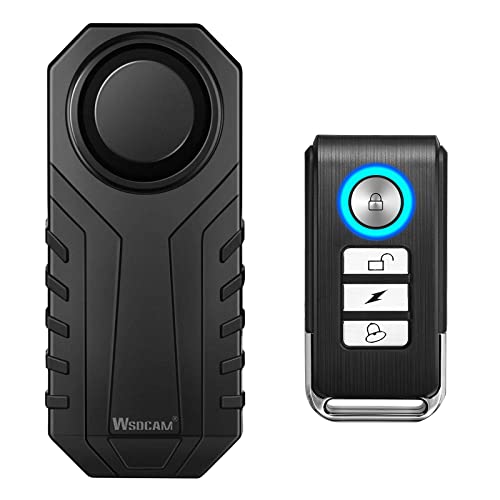
- Best for: Commuters who want the most tunable alarm and park within sight of the bike.
- Siren: up to 113 dB
- Sensitivity: 7 adjustable levels
- Volume: 3 adjustable levels
- Remote range: up to 66 ft

- Best for: E-bike and commuter riders who want rechargeable power and a longer-range remote.
- Siren: up to 110 dB
- Sensitivity: 7 adjustable levels
- Volume: 3 adjustable levels
- Remote range: up to 260 ft

- Best for: Riders who want a finder with distinct ringtones and an SOS tilt alert on a second bike or gate.
- Siren: up to 113 dB
- Sensitivity: 7 adjustable levels
- Vehicle search: 6 selectable ringtones
- SOS: tilt alert beyond 45 degrees
All 3 Picks at a Glance
| Product | Specs | Action |
|---|---|---|
| WSDCAM 113dB Bike Alarm with Remote |
| Check price on Amazon |
| WSDCAM USB Rechargeable Bike Alarm |
| Check price on Amazon |
| Onvian Wireless Anti-Theft Bike Alarm |
| Check price on Amazon |
Key takeaways
- Compare the best bike alarm systems with remotes: 113 dB vibration sirens, adjustable sensitivity, SOS tilt alerts and waterproof housings for bikes and e-bikes.
A bike alarm does not stop a thief from touching your bike. It changes what happens in the next ten seconds. The real decision is not how loud the siren is on paper, but whether the alarm reacts to the right kind of movement, stays quiet when a bus rumbles past, and can be armed or silenced from wherever you actually stand. Sensitivity range, remote reach and power source matter more than the headline decibel figure, because an alarm you stop using protects nothing.
This guide is for commuters who lock up outside shops and stations, e-bike owners whose bikes are too valuable to leave silent, and riders who store a bike in a shared garage or yard. The picks below are standalone vibration alarms with remotes, chosen from the product titles and specification details published on their Amazon listings.
Quick Picks
As an Amazon Associate we earn from qualifying purchases.
| Product | Best for | Key spec from title |
|---|---|---|
| WSDCAM 113dB Bike Alarm with Remote | Riders who want proven, adjustable protection | 113 dB siren with 7 sensitivity levels |
| WSDCAM USB Rechargeable Bike Alarm | Riders who hate swapping batteries | 110 dB siren with USB-C charging |
| Onvian Wireless Anti-Theft Bike Alarm | Riders who want a vehicle finder and SOS alert | 113 dB siren with tilt-triggered SOS |
How to Choose
Match the sensor to where you park
Every alarm here works the same basic way: a vibration sensor sits armed on the frame, and movement past a threshold triggers first a warning sound, then the full siren. What separates a useful alarm from an annoying one is how finely you can tune that threshold. Seven sensitivity levels let you run a gentle setting on a quiet residential street and a stricter one at a busy station rack where bags and handlebars brush past all day. If a listing offers only two or three levels, expect more false alarms in crowded places.
Decide how far the remote has to reach
The remote is the part you will use every single day, so its range shapes the whole experience. A short-range remote, around 66 feet, is fine when you park within sight of your desk or front door. Longer-range remotes, rated at 260 feet or more, let you arm and disarm from inside a café or an upstairs flat. Remember that published ranges are open-air maximums. Walls, cars and other bikes all shorten them, so treat the figure as a comparison tool rather than a promise.
Pick a power source you will actually maintain
Battery-powered alarms run for months on cheap AAA cells and ask nothing of you until a low-battery warning sounds. The catch is access: on strap-mounted units, changing cells can mean cutting cable ties and refitting the alarm. Rechargeable models remove that chore and usually slide off a bracket for a USB top-up, but they trade it for a different habit. A rechargeable alarm that sits uncharged in a drawer is worse than a battery model, so choose the routine that fits how you already treat your bike lights.
Check the weather rating before you mount it
A bike alarm lives outdoors, in road spray and rain, so the IP rating on the listing is worth reading properly. IP55 shrugs off splashes and light rain. IP65 adds dust sealing and withstands stronger water jets, which suits a bike that stays outside overnight or through winter commuting. No rating at this size means the housing is waterproof in the marketing sense only. Also look at how the unit mounts: a screw-on bracket resists tampering and removal better than adhesive tape alone.
The 3 Best Options
WSDCAM 113dB Bike Alarm with Remote
- Best for: Commuters who want the most tunable alarm and park within sight of the bike.
- Siren: up to 113 dB
- Sensitivity: 7 adjustable levels
- Volume: 3 adjustable levels
- Remote range: up to 66 ft
Commuters who want the most tunable alarm and park within sight of the bike.
The 66 ft remote range is the shortest here, and battery changes mean removing the unit from its straps or adhesive pad.
The original WSDCAM alarm, model SF22R, is the reference point for this whole category, and it earns that place through adjustability rather than raw noise. Seven sensitivity levels and three volume settings let you tune it to a quiet garage or a rattling city rack, and the remote handles arming, disarming and sensitivity changes without touching the unit. A vehicle-search function chirps the alarm so you can find your bike in a crowded stand, and an SOS mode, off by default, sounds the siren if the bike tilts beyond 45 degrees. It suits riders who park in varied places and want one alarm that adapts.
WSDCAM USB Rechargeable Bike Alarm
- Best for: E-bike and commuter riders who want rechargeable power and a longer-range remote.
- Siren: up to 110 dB
- Sensitivity: 7 adjustable levels
- Volume: 3 adjustable levels
- Remote range: up to 260 ft
E-bike and commuter riders who want rechargeable power and a longer-range remote.
At 110 dB it is the quietest siren here, and there is no clear charge indicator, so charging has to become a habit rather than a response.
This WSDCAM model answers the biggest complaint about the original: the batteries. A built-in 700mAh lithium cell charges over USB-C in about three hours and runs for one to three months depending on how often the alarm fires, with up to six months of standby. The housing is sealed to IP65, a step up from the battery model, and the upgraded remote reaches up to 260 feet. Three mounting options, a screw-on bracket, cable ties and double-sided tape, cover most frames, and the bracket lets the unit lift off for charging without cutting anything. It fits riders who already charge lights and want the alarm on the same routine.
Onvian Wireless Anti-Theft Bike Alarm
- Best for: Riders who want a finder with distinct ringtones and an SOS tilt alert on a second bike or gate.
- Siren: up to 113 dB
- Sensitivity: 7 adjustable levels
- Vehicle search: 6 selectable ringtones
- SOS: tilt alert beyond 45 degrees
Riders who want a finder with distinct ringtones and an SOS tilt alert on a second bike or gate.
The printed instructions are widely described as confusing, so budget a few extra minutes for the first setup and sensitivity adjustment.
The Onvian alarm covers the same core ground as the WSDCAM battery model, a 113 dB siren, seven sensitivity levels and a remote, then adds small quality-of-life touches. The vehicle-search function offers six ringtones, so your bike answers with a sound you recognize in a full rack. An SOS mode triggers when the bike tilts past 45 degrees, and a low-battery indicator warns you before the cells die silently. It is a sensible pick for riders who want the finder and fall-alert features of the category leader in a second unit for another bike, a gate or a trailer.
Which One Fits Your Situation
You lock up outside work or a station all day
Choose the WSDCAM USB Rechargeable. Its 260 ft remote lets you check and silence the alarm from inside the building, the IP65 housing handles daily weather, and the bracket mount is harder to knock off than tape. The rechargeable cell also suits a bike that gets used, and therefore disturbed, every day.
Your bike lives in a shared garage or yard
The battery-powered WSDCAM SF22R fits better here. Distances are short, so the 66 ft remote is no hardship, and months of standby on AAA cells means the alarm is still alive when you come back from a week away. Set sensitivity mid-range so neighbors’ doors and bins do not set it off.
You run two bikes, or a bike plus a gate or trailer
Pair the Onvian with either WSDCAM. Its six finder ringtones make it easy to tell which unit is answering, and the same arm-and-siren logic works on a fence gate or trailer door. Keeping the second unit on the same battery-check routine as the first avoids the classic dead-alarm surprise.
Your e-bike is the most valuable thing you own
Start with the WSDCAM USB Rechargeable for its sealing and range, but treat the alarm as one layer only. A high-value e-bike still needs a serious lock through the frame and, ideally, indoor storage overnight. The alarm’s job is to make noise early, while someone is still deciding whether your bike is worth the attention.
Common Mistakes
- Leaving the sensitivity on maximum. Most alarms ship at or near their highest setting, so the first week becomes a string of false alarms and the unit gets switched off.
- Believing the decibel figure is the whole story. Placement, sensitivity tuning and whether you hear the alarm matter more than the difference between 110 and 113 dB.
- Mounting with tape on a dirty or curved surface. A loose alarm rattles, triggers itself, and can be peeled off quietly; clean the frame and prefer the bracket or straps.
- Treating an alarm as a replacement for a lock. An alarm makes noise; it does not physically attach your bike to anything. Always lock the frame to a fixed object.
- Forgetting the remote’s battery. The alarm gets the attention, but a dead remote cell means walking back to the bike to disarm it by hand.
Frequently Asked Questions
Will a bike alarm stop someone stealing my bike?
Not by itself. An alarm is a deterrent and an alert: it makes a theft attempt loud and public, which pushes many opportunistic thieves to move on. It does not resist cutting tools. Pair any alarm here with a quality lock through the frame and a fixed object, and park where people can see and hear what happens.
How loud does a bike alarm need to be?
The alarms in this guide run from 110 to 120 dB at the top of the category, and anything from 110 dB up is painfully loud at arm’s length. In practice, tuning matters more than the last few decibels. A 110 dB alarm set to the right sensitivity will outperform a louder one that false-alarms so often its owner stops arming it.
Can one alarm work on an e-bike, a motorcycle or a scooter?
Yes. These are standalone vibration units that strap or stick to any frame, and the listings name bikes, e-bikes, motorcycles and scooters as compatible. Nothing connects to the vehicle’s electrics. Check the mounting space before ordering, because a unit that fits a bicycle down tube may sit awkwardly on a crowded motorcycle frame.
What does the SOS tilt function actually do?
If the bike leans or falls past roughly 45 degrees while the function is enabled, the alarm sounds as a call for attention, on the logic that a fallen rider may need help. It is switched off by default on the WSDCAM and Onvian units here, because a bike that gets knocked over in a rack would otherwise cry wolf. Enable it for solo rides, not for storage.
More from Amazon
Programs that pair well with the guide above. Offers and eligibility are set by Amazon and may change.
Free shipping on eligible items, Prime Video and more. Eligible new members can start with a free trial.
Start a Prime free trialAudiobooks and podcasts to listen to on the go. Eligible new members can start with a free trial.
Try Audible freeAd-free music streaming. Eligible new subscribers can start with a free trial.
Try Music Unlimited freeA free business account with business pricing and bulk-buying tools for work, shop or home office.
Create a business accountAs an Amazon Associate we earn from qualifying purchases.



Write Your Review
No reviews yet. Be the first to share your experience!