

Key takeaways
- The best charcoal chimney starters for most grill owners are the Weber Rapidfire for its fast airflow and comfortable heat shield, a large-capacity chimney for 22-inch kettles and bigger grills, and a compact 4–5-quart model for small balconies, portable grills,…
The best charcoal chimney starters for most grill owners are the Weber Rapidfire for its fast airflow and comfortable heat shield, a large-capacity chimney for 22-inch kettles and bigger grills, and a compact 4–5-quart model for small balconies, portable grills, and occasional use.
A chimney starter is a simple steel cylinder: newspaper or firelighter burns underneath, air enters through lower vents, and the rising heat ignites charcoal above. The differences that matter are capacity, steel thickness, handle design, airflow, and how well the starter survives repeated high-temperature use.
Our top picks


As an Amazon Associate we earn from qualifying purchases at no extra cost to you. Ratings are shown as listed on Amazon.
Best charcoal chimney starters by grilling situation
| Best for | Recommended type | Useful capacity | Why it fits | Main compromise |
|---|---|---|---|---|
| Small portable grill or balcony cooking | Compact 4–5-quart chimney | About 2–3 lb of briquettes | Uses less fuel and stores easily | May need two loads for a full-size kettle |
| Typical 18–22-inch kettle | Standard 5–6-quart chimney | About 3–5 lb of briquettes | Good balance of speed, control, and storage | Not always enough for a large two-zone fire |
| 22-inch kettle, flat-top grill, or frequent entertaining | Large 6–7-quart chimney | About 5–6 lb of briquettes | Lights a full cooking load in one batch | Heavier and hotter to handle |
| Large charcoal grill or smoking session | Extra-large chimney, roughly 7–9 quarts | About 6–8 lb of briquettes | Reduces repeated loading and waiting | Takes more storage space and fuel when partly filled |
Capacity is normally described in quarts, pounds, or an approximate number of briquettes. Those measurements are not interchangeable: lump charcoal varies substantially in size, while uniform briquettes pack more predictably. A chimney advertised for 100 briquettes may hold considerably fewer large pieces of lump charcoal.
Head-to-head comparison of established chimney starters
| Model or type | Approximate capacity | Construction and design | Heat protection | Best match |
|---|---|---|---|---|
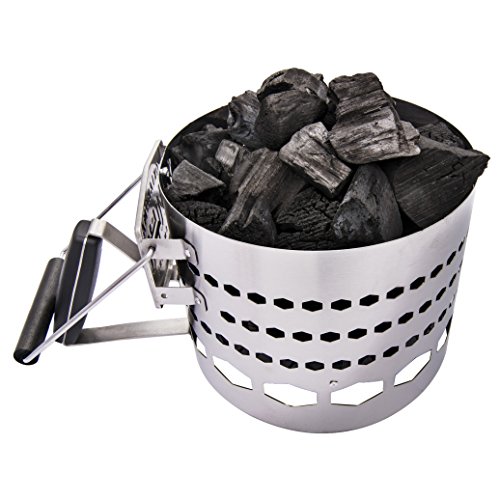
| Weber Rapidfire Chimney Starter | About 5–6 quarts; roughly 100 briquettes | Galvanized steel body with a high-mounted handle and cone-shaped interior | Secondary grip and heat shield keep the pouring hand farther from the body | Most 18–22-inch kettle grills and buyers prioritizing quick, repeatable lighting |
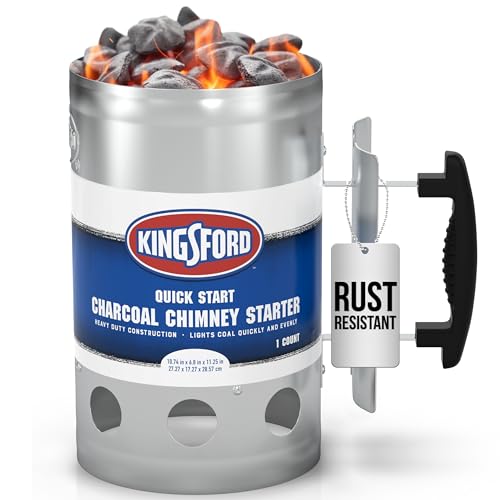
| Kingsford Large Charcoal Chimney Starter | About 5–6 quarts; roughly 100 briquettes | Steel cylinder with large lower vents and a two-handle pouring arrangement | Heat shield and separate support handle improve control when full | Full-size kettles and a lower-cost standard-capacity option |
| Compact 4–5-quart chimney starter | About 2–3 lb of briquettes | Shorter steel body with a smaller loading chamber | Quality varies; a secondary grip is especially valuable because the body is held closer to the hand | Portable grills, small households, and limited storage |
| Large 6–7-quart chimney starter | About 5–6 lb of briquettes | Taller or wider steel body with more vent area | Should include a shielded primary handle and a rigid secondary handle | Large kettles, cooking for groups, and two-zone fires |
The Weber Rapidfire is the safest general recommendation when fast ignition and handling matter more than maximum volume. Its tall shape creates a strong draft, while the second grip makes it easier to pour glowing coals accurately. The Kingsford Large is a practical alternative for a standard kettle, particularly when a familiar, full-size chimney is preferred without moving to an oversized model.
A generic compact chimney can be the better choice if your grill only needs 30 to 50 briquettes. Buying a large starter for a small grill does not make charcoal ignite proportionally faster; it may simply encourage overfilling and waste fuel. For a 26-inch kettle, a large chimney is more convenient, but two standard loads can provide better control than one overloaded cylinder.
What separates a fast chimney from a frustrating one
Capacity and grill sizing
Estimate the fuel needed before choosing the chimney. A small 18-inch kettle often uses around 40 to 60 briquettes for a moderate two-zone cook. A 22-inch kettle may need 60 to 90, depending on the food, weather, and cooking duration. A full bed for high-heat searing can require more.
As a rule, choose a chimney that holds at least 80 percent of your normal fuel load in one batch. If a typical cook requires 70 briquettes and your starter holds about 45, every session involves a second ignition cycle. That adds roughly 10 to 20 minutes and increases the amount of partially lit charcoal left over.
Steel thickness and heat retention
Thin sheet steel heats quickly but can warp, discolor, or develop weak spots around the lower vent holes. A heavier body retains heat more evenly and usually tolerates frequent use better, although it also weighs more and takes longer to cool. Product listings often omit gauge thickness, so inspect the rim, handle brackets, and vent edges: these areas reveal flimsy construction faster than the flat sidewall.
For weekly grilling, a standard galvanized or aluminized-steel chimney is usually sufficient. For several uses per week, look for reinforced handle mounts, a stable base ring, and a body that does not flex when lifted. Stainless steel resists rust particularly well, but the handle and fasteners can still deteriorate if the starter is left outside.
Handle heat protection
A single plastic-covered handle is less useful than a two-handle design. The main handle should be separated from the hot cylinder, while the smaller front handle supports the weight during pouring. A heat shield between the body and grip reduces radiant heat but does not make the handle safe to touch indefinitely.
Use insulated heat-resistant gloves when moving a full chimney. Keep children, dry grass, vinyl siding, and other combustible materials away from the pouring area. The handle is a control feature, not a substitute for safe clearance.
Airflow and ignition speed
Lower vents should be numerous, unobstructed, and large enough to supply oxygen beneath the fuel. Upper vents help hot gases move through the charcoal. A chimney with a tapered internal cone generally concentrates heat toward the upper briquettes, while excessive vent area can make the bottom burn fiercely without evenly lighting the top.
With dry briquettes, a well-designed chimney commonly produces pour-ready coals in about 15 to 25 minutes. Cold temperatures, wind, damp charcoal, and a tightly packed load can extend that time. Lump charcoal may ignite sooner, but its irregular pieces can block vents or spill through large openings.
Decision matrix: which chimney should you buy?
| Your situation | Prioritize | Best choice |
|---|---|---|
| Budget-conscious, occasional grilling | Standard capacity, stable base, usable heat shield | Standard 5–6-quart chimney |
| New to charcoal | Clear two-handle design and predictable airflow | Weber Rapidfire or a similar standard chimney |
| Limited storage | Short body and a hanging loop | Compact 4–5-quart model |
| Grilling for six or more people | One-load capacity and rigid handles | Large 6–7-quart model |
| Frequent weekly use | Thicker steel, reinforced brackets, rust resistance | Heavy-duty standard or large stainless-steel chimney |
How to use a chimney starter efficiently
-
Place the chimney on a noncombustible surface, such as a charcoal grate or concrete patio, away from overhanging materials.
-
Put one or two paraffin firelighter cubes beneath the lower vents. They burn more consistently than loosely crumpled paper and avoid ash blowing around the grill.
-
Fill the chimney to the desired level without compressing the charcoal. Leave enough air gaps for the draft to travel upward.
-
Light the starter from the side and watch for flames emerging through the top layer. When the upper briquettes show gray edges and the center is glowing, the load is usually ready.
-
Pour slowly while holding the main and support handles. Arrange the coals for direct heat, or bank them to one side for two-zone cooking.
-
Close the grill lid after positioning the cooking grate. This stabilizes the temperature and prevents a sudden wind-fed flare-up.
Do not use gasoline, lighter fluid, or other volatile liquids in a chimney. They can create dangerous flashback and leave unwanted odors. Keep the chimney upright while lighting; tipping it can spill burning fuel through the vents.
Durability, cleaning, and ownership costs
The lower rim, vent holes, handle brackets, and base are usually the first parts to wear. Repeated thermal cycling can loosen rivets or bolts, while ash mixed with moisture accelerates rust. After the chimney is completely cold, empty ash and unburned fragments. Brush loose residue away, but avoid soaking a galvanized-steel body; trapped water can rust the seams and fasteners.
Store the starter under cover and never leave hot charcoal inside it. A chimney used once a week for three years sees roughly 150 heating cycles. A $20–$40 standard model therefore costs about 13–27 cents per use before replacement parts. A larger or stainless model costing $35–$60 may be more economical for frequent cooks if it lasts several additional seasons.
Replace a chimney when the body is visibly warped, the base is unstable, vents are collapsing, or a handle mount is loose. Do not rely on a repaired handle when carrying several pounds of glowing charcoal.
Final recommendation
Choose a standard 5–6-quart chimney, such as the Weber Rapidfire or Kingsford Large, for the best balance of capacity, airflow, ignition speed, and handling on common kettle grills. Select a compact model when storage and small fuel loads matter more than one-batch convenience. Choose a reinforced 6–7-quart chimney for large grills and frequent group cooking, but confirm that its second handle, base, and vent openings are as substantial as its capacity.





Write Your Review
No reviews yet. Be the first to share your experience!