

Key takeaways
- Prefer folded or rounded edges over sharp seams where crumbs can lodge.
- Choose a removable lid or door if the mechanism is likely to collect flour.
- Look for silicone or rubber feet that are replaceable or securely bonded.
- Check that the ventilation holes are large enough to wipe clean.
- Avoid interior fabric liners unless they can be removed and washed.
- Use brushed steel if visible fingerprints would bother you.
The best stainless steel bread box for kitchen use is usually a 304-grade, 18/8 or 18/10 steel box with controlled ventilation, a roll-top or lift-up lid, and enough capacity for your household’s weekly bread routine.
Our top picks
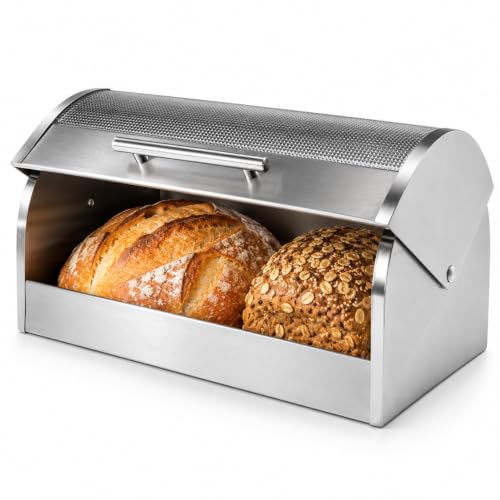
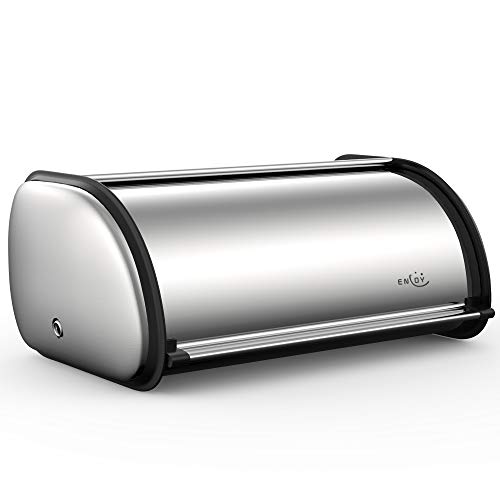

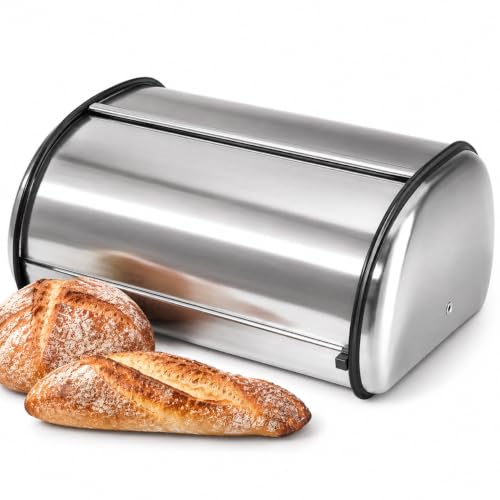
As an Amazon Associate we earn from qualifying purchases at no extra cost to you. Ratings are shown as listed on Amazon.
Quick picks by kitchen and buying priority
| Kitchen situation | Best choice | Recommended size | Why it fits |
|---|---|---|---|
| Small apartment or narrow counter | Compact stainless steel box | 12–15 in wide, 6–8 in deep | Uses less counter space while holding one standard loaf |
| Two people, occasional bread | Single-loaf ventilated box | 18–22 L internal volume | Enough room without leaving excessive empty air around the loaf |
| Family using sliced bread daily | Large lift-lid or roll-top box | 28–35 L internal volume | Accommodates two loaves, buns, or a loaf plus pastries |
| Freshly baked crusty bread | 304 stainless steel with generous vents | At least 25 L | Allows moisture to escape and reduces condensation |
| Lowest purchase price | 430 stainless steel, simple hinged lid | 18–25 L | Usually costs less, though it needs more careful drying |
Stainless steel grades: 304 versus 430
Stainless steel grade affects corrosion resistance, appearance, magnetism, and usually price. Many bread boxes use one of two common grades.
304 stainless steel: the safer long-term choice
304 stainless steel is commonly described as 18/8 or 18/10, referring broadly to its chromium and nickel content. It offers strong resistance to kitchen humidity, acidic residue, and ordinary staining. Choose it if the box will sit near a sink, be cleaned frequently, or hold warm bread that releases substantial moisture.
A brushed 304 finish is especially practical because small fingerprints and fine scratches are less visible than on a mirror-polished surface. It is not immune to rust: salt deposits, trapped water, and harsh chlorine cleaners can still cause discoloration.
430 stainless steel: practical but less forgiving
430 stainless steel is a ferritic grade with good heat and general corrosion resistance, but it contains little or no nickel compared with 304. It is often magnetic and can be less expensive. For a dry countertop and routine bread storage, a well-made 430 box can be perfectly serviceable.
Choose 430 when budget matters and the box can be kept dry. Avoid leaving damp crumbs or condensation inside for days, particularly around seams, hinges, and the bottom edge. If a product listing does not identify the grade, treat the steel specification as unknown rather than assuming it is 18/10.
Ventilation matters more than a polished finish
Bread boxes do not preserve bread by sealing it completely. A fully airtight container can trap moisture from warm bread, making crusts soft and increasing the chance of mold. An uncovered loaf, however, loses moisture quickly and becomes stale.
Look for several small vents or a deliberately loose-fitting lid. Vents placed high on the rear or sides allow humid air to escape without exposing the bread as much as a large opening. A box intended for crusty artisan bread should have more airflow than one used mainly for packaged sandwich bread.
Do not place hot bread straight into a closed steel box. Let a loaf cool until it is no longer releasing visible steam. For a typical 700–900 gram loaf, that often means waiting roughly 60–120 minutes on a rack, depending on its shape and crust. Closing it earlier can create condensation on the lid and sides.
Capacity and countertop footprint
External dimensions can be misleading because the lid mechanism and rounded corners reduce usable space. Measure the box’s internal width, height, and depth, then compare those dimensions with your bread rather than relying only on a stated litre capacity.
A standard sliced loaf is commonly around 11–13 inches long, 5 inches wide, and 5 inches high. A compact box that is only 10 inches long may technically be marketed for bread but force the loaf to bend or be stored diagonally. For a bakery-style boule, measure the widest point; height alone is not enough.
| Box category | Typical external size | Approximate capacity | Typical empty weight | Best use |
|---|---|---|---|---|
| Compact | 12–15 × 6–8 × 8–10 in | 12–18 L | 1.5–2.5 lb | One small loaf or a limited counter |
| Medium | 16–18 × 8–10 × 10–12 in | 18–28 L | 2–3.5 lb | One large loaf plus rolls |
| Large | 18–22 × 10–12 × 11–14 in | 28–40 L | 3–5 lb | Two loaves or frequent home baking |
Allow extra clearance above a lift lid and behind a roll-top door. A box that measures 18 inches wide may need 20 inches of usable counter width once the lid is opened or the door is pulled back. If overhead cabinets are low, a front-opening roll-top design can be more convenient than a hinged lid.
Head-to-head: roll-top, hinged, and lift-up designs
Roll-top boxes
A roll-top door uses little vertical clearance and is useful beneath wall cabinets. The trade-off is that the sliding tracks can collect crumbs. Inspect whether the door is removable and whether the tracks are open enough to wipe with a cloth or narrow brush.
Hinged-lid boxes
Hinged lids are simple and usually easy to operate with one hand. They need clearance above the box and can be awkward if placed directly under cabinets. A lid stop or rear hinge can also become a wear point, so check that the hinge is metal or reinforced rather than thin painted sheet material.
Lift-up lids
Lift-up designs provide the clearest access and are convenient for households that use bread several times a day. They take the most vertical space and may need both hands if the box is light. Non-slip feet help prevent the container from moving across the counter.
Ease of cleaning and durability
The steel body is rarely the first part to fail. Hinges, sliding tracks, rubber feet, plastic handles, and painted logos usually show wear first. A box with a slightly heavier body and fewer decorative parts may last longer than a cheaper box with a thin lid and complicated trim.
- Prefer folded or rounded edges over sharp seams where crumbs can lodge.
- Choose a removable lid or door if the mechanism is likely to collect flour.
- Look for silicone or rubber feet that are replaceable or securely bonded.
- Check that the ventilation holes are large enough to wipe clean.
- Avoid interior fabric liners unless they can be removed and washed.
- Use brushed steel if visible fingerprints would bother you.
For normal maintenance, remove crumbs every few days, then wipe the interior with warm water and a small amount of dish detergent. Dry all surfaces immediately, especially the bottom seam and hinge area. For dried residue, let a damp cloth sit on the spot for several minutes rather than scraping with steel wool. Chlorine bleach, abrasive scouring powder, and harsh oven cleaner can damage stainless steel.
A practical sizing calculation
Suppose your loaf measures 12 inches long, 5 inches wide, and 5 inches high. Its rectangular bounding volume is 300 cubic inches, or about 4.9 litres. Bread is not a rigid block, and ventilation requires space around it, so a box should not be selected at only 5 litres. Adding approximately 50–100% clearance gives a sensible target of about 7.5–10 litres of usable internal space for one loaf.
In practice, many single-loaf boxes advertise 12–18 litres because their dimensions also accommodate rolls, uneven crusts, and hand access. If you regularly store two loaves, doubling the volume is not always enough: choose a wider box so the loaves do not press against one another and restrict airflow.
What should you spend?
General market pricing in 2026 is roughly $20–$35 for a basic 430 stainless steel box, $30–$60 for a sturdier medium box, and $60–$100 or more for a large 304-grade model with a better mechanism and heavier construction. Price alone does not prove the steel grade or ventilation quality.
For most kitchens, the best value is a medium 304 or clearly identified 18/8 box with a brushed finish, removable or accessible lid mechanism, and at least two ventilation areas. Spend more for capacity, smoother operation, and stronger hinges—not simply for mirror-polished metal or decorative lettering.
Final buying recommendation
Choose a compact 12–18 litre box for a small kitchen and one regular loaf, a 18–28 litre 304 box for most two-person households, and a 28–40 litre ventilated model for families or frequent bakers. Prioritize the correct internal dimensions, identifiable stainless grade, useful airflow, and cleanable mechanisms. Those details have more effect on daily satisfaction and bread storage than the finish or appearance alone.

Write Your Review
No reviews yet. Be the first to share your experience!