

Key takeaways
- Choose the REP FT-5000 2.0 if you want a broadly capable dual-stack trainer without moving into the largest commercial-style footprint. Choose the Rogue FM-6 if heavy resistance, frequent use, and a robust frame outweigh price and installation difficulty. Choose a compact or wall-mounted system when…
The best functional trainers for most home gyms are the REP Fitness FT-5000 2.0 for balanced value, the Rogue FM-6 for heavy, commercial-style training, and a compact adjustable-pulley trainer when ceiling height or floor space is the limiting factor.
A functional trainer is only useful if its cables reach the positions you actually use, its resistance suits your strength, and the frame fits the room with enough clearance to assemble and operate it safely. The most important comparison is not the maximum advertised weight; it is the combination of cable travel, pulley height, resistance ratio, footprint, and long-term serviceability.
Our top picks
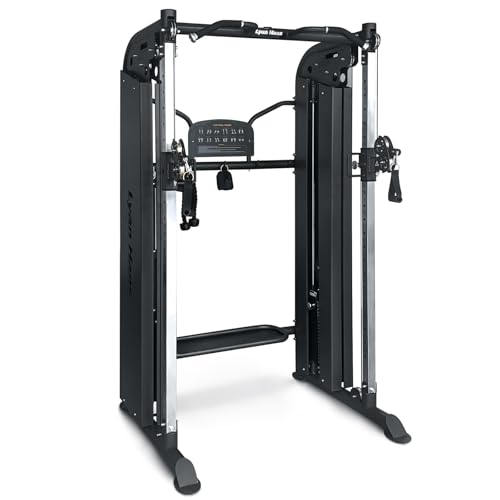
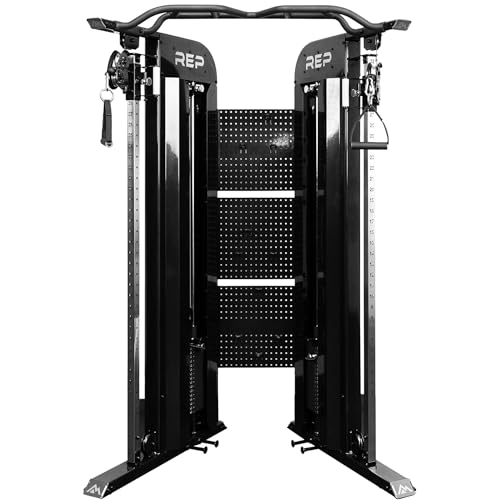

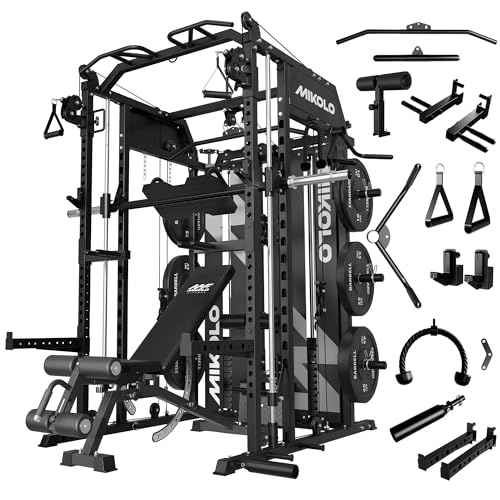
As an Amazon Associate we earn from qualifying purchases at no extra cost to you. Ratings are shown as listed on Amazon.
Best functional trainers by situation
| Situation | Best fit | Why it makes sense | Main compromise |
|---|---|---|---|
| One machine for most full-body workouts | REP Fitness FT-5000 2.0 | Two independent weight stacks, broad pulley adjustment, pull-up station, and a relatively compact commercial-style layout | Heavy and difficult to assemble in a small room |
| Frequent use and heavy training | Rogue FM-6 Functional Trainer | Robust steel construction, dual 250-pound stacks, and many cable positions | High cost, substantial weight, and demanding delivery |
| Low ceiling or limited floor area | Low-profile adjustable-pulley trainer | Usually narrower and shorter than a full dual-stack unit; easier to place against a wall | Often has a smaller weight stack and fewer integrated stations |
| Budget-conscious beginner | Plate-loaded cable crossover | Lower purchase price and no fixed stack to wear out | Requires weight plates, takes longer to change resistance, and may feel less smooth |
| Apartment or rented home | Wall-mounted cable system | Small floor footprint and no large rear frame | Requires suitable wall structure and careful installation |
Head-to-head: the important specifications
| Trainer or category | Approximate dimensions | Resistance | Pulley adjustment | Typical cable ratio |
|---|---|---|---|---|
| REP FT-5000 2.0 | About 80.5 in high × 58 in wide × 36 in deep | Two 220 lb weight stacks | Multiple vertical positions on each side | Commonly configured as 2:1 for more cable speed |
| Rogue FM-6 | About 80 in high × 56 in wide × 40 in deep | Two 250 lb weight stacks | Extensive independently adjustable pulley positions | 2:1 on the functional trainer pulleys |
| Compact selectorized trainer | Usually 72–82 in high × 40–55 in wide × 20–35 in deep | Commonly two 100–200 lb stacks | Often 10–20 positions per side | 1:1 or 2:1, depending on the model |
| Plate-loaded cable crossover | Usually 80–90 in high × 40–60 in wide × 20–30 in deep | Limited by the manufacturer’s plate-load rating | Often 10–15 positions per side | Frequently 2:1 |
Dimensions and pulley ratios vary by configuration, so confirm the current manufacturer specification before ordering. The numbers above are decision-making ranges rather than a substitute for the installation manual.
Why cable ratio changes the experience
With a 2:1 ratio, the handle generally moves about twice as far as the weight stack and feels smoother and faster, but the effective resistance at the handle is approximately half the selected stack weight. A 100-pound setting may therefore provide roughly 50 pounds of handle resistance before friction and mechanical differences.
A 1:1 pulley feels heavier at the same stack number and is useful for rows, pulldowns, and strength work, but it provides less cable travel. Check the ratio before comparing a “220-pound stack” with a “200-pound stack” from another brand. The larger printed number is not automatically the stronger machine.
What separates a good full-body trainer from a frustrating one
Cable travel and pulley height
Look for enough travel to perform low rows, mid-height presses, chest flyes, face pulls, high cable curls, and standing pulldowns without the cable reaching its stop. A practical target is roughly 70–80 inches of vertical pulley adjustment on a full-size machine. Shorter systems can work well, but the lowest position may be too high for certain leg and rowing movements.
Independent pulleys matter. If both handles share one adjustment mechanism, changing from a fly to a one-arm press can be inconvenient. Separate carriages let you set one side high and the other low for movements such as split-stance presses, rotational pulls, and asymmetric exercises.
Resistance range
For general home training, two stacks in the 150–220-pound range are sufficient for many users, particularly with a 2:1 system. Stronger users, frequent family use, and heavy rows or pulldowns justify 250-pound stacks or a 1:1 option. Beginners should not overpay for maximum resistance they cannot control; smooth increments and a low starting weight are more useful during the first months.
Footprint and ceiling clearance
Measure the room, not just the machine. Add at least 24 inches in front of the trainer for standing cable work, and more if you plan to use a bench. A full-size unit that is 36–40 inches deep can require 7–8 feet of usable depth once the exercise area is included.
Ceiling clearance is equally important. An 80-inch frame may fit beneath an 84-inch ceiling, but assembly can be impossible if the top crossmember must be raised vertically. For an 8-foot ceiling, check the manual for a horizontal or staged assembly method. Also account for flooring thickness, overhead lights, sprinkler heads, and pull-up clearance.
Attachments and useful accessories
A sensible starter set includes two single handles, a straight bar, a short bar, an ankle strap, a triceps rope, and a long lat bar. A bench is useful but not always included. A belt squat attachment, low-row footplate, landmine, or storage horns can expand the machine’s usefulness, but confirm compatibility before buying because attachment interfaces are not universal.
Assembly and ownership realities
Expect a full dual-stack trainer to weigh several hundred pounds and require two or more people for safe assembly. Before delivery, clear the route through doors and turns. Measure the narrowest point, not only the room entrance. Assemble on protective flooring, leave access to the rear panels, and do not remove shipping braces until the frame is stable.
A practical setup sequence is:
- Position and level the base before tightening all frame bolts.
- Install the guide rods and weight stacks without forcing misaligned holes.
- Route each cable exactly as shown in the manual; one incorrect pulley path can change resistance and create excessive wear.
- Cycle every pulley through its full range before loading the stack.
- Inspect cable ends, retaining clips, and safety stops after the first few sessions, when bolts can settle.
The first wear points are usually cable sleeves, pulleys, guide-rod bushings, attachment clips, and adjustment pins rather than the steel frame. Wipe sweat from painted surfaces, keep guide rods clean, and follow the manufacturer’s lubrication instructions. Do not spray general-purpose oil onto cables or weight-stack surfaces unless the manual permits it; excess lubricant can attract grit.
Common mistakes include slamming the stack, pulling the handle sideways against a pulley, leaving a cable twisted, and using a handle with a damaged carabiner. These habits can shorten cable and pulley life. Keep the stack shrouds installed where provided, and replace a frayed cable rather than wrapping it with tape.
Worked value calculation
Suppose a functional trainer costs $2,000 and is used four times per week for five years. That is approximately 1,040 sessions, or about $1.92 per session before maintenance and delivery. If a cheaper $1,200 trainer is used only twice per week because its pulley positions are inconvenient, it produces about 520 sessions over the same period, or $2.31 per session.
The calculation is not a promise of durability; it shows why the least expensive machine is not always the lowest-cost choice. Frequency of use, usable cable travel, and access to replacement parts matter more than a small difference in the advertised stack capacity.
Bottom line
Choose the REP FT-5000 2.0 if you want a broadly capable dual-stack trainer without moving into the largest commercial-style footprint. Choose the Rogue FM-6 if heavy resistance, frequent use, and a robust frame outweigh price and installation difficulty. Choose a compact or wall-mounted system when the room is the constraint, and choose a plate-loaded crossover only if changing plates is acceptable.
Before buying, verify five measurements: the machine’s assembled height, the clearance needed for assembly, the full exercise depth, the actual cable ratio, and the lowest and highest pulley positions. Those details predict whether the trainer will support full-body workouts far more reliably than a long attachment list or a large maximum-weight number.

Write Your Review
No reviews yet. Be the first to share your experience!