

Key takeaways
- Allow for movement: You should be able to raise your arms, rotate your torso, and lift your knees without the jacket or trousers pulling tight.
- Check the cuffs: Sleeves and trouser legs should not cover the hands or trail on the floor. Competition rules may set minimum and maximum lengths.
- Account for shrinkage: Cotton can shrink, especially with hot washing or tumble drying. A cotton-polyester blend often shrinks less, but follow that specific brand’s care instructions.
- Do not guess at “room to grow”: For children, a little length allowance is practical; oversized cuffs and hems can snag or obstruct movement.
Best Karate Gis for Training & Competition
The best karate gi for most adults is a midweight, cotton-rich uniform with reinforced seams and enough room to move; choose a lighter, quicker-drying blend for frequent training, and a competition-approved cut and fabric weight for tournaments. For children, prioritize a comfortable fit with room to grow—but not so much excess fabric that sleeves or trouser legs interfere with practice.
Quick picks by situation
| Situation | Best gi type | Why it fits | Check before buying |
|---|---|---|---|
| First gi or occasional classes | Lightweight cotton-polyester, about 6–8 oz (170–225 g/m²) | Usually affordable, easier to wash and quicker to dry than heavy cotton | Confirm your dojo accepts the cut and color |
| Training two or three times weekly | Midweight cotton-rich, about 8–10 oz (225–285 g/m²) | A useful balance of movement, durability, and structure | Check shrinkage guidance and seam reinforcement |
| Frequent or demanding practice | Heavier cotton or reinforced blend, about 10–14 oz (285–400 g/m²) | More substantial fabric can stand up to repeated gripping and washing | Expect more heat, weight, and drying time |
| Kata competition | Structured, heavier gi in the required cut | A crisp silhouette and audible technique are valued in some kata settings | Verify the event’s current uniform rules; approval is not universal |
| Kumite competition | Lightweight, roomy competition cut | Allows fast movement and reduces excess heat | Check sleeve, trouser, and jacket requirements for the event |
| Growing child | Lightweight, easy-care gi in a close but comfortable size | Lower weight is manageable, and quicker drying helps between classes | Do not buy so large that hems drag or cuffs cover hands |
Weight labels are not perfectly standardized: brands may describe fabric in ounces per square yard or grams per square metre, and some list jacket weight rather than the full uniform. Treat the ranges as a comparison guide, not a guarantee of identical feel.
Our top picks


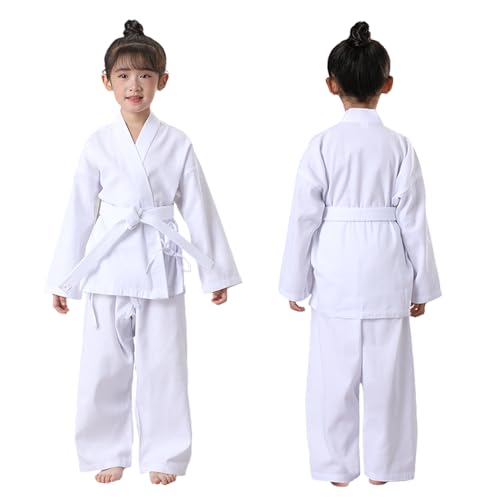
As an Amazon Associate we earn from qualifying purchases at no extra cost to you. Ratings are shown as listed on Amazon.
How to choose fabric weight and weave
Lightweight: easy movement and lower maintenance
A lightweight gi is a sensible first purchase, especially for children, beginners, hot dojos, and people training several times a week. It tends to dry sooner and feel less restrictive. The trade-off is that thin cloth may show wear sooner at high-friction points, particularly the knees, inner thighs, collar, and underarms. A polyester blend can resist wrinkling and often shrinks less than untreated cotton, though it may feel warmer or less natural against the skin.
Midweight: the versatile training choice
For regular adult classes, midweight fabric is often the safest all-round choice. A cotton-rich weave has a traditional feel, while a blended fabric can be easier to care for. Look for tightly woven cloth, double stitching at stress points, reinforced knees, and a collar that holds its shape. A uniform’s stitching and patterning matter as much as its listed weight: a heavy gi with weak seams is not automatically durable.
Heavyweight: structure at the cost of comfort
Heavy gis are most useful when you specifically want a structured kata uniform or expect substantial wear. They can take longer to dry, feel hot during conditioning, and be tiring for younger students. Heavier fabric does not necessarily create a better competition sound or performance; technique, fit, and the event’s rules remain decisive. Avoid paying for a competition-weight gi if your classes are casual and your instructor has no such requirement.
Weave affects the hand and feel of the uniform. A rice-grain or “pearl” weave is commonly associated with a more textured, substantial jacket; a plain or finer weave can feel lighter and smoother. Names are not consistent across manufacturers, so compare the stated weight, fabric composition, reinforcement, and return or exchange policy rather than relying on the weave name alone.
Fit, shrinkage, and sizing: what listings leave out
Karate gi sizing is commonly based on height, but body shape and brand patterns vary. Before ordering, compare your height and chest or waist measurements with the brand’s chart. Check whether the trousers have an elastic waist, drawstring, or both, and whether the jacket is sold as a set or separately. If you have a long torso, broad shoulders, or fuller hips, separate sizing can help avoid a jacket that pulls or trousers that bind.
- Allow for movement: You should be able to raise your arms, rotate your torso, and lift your knees without the jacket or trousers pulling tight.
- Check the cuffs: Sleeves and trouser legs should not cover the hands or trail on the floor. Competition rules may set minimum and maximum lengths.
- Account for shrinkage: Cotton can shrink, especially with hot washing or tumble drying. A cotton-polyester blend often shrinks less, but follow that specific brand’s care instructions.
- Do not guess at “room to grow”: For children, a little length allowance is practical; oversized cuffs and hems can snag or obstruct movement.
A simple fit check after washing is more useful than relying on the size tag: lay the gi flat, compare sleeve and trouser length with the brand’s chart, then have the student try it on and perform a few basic movements. If it is already borderline long before its first wash, it may become either too short after shrinkage or inconveniently loose if you size up further.
Care and durability over a season
The first parts to show wear are usually the knees, inner thighs, collar, and seams where the jacket and trousers experience repeated pulling. Reinforced panels help, but they cannot compensate for poor fit: fabric that is constantly stretched or dragging across the floor wears faster.
- Wash promptly after training to limit odor and sweat buildup; turn the gi inside out if the care label permits.
- Use the temperature specified by the manufacturer. Hot water may make a cotton gi shrink unpredictably, while overly aggressive washing can stress stitching.
- Air-dry when possible. High heat can shorten the life of cotton fabric and elastic waist components.
- Keep a spare gi if you train on consecutive days. A fully dry uniform is more comfortable and less likely to develop persistent odor than one worn damp.
- Inspect knee panels, drawstrings, and seams every few weeks. Small repairs are easier before a seam opens during class.
For example, if a midweight gi costs $60–$100 and is worn three times a week for a year, that is about 156 sessions, or roughly $0.38–$0.64 per session before laundering. A second uniform costs more upfront but can reduce rushed washing and damp-gi wear when training frequently.
Which type should you buy?
Choose a lightweight blend for a beginner, a child, or a hot training environment; a midweight cotton-rich gi for most regular adult practice; and a heavier, structured option only when your training needs or competition rules call for it. For tournaments, ask your instructor or check the organizer’s current rules before buying: a gi suitable for everyday karate may not meet a particular event’s requirements.
The best karate gis are not simply the heaviest or most expensive. The right one matches the student’s training frequency, the dojo’s expectations, the climate, and a fit that stays comfortable after washing. If possible, compare the size chart and care label before ordering, and favor solid construction over extra weight or decorative details.

Write Your Review
No reviews yet. Be the first to share your experience!