

Our Top Picks



The X-Sense SC07-W is the best all-round combination smoke and carbon monoxide alarm for most homes in 2026, the First Alert SCO5CN is the dependable battery-powered pick, and the Kidde Smart Smoke + CO alarm is the best Wi-Fi option that needs no hub. For a hardwired house, a Kidde hardwired combination alarm with battery backup is the standard choice, and for a smart-home upgrade the First Alert SC5 is the model positioned to take over from the discontinued Google Nest Protect.
This is a safety purchase, so the ranking below favors certification, sensor design, power backup and end-of-life warnings over app features. A smart alarm that sends a phone alert is nice; an alarm that is correctly placed, powered and replaced on schedule is what saves lives.
How we chose
This guide is research-based. We compared manufacturer specification pages, safety standards and 2026 buyer roundups. We did not run any physical evaluation, and we make no claim about how any unit behaves in a real fire. A model qualified only if it is currently sold, carries the standard safety listings for its type, and offers a clear power and replacement story. When a spec could not be confirmed for a specific model, we describe the feature by class instead of inventing a number.
- Listings: smoke alarms should be listed to UL 217, and carbon monoxide alarms to UL 2034 (or the combined standards).
- Sensing: photoelectric smoke sensing responds faster to slow, smoldering fires; dual-sensor units add ionization for fast flaming fires.
- Power: sealed 10-year battery, replaceable battery, or hardwired with battery backup.
- Interconnection: when one alarm sounds, all of them should sound.
- End-of-life warning: the unit must signal when its sensors expire.
Smoke alarm and CO alarm basics
Why both hazards matter
Smoke alarms respond to fire. Carbon monoxide (CO) alarms respond to an odorless gas produced by fuel-burning appliances, fireplaces, vehicles and generators. A smoke alarm will not detect CO, and a CO alarm will not detect smoke, so you need either two devices or a combination unit that does both.
Photoelectric, ionization and dual-sensor
Photoelectric alarms use a light beam and are generally quicker at detecting smoldering fires and less prone to nuisance alarms near kitchens. Ionization alarms are generally quicker at detecting fast, flaming fires. Dual-sensor alarms combine both. Fire-safety organizations commonly recommend photoelectric technology or dual-sensor coverage in homes, so we favor models that disclose their sensor type.
Where to put them
Common code-based guidance, which you should confirm with your local fire authority, is a smoke alarm inside every sleeping room, outside each sleeping area, and on every level including the basement. CO alarms belong outside each separate sleeping area and on every level. Keep smoke alarms away from bathrooms and cooking appliances to reduce false alarms, and mount ceiling alarms away from corners where dead air collects.
How long they last
Smoke alarms should be replaced when they reach the end of their service life, commonly 10 years from the manufacture date printed on the back. CO sensors wear out sooner on many models, and lifespans vary by product, so read the label. An alarm that chirps an end-of-life pattern needs replacement, not just a new battery.
CO alarm response thresholds
UL 2034 sets how long a CO alarm may take to sound at given concentrations, so the alarm does not trip on harmless trace amounts but does warn before dangerous exposure.
| CO concentration | Alarm must sound within |
|---|---|
| 70 ppm | 60 to 240 minutes |
| 150 ppm | 10 to 50 minutes |
| 400 ppm | 4 to 15 minutes |
A digital display (as on the Kidde Nighthawk) can show a low-level reading below the alarm threshold, which helps you spot a slowly developing problem such as a faulty appliance. It does not replace the alarm itself.
Comparison at a glance
| Model | Type | Power | Connectivity |
|---|---|---|---|
| X-Sense SC07-W | Smoke + CO combo | Sealed long-life battery | Wireless interconnect |
| First Alert SCO5CN | Smoke + CO combo | Battery | Standalone |
| First Alert SC5 | Smart smoke + CO | Per model: hardwired or battery variants | Wi-Fi, Google Home support |
| Kidde Smart Smoke + CO | Smart combo | Per model | Wi-Fi, no hub |
| Kidde Nighthawk | CO alarm with display | Plug-in with battery backup | Standalone |
| First Alert Onelink Safe & Sound | Smart combo with speaker | Hardwired | Wi-Fi, Alexa built in |
| Kidde hardwired combo (30CUA10-V class) | Hardwired smoke + CO | AC with battery backup | Wired interconnect |
The seven best smoke and carbon monoxide detectors
1. X-Sense SC07-W – best overall
Spec line: combination smoke and CO alarm · sealed long-life battery · wireless interconnect between units · app-based status where supported.
Best for: renters and owners of homes without alarm wiring who want a set-and-forget unit that talks to its neighbors.
Skip if: your building code requires hardwired alarms, or you want a speaker with voice location announcements.
- Pros: no battery changes during its service life, interconnection without wires, combination design saves ceiling space.
- Cons: sealed units are disposed of as a whole at end of life, and wireless link range depends on construction.
As an Amazon Associate we earn from qualifying purchases at no extra cost to you.

2. First Alert SCO5CN – best battery-powered combo
Spec line: combination smoke and CO alarm · battery operated · standalone · common retrofit size.
Best for: bedrooms, hallways and rental units where you need a simple, widely stocked alarm.
Skip if: you want phone alerts or interconnection between rooms without wiring.
- Pros: easy to buy, familiar brand, straightforward installation.
- Cons: standalone alarms only sound in the room where they detect, and replaceable batteries need regular attention.
3. First Alert SC5 – best smart upgrade for Google Home
Spec line: smart smoke and CO alarm · Wi-Fi connected · positioned as the successor to Nest Protect · Google Home support.
Best for: households that used Nest Protect and want an equivalent with phone notifications.
Skip if: you do not use Google Home, or want the lowest-cost alarm.
- Pros: remote notifications, named-room alerts through the app, platform support from a major assistant.
- Cons: a newer product line with less history, and smart features depend on your Wi-Fi and the app.

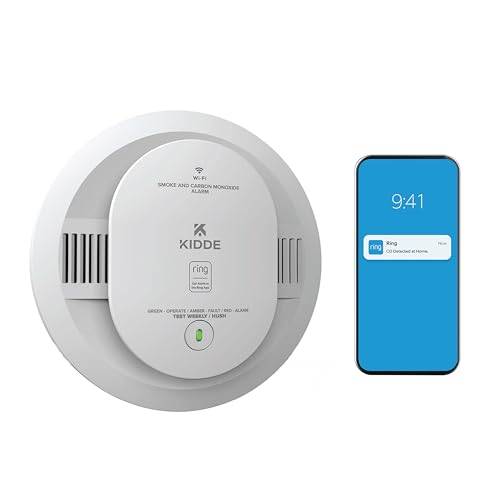
4. Kidde Smart Smoke + CO – best Wi-Fi budget pick
Spec line: smoke and CO detection · built-in Wi-Fi · no separate hub required · phone alerts.
Best for: homeowners who want alerts when away without paying for a hub.
Skip if: your router coverage is weak in the hallway where the alarm goes.
- Pros: remote notification at an entry-level tier, from a long-established fire-safety brand.
- Cons: if Wi-Fi drops you lose the phone alert, though the local siren still works.
5. Kidde Nighthawk – best CO alarm with a readout
Spec line: CO alarm · digital display showing ppm readings · plug-in design with battery backup.
Best for: homes with gas appliances, attached garages or a fireplace where trending CO levels are useful.
Skip if: you need smoke detection in the same unit.
- Pros: shows low-level CO, battery backup for power outages.
- Cons: occupies an outlet and does not replace a smoke alarm.
6. First Alert Onelink Safe & Sound – best with Alexa
Spec line: smoke and CO alarm · hardwired · built-in speaker with Alexa · Wi-Fi.
Best for: Alexa households replacing a hardwired ceiling alarm.
Skip if: you prefer a plain alarm without a smart speaker, or do not have alarm wiring.
- Pros: spoken alerts, speaker doubles as an Alexa device.
- Cons: depends on household electrical wiring and installation by a qualified person in many cases.
7. Kidde hardwired combination alarm (30CUA10-V class) – best for hardwired homes
Spec line: smoke and CO alarm · AC power with battery backup · wired interconnect · listed for permanent installation.
Best for: new construction and remodels where code requires interconnected hardwired alarms.
Skip if: you rent and cannot modify wiring.
- Pros: interconnection through the house wiring, battery backup, familiar installation.
- Cons: installation involves mains power, so turn off the circuit and use a licensed electrician if you are not experienced. Confirm the exact model number and replacement bracket before buying.
A note on the Google Nest Protect: reports in 2026 indicate it has been discontinued, with First Alert positioned as its successor. If you already own one, keep it in service until its end-of-life date; if you are shopping, the models above are current choices.

Worked example: how many alarms does your home need?
Use this step-by-step count to avoid buying too few. Take a two-story house with a basement, four bedrooms, and a gas furnace and water heater in the basement.
- Smoke alarms inside each sleeping room: 4.
- Smoke alarms in the hallway outside the bedrooms (one per sleeping area): 1.
- Smoke alarm at the top of the basement stairs or in the basement: 1.
- Smoke alarm on the main living level, such as near the stairs: 1. Subtotal: 7 smoke-sensing devices.
- CO alarms: one outside the bedroom hallway, one on the main level, one in the basement near fuel-burning appliances: 3.
- If you choose combination units for the hallway, main level and basement, those three devices cover both hazards. Then you need 4 bedroom smoke alarms plus 3 combination alarms, 7 devices in total.
Seven devices cover the same checklist that would otherwise need ten. Interconnection matters here: with seven standalone alarms, a fire in the basement may not wake someone on the top floor. Choose interconnected models so one trigger sounds them all.
All 13 alarms compared
| Model | Detects | Power | Interconnect or smart |
|---|---|---|---|
| X-Sense SC07-W | Smoke + CO | Sealed battery | Wireless interconnect |
| First Alert SCO5CN | Smoke + CO | Battery | Standalone |
| First Alert SC5 | Smoke + CO | Battery or hardwired variants | Wi-Fi, Google Home |
| Kidde Smart Smoke + CO | Smoke + CO | Per model | Wi-Fi, no hub |
| Kidde Nighthawk | CO | Plug-in with backup | Digital readout |
| First Alert Onelink Safe & Sound | Smoke + CO | Hardwired | Alexa speaker |
| Kidde 30CUA10-V class | Smoke + CO | Hardwired with backup | Wired interconnect |
| First Alert SMCO210 | Smoke + CO | Sealed battery | Standalone |
| First Alert SMICO100-AC | Smoke + CO | Hardwired, 9V backup | Wired interconnect |
| X-Sense XP0H-WN | Smoke + CO | Sealed battery | Wireless interconnect |
| Kidde 30CUDR | Smoke + CO | AA battery | Standalone |
| Kidde Smart with Ring | Smoke + CO | AA battery | Ring app, wireless interconnect |
| Kidde Smart CO plug-in | CO | Plug-in with backup | Mobile alerts |
How to choose: thresholds that decide the purchase
- Power and lifespan. Count a 10-year service life from the manufacture date on the back. If a package shows a date more than a year old, the alarm has already used part of that life.
- Coverage count. Plan one smoke-sensing alarm per sleeping room, one outside each sleeping area and one per level. CO coverage goes outside each sleeping area and on every level, so combination units on the hallway, main floor and basement cover both lists.
- Interconnection. In any home with more than one floor, choose interconnected models, wired or wireless. A basement fire should wake the top-floor bedrooms.
- CO response. A UL 2034 alarm must sound within 60 to 240 minutes at 70 ppm, 10 to 50 minutes at 150 ppm and 4 to 15 minutes at 400 ppm. A unit that lists this standard clears the bar.
- Wi-Fi alerts. Buy a smart alarm only if the router signal reaches the mounting spot. If the signal drops out at the ceiling location, choose a non-smart interconnected alarm.
- Budget tier. Entry-level covers plain battery combos such as the Kidde 30CUDR and First Alert SMCO210. Mid-range covers X-Sense and Wi-Fi units. Premium covers hardwired smart and speaker models.
Decision matrix
| Your situation | Best fit | Why |
|---|---|---|
| Renter, no wiring | X-Sense SC07-W | Sealed battery, wireless interconnect |
| Simple bedroom upgrade | First Alert SCO5CN | Widely available, easy swap |
| Want phone alerts, no hub | Kidde Smart Smoke + CO | Built-in Wi-Fi |
| Replacing Nest Protect | First Alert SC5 | Google Home support |
| Gas appliances, want a readout | Kidde Nighthawk | Displays ppm |
| Alexa home, hardwired ceiling | First Alert Onelink Safe & Sound | Voice alerts |
| New build or remodel | Kidde hardwired combo | Wired interconnect, backup |
Installation and maintenance
- Test each alarm monthly using its test button, and test again after a power outage or long absence.
- Write the install date on the alarm or in a calendar, and replace the unit at its end-of-life date.
- Vacuum dust from vents twice a year; dust and insects are common causes of nuisance alarms.
- Never disable an alarm because of cooking smoke; move it or choose a photoelectric model.
- Do not paint over alarms.
- Install a CO alarm at the height the manufacturer specifies, since CO mixes with air rather than hugging the floor or ceiling.
- Make and practice a home escape plan with two exits from every bedroom.
What to do when a CO alarm sounds
Treat a CO alarm as an emergency. Move everyone outdoors to fresh air, call your local emergency number from outside, and do not re-enter until responders say it is safe. A chirp usually means a low battery or end of life; a continuous alarm means a detection. If anyone has headache, dizziness or nausea while the alarm sounds, seek medical attention promptly.
Common buying mistakes
- Buying only the cheapest alarm and skipping interconnection, which leaves upstairs sleepers unwarned about a basement fire.
- Mixing brands on a hardwired circuit; wired interconnect usually works only between compatible models from the same maker.
- Ignoring the manufacture date on retail packaging, which can show an alarm has already used part of its service life.
- Choosing a smart alarm but placing it where Wi-Fi is weak, so remote alerts never arrive.
- Treating a CO display reading as a replacement for the alarm; the alarm is the safety device.
Six more smoke and carbon monoxide alarms worth shortlisting
The seven picks above cover most layouts. These six add a sealed-battery slim combo, a hardwired First Alert, a second X-Sense, a plain Kidde battery combo, a Ring-compatible smart alarm and a smart CO-only plug-in. Specs come from manufacturer listings; for anything not confirmed, the spec class is described. Always check the listing marks and the manufacture date on the package.
8. First Alert SMCO210 – best slim sealed-battery combo
This First Alert unit pairs both sensors with a sealed power source, so the only maintenance is the monthly test button and the replace-by date.
Spec line: smoke and CO combination · sealed 10-year battery · slim profile design · standalone
Best for: bedrooms and hallways where you want no battery changes and a low-profile body.
Skip if: you need interconnection between rooms, phone alerts or hardwired power.
Pros: no battery swaps during its service life, small footprint, widely stocked brand.
Cons: sealed units are replaced whole at end of life, and standalone units only sound where they sense.

9. First Alert SMICO100-AC – best First Alert hardwired combo
If your circuit already carries First Alert alarms, this model is the like-for-like replacement and avoids mixing brands on the wired link.
Spec line: smoke and CO combination · hardwired AC power · 9V battery backup · interconnectable with compatible First Alert alarms
Best for: remodels and homes with existing First Alert wiring where code calls for hardwired alarms.
Skip if: you rent and cannot touch the ceiling wiring.
Pros: battery backup during an outage, wired interconnection with matching units, familiar mounting.
Cons: installation involves mains power, and mixed brands on one circuit often will not interconnect.

10. X-Sense XP0H-WN – best second X-Sense for wireless interconnect
A wireless link lets one alarm trigger the rest, which solves the basement-fire, upstairs-sleeper problem without an electrician.
Spec line: wireless combination smoke and CO alarm · sealed 10-year battery · wireless interconnect between units
Best for: homes without wiring that already own the SC07-W and want another wireless option in the same family.
Skip if: you need hardwired alarms or a voice location announcement.
Pros: no battery changes during its service life, wireless interconnect, entry-level to mid-range tier.
Cons: sealed design means whole-unit replacement, and wireless range depends on building materials.

11. Kidde 30CUDR – best plain AA-battery combo
A replaceable battery means you control when the cells are swapped, which some owners prefer over a sealed, throw-away design.
Spec line: smoke and CO combination · AA battery power · LED status lights · standalone
Best for: rentals and bedrooms where you want a familiar fire-safety brand and a replaceable battery.
Skip if: you want a sealed battery that never needs changing.
Pros: easy to buy, simple mounting, replaceable cells.
Cons: the battery needs yearly attention, and a standalone alarm only sounds in its own room.

12. Kidde Smart Smoke and CO with Ring – best for Ring households
This Kidde variant ties into the Ring app, which makes it the natural match for homes that already use Ring cameras or an alarm base station.
Spec line: smoke and CO combination · AA battery · Ring app support · wireless interconnect · voice alerts
Best for: Ring and Alexa homes that want phone alerts without a separate hub.
Skip if: you use Google Home or want the lowest-cost alarm.
Pros: app notifications, wireless interconnect, spoken alerts.
Cons: smart features rely on Wi-Fi and the app, so confirm the local siren works on its own.

13. Kidde Smart CO Alarm, plug-in – best smart CO-only add-on
CO moves through a home differently from smoke, so a dedicated unit near sleeping areas or a basement can be easier to place than a ceiling combo.
Spec line: carbon monoxide alarm · plug-in power with AA battery backup · real-time mobile alerts · no smoke sensing
Best for: homes with gas appliances, an attached garage or a basement furnace that want a phone alert for CO.
Skip if: you need smoke detection in the same unit.
Pros: backup during outages, remote alerts, takes the place of an existing outlet plug.
Cons: uses an outlet and does not replace a smoke alarm.

Frequently asked questions
Do I need separate smoke and carbon monoxide detectors?
No. A combination alarm does both jobs, but you can also use separate devices. What matters is that every required location has coverage for each hazard.
Combination units save ceiling space; separate units let you place a CO alarm where it works best.
Which is better, photoelectric or ionization?
Photoelectric alarms are generally better for smoldering fires and cause fewer kitchen false alarms; ionization responds faster to flaming fires. Dual-sensor alarms cover both.
Many fire-safety organizations recommend photoelectric or dual-sensor protection, so check the sensor type on the package.
How often should I replace smoke and CO detectors?
Replace smoke alarms about every 10 years and CO alarms by the manufacturer’s stated life, which can be shorter. The date is printed on the back.
An end-of-life chirp means replace the whole unit, not just the battery.
Are smart smoke detectors worth it?
They are worth it if you travel, have a large home or want alerts when you are away. The local siren must still work without Wi-Fi.
The safety benefit comes from the alarm itself; the smart layer adds notification and troubleshooting convenience.
Where should carbon monoxide detectors go?
Put one outside each sleeping area and on every level of the home, following the manufacturer’s instructions and local code.
Avoid placing them directly beside fuel-burning appliances, where brief start-up emissions can cause nuisance alarms, unless the instructions say otherwise.
Why does my smoke alarm chirp every minute?
A regular chirp usually signals a low battery, but a chirp pattern can also mean a fault or end of life. Read the manual for the pattern.
If a fresh battery does not stop it, check the manufacture date and replace the unit if it is near 10 years old.
Do hardwired alarms still need batteries?
Most hardwired alarms include a battery backup so they keep working during a power outage. Replace it as directed.
Wiring and replacement should follow the manufacturer’s instructions; hire an electrician if you are unsure.
Can I install smoke detectors myself?
Battery-powered alarms are designed for simple do-it-yourself mounting. Hardwired alarms connect to household power and are safer to leave to a qualified electrician.
Always turn off the circuit breaker before touching any wiring, and confirm local requirements first.
More from Amazon
Programs that pair well with the guide above. Offers and eligibility are set by Amazon and may change.
Free shipping on eligible items, Prime Video and more. Eligible new members can start with a free trial.
Start a Prime free trialAudiobooks and podcasts to listen to on the go. Eligible new members can start with a free trial.
Try Audible freeAd-free music streaming. Eligible new subscribers can start with a free trial.
Try Music Unlimited freeA free business account with business pricing and bulk-buying tools for work, shop or home office.
Create a business accountAs an Amazon Associate we earn from qualifying purchases.




Write Your Review
No reviews yet. Be the first to share your experience!