

Key takeaways
- Noise: cordless inflators use a high-speed compressor and are not quiet. Wear hearing protection if operating one for extended periods in a confined garage, and do not expect to hold a normal conversation beside it.
- Hose length: 20 to 26 inches is workable for most cars; around 30 inches is more comfortable for SUVs, trailers, and awkward valve locations.
- Portability: a smaller battery improves balance and storage, but a larger pack may provide more useful operating time. Keep the tool and battery protected from moisture.
- Controls: a large display and simple preset buttons are easier to use at night than a tiny pressure gauge.
- Chuck design: a screw-on chuck can seal well but takes longer; a lever chuck is faster if it fits securely and does not leak.
Best Cordless Tire Inflators for Fast Top-Ups
The best cordless tire inflator for most drivers is the one that matches a battery system they already own: choose the Milwaukee M18 inflator for the fastest repeated top-ups, the DeWalt 20V MAX inflator for broad vehicle compatibility, the Makita 18V LXT inflator for compact emergency storage, and the Ryobi ONE+ inflator for the lowest-cost entry into a large battery platform.
These tools are designed mainly for correcting pressure loss, not replacing a workshop compressor for truck tires, trailers, or large-volume inflatables. Their practical differences are battery availability, shutoff accuracy, inflation speed, hose reach, heat management, and whether you can keep the tool charged in the vehicle.
Our top picks


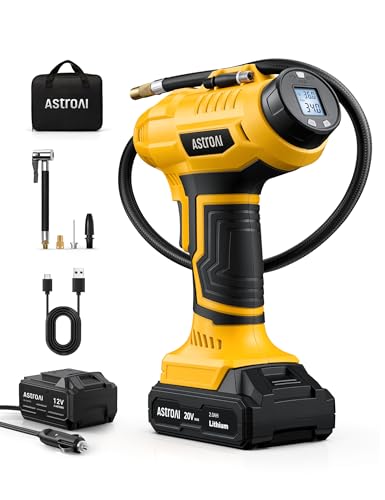

As an Amazon Associate we earn from qualifying purchases at no extra cost to you. Ratings are shown as listed on Amazon.
Quick comparison
| Inflator | Battery platform | Maximum pressure | Published hose length | Useful strengths | Best fit |
|---|---|---|---|---|---|
| Milwaukee M18 2848-20 | M18 18V | 150 psi | 26 in | Fast inflation, digital preset, automatic shutoff, high-duty-cycle design | Frequent car, SUV, and light-truck use |
| DeWalt 20V MAX DCC020IB | 20V MAX | 160 psi | 31 in | 12V vehicle socket and AC compatibility, digital gauge, strong portability | Roadside versatility and mixed power sources |
| Makita 18V LXT DMP180Z | 18V LXT | 121 psi | 25 in | Small body, preset shutoff, thermal protection, convenient onboard adapters | Compact emergency kits and occasional use |
| Ryobi ONE+ P737D | 18V ONE+ | 150 psi | Approximately 20 in | Low platform cost, digital display, automatic shutoff, broad tool ecosystem | Home users who already own ONE+ batteries |
Specifications can vary by regional revision and whether a battery is included. Tool-only versions are common, and the battery, charger, and case can materially change the purchase price.
Head-to-head: which one inflates fastest?
Milwaukee M18 2848-20: best for repeated top-ups
The Milwaukee is the strongest choice when speed matters more than minimum size. Its 150-psi rating is ample for ordinary passenger vehicles, and its high-output design is intended to fill tires quickly while limiting downtime between tires. It uses an automatic shutoff, so you can set the target pressure and prepare the next wheel rather than holding a trigger continuously.
Its disadvantages are weight, bulk, and the cost of entering the M18 system. An M18 battery is considerably larger than the small packs used with compact inflators, and the tool is more equipment-like than glovebox-like. It makes sense for a household with several M18 tools, a work vehicle, or drivers who regularly adjust pressures for towing, temperature changes, or off-road use.
DeWalt DCC020IB: best roadside flexibility
The DeWalt stands out because it can use a 20V MAX battery, a 12V vehicle outlet, or household AC power with the appropriate connection. That flexibility reduces the risk of arriving at a flat tire with an empty tool battery. Its 31-inch hose is also among the more useful lengths in this group, especially when the vehicle’s valve stem is awkwardly positioned.
The DCC020IB is not the smallest option, but its built-in storage and digital controls make it practical for a trunk or roadside kit. The 160-psi maximum is more than a normal car needs; the important feature is not the headline pressure but the ability to set a target and stop automatically. The 12V cable can be slower under demanding use, so a charged 20V battery is preferable when speed is important.
Makita DMP180Z: best compact platform choice
The Makita is a good match for drivers who want a smaller emergency tool and already have 18V LXT batteries. At 121 psi, it covers the pressure requirements of most cars, crossovers, motorcycles, and bicycles. Its hose is shorter than DeWalt’s, but the compact body is easier to store under a seat or beside a spare tire.
It is better viewed as a precision top-up tool than a rapid solution for a completely deflated large tire. A small battery keeps the kit light, while a larger LXT battery can make the tool less convenient to carry. As with other compact inflators, pause if the housing becomes hot during consecutive fills.
Ryobi ONE+ P737D: best budget platform entry
The Ryobi is attractive when the owner already has ONE+ batteries or wants access to one of the broadest consumer tool ecosystems. Its 150-psi rating, digital pressure control, and automatic shutoff provide the features that matter for routine tire corrections.
For a single emergency purchase, calculate the cost of the tool, battery, and charger together. A low tool-only price is not a saving if you need a battery and charger as well. The Ryobi is generally most compelling for occasional household use, bicycles, lawn equipment, and car tires rather than demanding commercial work.
Decision matrix by situation
| Your situation | Most suitable choice | Why | Trade-off |
|---|---|---|---|
| You already own M18 batteries and inflate several tires at once | Milwaukee M18 | Fast output and strong repeated-use capability | Heavier and more expensive than compact models |
| You want backup power from the car or AC outlet | DeWalt DCC020IB | Three practical power options and a long hose | Less compact for a small trunk kit |
| You have limited storage space | Makita DMP180Z | Small, light format with adequate car-tire pressure | Slower on fully flat or larger tires |
| You want the lowest total platform cost | Ryobi ONE+ P737D | Accessible battery ecosystem and useful automatic controls | Less suited to high-frequency commercial use |
| You need to inflate trailer or light-truck tires frequently | Milwaukee or DeWalt | Better hose reach and faster high-volume work | Expect more heat, battery consumption, and pauses than with a shop compressor |
Preset accuracy matters more than maximum psi
Most car tires are inflated somewhere in the 30-to-40-psi range, so a 121-psi or 160-psi maximum does not by itself indicate better performance. Look for a readable digital display, a secure chuck, automatic shutoff, and controls that allow small pressure increments.
A practical check is to set the inflator to 35 psi, fill the tire, and then verify it with a separate, known-good gauge after the tool stops. A difference of about 1 psi can result from gauge tolerance, hose pressure, temperature, or the brief pressure drop that occurs when the chuck is removed. Set pressure using the vehicle placard, usually found on the driver’s door frame, rather than the maximum pressure printed on the tire sidewall.
Worked runtime and speed expectations
Inflation time depends on tire volume, starting pressure, temperature, battery condition, and the tool’s duty cycle. A compact inflator may be perfectly adequate for adding 5 psi to four tires but frustrating when asked to raise a completely flat SUV tire from near zero.
For example, suppose a vehicle needs 4 psi added to each of four tires. If a tool takes approximately 90 seconds per tire under that load, the active inflation time is about 6 minutes. Add setup, moving around the vehicle, and pressure checks, and the roadside job may take 10 minutes. A tool that inflates twice as fast saves only a few minutes in this situation; its larger advantage appears when correcting multiple vehicles or filling a tire from a very low starting pressure.
Battery capacity is best considered in watt-hours. A 4.0 Ah battery on an 18V platform stores roughly 72 watt-hours before losses. Actual runtime varies substantially, but this explains why a small 2.0 Ah pack is convenient for a single top-up while a 4.0 Ah or 5.0 Ah pack is more reassuring for four tires, cold weather, or repeated use.
Noise, hose length, and roadside handling
- Noise: cordless inflators use a high-speed compressor and are not quiet. Wear hearing protection if operating one for extended periods in a confined garage, and do not expect to hold a normal conversation beside it.
- Hose length: 20 to 26 inches is workable for most cars; around 30 inches is more comfortable for SUVs, trailers, and awkward valve locations.
- Portability: a smaller battery improves balance and storage, but a larger pack may provide more useful operating time. Keep the tool and battery protected from moisture.
- Controls: a large display and simple preset buttons are easier to use at night than a tiny pressure gauge.
- Chuck design: a screw-on chuck can seal well but takes longer; a lever chuck is faster if it fits securely and does not leak.
Ownership realities and common mistakes
The first parts likely to wear are the air hose, chuck seal, and threaded or rubber valve connection. Keep the hose free of sharp bends, avoid dragging the tool by it, and replace a damaged seal rather than compensating with excessive tightening. Dust and sand can also enter the chuck and create a slow leak.
Do not run a compact inflator continuously beyond its stated duty cycle. Heat reduces output and can shorten the life of the motor and battery. Inflate one tire, allow a brief cooling period when the housing becomes hot, and keep the battery out of direct sun. Do not leave a lithium-ion battery in a hot parked vehicle for long periods.
Before placing an inflator in a vehicle, charge the battery, confirm that the correct adapter is present, and check the tool on each valve type you expect to use. Store a separate pressure gauge, a valve-core tool only if you know how to use it, and a flashlight. An inflator cannot repair a puncture, replace a missing valve core, or make a tire safe after sidewall damage.
Bottom line
Choose the Milwaukee M18 for the fastest repeated car and light-truck top-ups, the DeWalt DCC020IB for the most flexible roadside power options, the Makita DMP180Z for compact LXT-based emergency storage, and the Ryobi ONE+ P737D for economical occasional use. Whichever model you select, prioritize a compatible battery you can keep charged, an accurate preset shutoff, a hose long enough for your vehicle, and a separate gauge for verification.







Write Your Review
No reviews yet. Be the first to share your experience!