

Key takeaways
- Up to 40 people: prioritize vocal clarity and easy placement. One 6.5- to 8-inch speaker is usually enough.
- 40 to 100 people: choose an 8-inch speaker with adequate headroom, especially for music. A second speaker improves stereo coverage and reduces the need to run one unit near its limit.
- 100 to 200 people: use two speakers on stands, ideally with 10- or 12-inch drivers if music has significant bass.
- More than 200 people: consider a modular PA with dedicated mains, subwoofers and a mixer. Battery convenience becomes less important than even coverage and system headroom.
The best portable PA systems in 2026 are the Bose S1 Pro+ for quick small events, the JBL EON One MK2 for a self-contained performer setup, the Electro-Voice EVERSE 8 for battery-powered sound with strong coverage, and the Yamaha STAGEPAS 200BTR when you need a compact, flexible speaker that can also run from mains power.
Our top picks


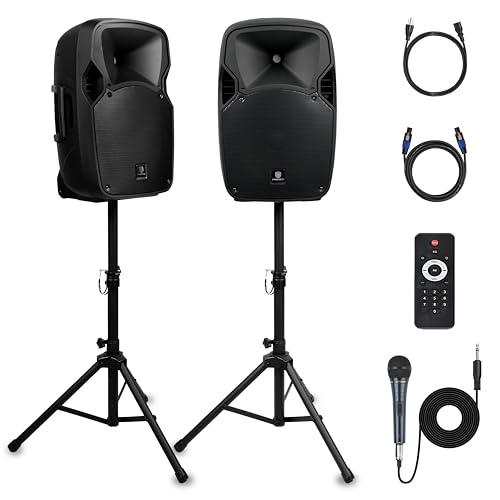

As an Amazon Associate we earn from qualifying purchases at no extra cost to you. Ratings are shown as listed on Amazon.
Best portable PA systems by situation
| Best for | Recommended type or model | Useful specification | Why it fits |
|---|---|---|---|
| Speech, presentations, small ceremonies | Bose S1 Pro+ | Battery operation, built-in mixer, approximately 11 kg | Fast setup, clear vocal projection, multiple placement angles |
| Solo musicians and acoustic performers | JBL EON One Compact | Eight-inch woofer, four-channel mixer, rechargeable battery | More input flexibility than a basic Bluetooth speaker |
| Outdoor events and larger audiences | Electro-Voice EVERSE 8 | Eight-inch woofer, battery-powered operation, approximately 7.6 kg | High output for its size and weather-resistant construction |
| Small bands and compact production setups | JBL EON One MK2 | Eight-inch woofer, integrated digital mixer, approximately 19.3 kg | Combines speaker, mixer, effects and battery operation |
| Users who want mains or battery power | Yamaha STAGEPAS 200BTR | Eight-inch coaxial driver, optional battery operation, approximately 12.5 kg with battery | Useful as a portable PA, monitor or compact installation speaker |
Specifications vary by configuration, battery, region and firmware. Treat published wattage as a guide rather than a direct measure of loudness: amplifier power ratings are not standardized, while maximum SPL, driver size, dispersion and limiting behavior are more useful for comparing real coverage.
How much wattage do you need?
For speech and background music, a small battery PA with roughly 100 to 300 watts of amplifier power can be sufficient for 30 to 80 people in a quiet indoor room. A system with approximately 300 to 1,000 watts is more appropriate for amplified music, outdoor use or audiences approaching 100 to 200 people. Larger events normally need two mains speakers, subwoofers or a professional sound system rather than one “high-wattage” portable box.
- Up to 40 people: prioritize vocal clarity and easy placement. One 6.5- to 8-inch speaker is usually enough.
- 40 to 100 people: choose an 8-inch speaker with adequate headroom, especially for music. A second speaker improves stereo coverage and reduces the need to run one unit near its limit.
- 100 to 200 people: use two speakers on stands, ideally with 10- or 12-inch drivers if music has significant bass.
- More than 200 people: consider a modular PA with dedicated mains, subwoofers and a mixer. Battery convenience becomes less important than even coverage and system headroom.
A speaker’s stated wattage does not tell you how far sound will travel. A narrow, horn-loaded speaker can throw speech farther than a similarly rated wide-dispersion box, while bass disappears quickly outdoors. For outdoor events, add a second speaker before simply buying a more powerful single unit.
Head-to-head: Bose S1 Pro+ versus JBL EON One MK2
The Bose S1 Pro+ is the easier choice for presenters, instructors, celebrants and performers who value speed. It is relatively light, can be used upright, tilted back or on a speaker stand, and includes a built-in mixer with wireless control through the Bose app. Its battery is intended for portable events rather than all-day high-volume concert use. Bluetooth makes it convenient for backing tracks, but it is not a replacement for a full mixer when several microphones and instruments are required.
The JBL EON One MK2 is larger and heavier, but it offers a more complete all-in-one system. Its integrated mixer provides multiple inputs, phantom power for suitable microphones, effects and app-based control. It is better suited to a singer who needs a vocal microphone, guitar, backing track and monitor-style control from one cabinet. The trade-off is transport: at approximately 19 kg, it is portable in the “one person can move it” sense, not the “carry it casually all day” sense.
Choose the Bose for fast speech and small acoustic performances. Choose the JBL when input count, mixing control and musical flexibility matter more than minimum weight.
Battery runtime: calculate for the real event
Manufacturers commonly quote battery life at moderate volume. Maximum-volume playback, heavy bass, wireless microphone receivers and cold weather can reduce that figure. A practical planning method is to reserve 25 percent of the advertised runtime.
For example, if a PA is advertised for 12 hours, plan on approximately:
12 hours × 0.75 = 9 hours of dependable event use.
If your event lasts six hours, that leaves about three hours for sound checks, delays and louder passages. If the PA is rated for six hours, the same calculation gives only 4.5 hours, so you should arrange mains power, a spare battery or a second unit. Do not assume that USB power banks can recharge a PA unless the manufacturer specifically supports that charging method; many speakers require a proprietary battery or mains adapter.
Wireless microphones, inputs and Bluetooth
Bluetooth is useful for playlists and walk-in music, but it introduces latency and connection risk. It is usually unsuitable for live instrument monitoring or anything requiring tight synchronization. Check whether the system supports a separate wired input while Bluetooth plays in the background, and whether the volume of each source can be controlled independently.
For one presenter, a single microphone input may be enough. For a panel, wedding ceremony or small performance, look for at least two microphone-capable channels. A built-in wireless microphone receiver is convenient, but the transmitter type matters:
- Handheld wireless microphone: practical for announcements and singers, but it must remain near the speaker’s compatible receiver.
- Lavalier or headset system: keeps the presenter’s hands free, but requires careful gain adjustment to avoid feedback.
- UHF or digital wireless systems: generally offer more reliable event operation than inexpensive generic Bluetooth microphones.
Also check for XLR inputs, a line or instrument input, a mix output and phantom power if you use condenser microphones or certain direct boxes. A speaker described as having “multiple inputs” may still offer only one proper microphone preamp.
Portability and sound coverage
Weight is only part of portability. A 12 kg cabinet with a comfortable handle may be easier to transport than a 9 kg speaker with an awkward shape. Look for a stable base, integrated handle, stand-mount socket, protected control panel and a battery that can be replaced rather than permanently sealed.
Coverage depends on placement as much as on the speaker. Put the cabinet above head height, angle it toward the audience and keep the microphone behind the front of the speaker. This helps voices reach the back row and reduces feedback. For a wide audience, two speakers placed left and right usually provide more even sound than one speaker turned up louder.
As a rough layout example, a 60-person indoor audience spread across a 12-metre-wide room will usually benefit from two speakers aimed across the room rather than one cabinet at the center. The second speaker does not merely add volume: it reduces the difference between people standing near the PA and those at the edges.
Decision matrix for buying frequency and experience
| Your situation | Best priority | Suitable choice |
|---|---|---|
| First-time buyer, occasional speech events | Simple controls, low weight, feedback-resistant placement | Bose S1 Pro+ or a similar compact battery PA |
| Weekly solo performer | At least three useful input paths, effects and reliable battery | JBL EON One Compact or comparable integrated-mixer PA |
| Outdoor use several times per month | Output headroom, weather resistance and replaceable battery options | Electro-Voice EVERSE 8 or two compact battery speakers |
| Small band with multiple sources | Digital mixer, phantom power, monitor output and two-speaker expansion | JBL EON One MK2 or a PA plus separate mixer |
| Low budget, mostly background music | Clear Bluetooth playback and mains power | Compact powered PA speaker; avoid paying for unused wireless features |
Ownership realities and common mistakes
The first parts likely to wear are rechargeable batteries, input sockets, carrying handles and the protective grille. Battery capacity gradually falls with age, particularly when the unit is stored fully discharged or in high heat. Recharge it according to the manufacturer’s guidance, avoid leaving it in a hot vehicle and test runtime before an important event.
Keep drinks away from the control panel even when a cabinet is advertised as weather resistant. Wipe dust from the grille, inspect cables for intermittent connections and transport the PA in a padded bag. Do not place it directly on wet ground. When using stands, spread the legs fully, add appropriate ballast outdoors and keep cables taped down to prevent trips.
The most common setup mistake is running the speaker at maximum volume to compensate for poor placement. Raise the cabinet, point it at the audience, reduce unnecessary bass and set microphone gain just below feedback. These changes often produce clearer sound and longer battery life than buying a higher-wattage model.
Final buying recommendation
For the simplest portable event system, choose the Bose S1 Pro+. For an all-in-one musician setup, choose the JBL EON One MK2 or the smaller EON One Compact. For outdoor coverage and a light, weather-resistant design, the Electro-Voice EVERSE 8 is a strong option. If you regularly serve more than 100 people, buy two compatible speakers or move to a modular PA rather than relying on one cabinet’s headline wattage. The right choice is the system that provides enough clean headroom, battery reserve and input capacity for your actual event—not the one with the largest power number on the box.

Write Your Review
No reviews yet. Be the first to share your experience!