

Key takeaways
- Choose a basic analog scanner only after confirming that the services you want are analog and conventional. For most current public-safety monitoring, a digital trunking scanner with an updateable local database is the safer purchase. The Uniden SDS100 favors portability and difficult RF environments, the…
Best Police Scanners for Clear Local Monitoring in 2026
The best police scanner for most serious listeners is a digital trunking scanner with a location-based database, while an inexpensive analog model is sufficient if your local agencies still use conventional VHF or UHF channels.
The important distinction is not brand name but system compatibility. Before buying, check whether nearby police, fire, EMS, transportation, and utility agencies use conventional analog frequencies, a digital trunked system, or encrypted talkgroups. A scanner cannot make an encrypted transmission intelligible, and a model that lacks the required digital standard may be unable to follow a busy modern public-safety network.
Our top picks

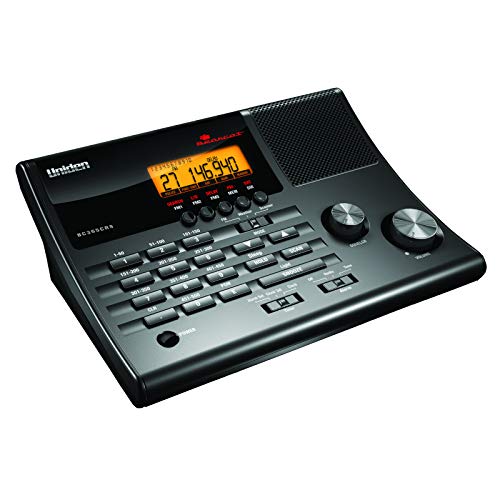

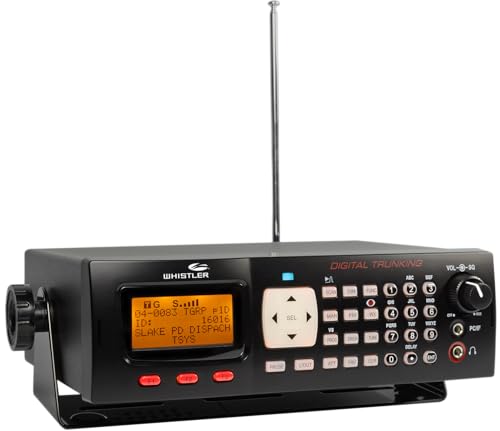
As an Amazon Associate we earn from qualifying purchases at no extra cost to you. Ratings are shown as listed on Amazon.
Quick picks by listening situation
| Situation | Best fit | Why | Main compromise |
|---|---|---|---|
| Low budget and known local analog channels | Analog conventional scanner | Simple, inexpensive, and easy to monitor a short channel list | Cannot follow most modern digital trunked systems |
| First digital scanner, local database desired | Uniden HomePatrol-style database scanner | Enter a ZIP code or location and let the scanner load nearby systems | Automatic selection can include too many unwanted services |
| Frequent travel or field listening | Uniden SDS100 or Whistler TRX-1 | Portable design, rechargeable battery, memory-card storage, and digital trunking | Small speakers and shorter battery life than a desktop unit |
| Weak indoor reception or a fixed listening desk | Uniden SDS200 or another desktop digital scanner | Larger controls, external antenna connection, and continuous power | Not practical for carrying around |
| Experienced user who wants maximum control | Programmable digital trunking scanner | Custom systems, talkgroups, quick keys, and detailed scan lists | Programming takes time and current system information |
Analog versus digital trunking: the decision that matters most
Conventional analog
Analog scanners receive one frequency at a time. They work well for older VHF and UHF channels, weather broadcasts, amateur radio, aviation, and some smaller agencies. Programming is usually straightforward: enter a frequency, choose a channel, and set the required tone if one is used.
The limitation is substantial. An analog scanner will not properly follow a digital trunked system, even if it can receive some of the system’s control-channel energy. Buying an analog model because it is cheaper can become a false economy if your county changes systems later.
Digital trunking
A digital trunking scanner follows a control channel as conversations move between frequencies. Depending on the system, useful standards may include P25 Phase I and P25 Phase II. Some models also support additional formats such as DMR or NXDN, but those features should be treated as a local compatibility question rather than an automatic reason to spend more.
Digital voice quality is often clean until reception drops below the usable threshold. Instead of gradually becoming noisy like analog audio, it may break up, mute, or sound robotic. This makes antenna placement, terrain, building materials, and distance especially important.
Leading scanner types compared
| Type or example | Digital trunking | Approximate size and weight | Typical battery or power arrangement | Programming difficulty |
|---|---|---|---|---|
| Uniden SDS100 | P25 Phase I and Phase II; broad digital format support | About 5.3 × 2.4 × 1.4 inches; roughly 14–15 ounces with battery | Rechargeable battery; commonly about 6–10 hours depending on backlight, signal, and scanning load | Low with ZIP-code setup; moderate for custom configuration |
| Uniden SDS200 | P25 Phase I and Phase II; broad digital format support | About 7.2 × 6.4 × 2.2 inches; roughly 2 pounds | AC power for fixed use; suitable for an external antenna | Low for database use; moderate for advanced profiles |
| Whistler TRX-1 | P25 Phase I and Phase II, plus selected additional digital formats | About 5.8 × 2.4 × 1.5 inches; roughly 10 ounces | Rechargeable battery; often approximately 8–10 hours under moderate use | Moderate, especially when using EZ Scan software |
| Basic analog handheld scanner | No | Often 4–6 inches tall; commonly 8–14 ounces | AA or rechargeable cells; commonly 10–30 hours depending on volume and battery type | Low when only a few frequencies are needed |
Dimensions, weights, and runtime vary by battery, accessory, screen brightness, and scanning activity. Treat the figures as buying estimates rather than guarantees. A digital handheld can consume power quickly when it is constantly searching across many systems.
Local database access: convenience versus control
A built-in or computer-updatable frequency database is valuable when you travel or do not know the local system details. Location-based scanners can load agencies near a ZIP code or geographic position, which is much faster than researching every frequency manually.
Database access is not the same as guaranteed reception. Entries can be outdated, agencies can reorganize talkgroups, and a scanner may select public works, schools, aircraft, or distant counties that make the scan seem slow. After the initial setup, create separate scan lists for police, fire, EMS, weather, transportation, and neighboring jurisdictions. This reduces missed traffic and improves battery life.
Advanced users may prefer software such as Uniden’s Sentinel workflow or Whistler’s EZ Scan software. These tools allow more precise control over sites, departments, service types, priority behavior, and avoided channels. The trade-off is a steeper learning curve.
Antenna performance is often worth more than a feature upgrade
The supplied rubber antenna is convenient, but it is a compromise. For a handheld, an antenna cut for the bands you monitor can improve reception, although a longer antenna may be awkward and more vulnerable to bending. For a desktop scanner, an outdoor antenna mounted as high and clear as practical usually provides a larger improvement than moving from one similarly capable scanner to another.
Do not assume that the strongest signal is always the best signal. A wideband antenna can collect interference from nearby transmitters, while a band-specific antenna may perform better on a narrow group of frequencies. Keep the scanner away from USB chargers, LED lamps, computers, and poorly shielded power supplies, all of which can create local noise.
How difficult is setup?
- Check the local system first. Identify the system type, digital standard, frequency band, and whether important talkgroups are encrypted.
- Choose the scanner around compatibility. Do not buy an analog-only model for a P25 trunked county.
- Update the database and firmware. Use the manufacturer’s supported software and a reliable USB cable. Updates can fix system data and improve operation.
- Start with one county or system. A small test list makes it easier to distinguish poor reception from incorrect programming.
- Adjust the antenna and location. Try a window, upper floor, or outdoor antenna before changing numerous software settings.
- Build focused scan lists. Keep essential services separate from low-priority channels and avoid everything you do not actually want to hear.
A useful troubleshooting calculation is to estimate how much of the scan is spent on unwanted channels. If a scanner checks 400 channels and only 40 are relevant, roughly 90% of its scan time is being spent elsewhere. Removing those 360 channels will not strengthen a weak signal, but it can make the scanner appear much more responsive.
Ownership costs and durability realities
Expect a digital handheld scanner to cost roughly $350–$700, while a capable desktop digital model commonly falls in the $500–$800 range. Basic analog scanners are often available for under $150. Prices change with inventory, accessories, and included software or database services.
The parts most likely to cause problems are the rechargeable battery, belt clip, antenna connector, keypad, and USB port—not the receiver itself. Avoid leaving a lithium battery in a hot vehicle, replace a swollen or damaged battery, and use a case if the scanner will be carried regularly. Keep dust out of the antenna connector and clean the exterior with a lightly damp cloth rather than spraying cleaner into openings.
Rechargeable batteries gradually lose capacity. If a scanner originally runs eight hours and later runs five, that is a 37.5% reduction in runtime, calculated as (8 − 5) ÷ 8. A replacement battery may restore portability more cheaply than replacing the entire scanner.
Legal listening limits
Scanner ownership and monitoring laws vary by country, state, province, and municipality. Some jurisdictions restrict scanners in vehicles, prohibit use while committing another offense, regulate certain frequencies, or impose special rules on cellular and other protected communications. Encryption cannot lawfully or technically be bypassed by an ordinary scanner.
Do not use intercepted information to threaten people, interfere with emergency operations, evade law enforcement, or publish private communications. Before carrying a scanner in a vehicle or using it for work, check current local law and any applicable licensing rules. If you are unsure, consult an official government source or a qualified local attorney.
Bottom line
Choose a basic analog scanner only after confirming that the services you want are analog and conventional. For most current public-safety monitoring, a digital trunking scanner with an updateable local database is the safer purchase. The Uniden SDS100 favors portability and difficult RF environments, the Uniden SDS200 favors fixed-location use and antenna flexibility, and the Whistler TRX-1 suits listeners who want broad digital support with software-based control. Whichever model you choose, accurate local programming and a sensible antenna often matter more than adding another feature to the specification sheet.







Write Your Review
No reviews yet. Be the first to share your experience!