

Key takeaways
- 1% openness: best for strong sun, computer-screen glare, and high privacy during daylight. The view is dimmer and more muted.
- 3% openness: the most balanced choice for many living rooms and offices. It reduces glare while retaining a recognizable view outside.
- 5% openness: better for rooms where daylight and outward visibility matter more than privacy. Interior visibility can reverse at night.
- 10% openness: primarily a glare-softening choice. It is not a reliable privacy solution after sunset.
Best Roller Shades for Privacy and Light Control
The best roller shades for most homes are dual-layer shades with a solar or light-filtering fabric for daytime privacy and a blackout roller for bedrooms, media rooms, or street-facing windows at night.
The right choice depends less on color than on four specifications: fabric openness, blackout performance, thermal construction, and mounting position. Measure carefully before ordering, because a shade that is only a few millimeters too wide can bind inside a frame, while a shade that is too narrow can leave visible light gaps.
Our top picks


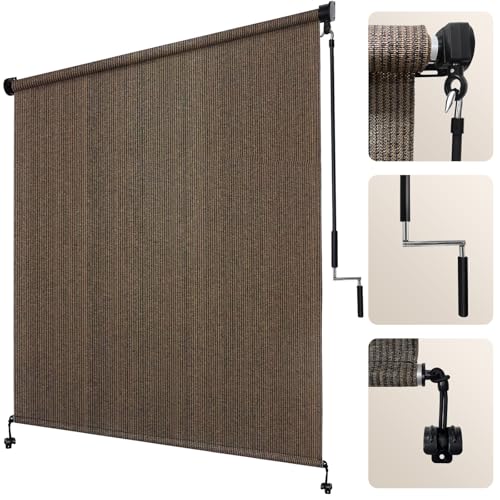
As an Amazon Associate we earn from qualifying purchases at no extra cost to you. Ratings are shown as listed on Amazon.
Quick comparison: which roller shade fits your situation?
| Situation | Best shade type | Useful specification | Main compromise |
|---|---|---|---|
| Living room with daytime glare | Solar screen roller shade | 3% to 5% fabric openness | Not fully private after dark when lights are on |
| Bedroom needing darkness | Blackout roller shade | Opaque fabric plus side channels or an overlap | Less outward visibility and daylight |
| Street-facing room | Light-filtering shade | 1% to 3% openness or privacy weave | Soft glow remains in the room |
| Cold or sunny window | Thermal-backed roller shade | Foam-backed or multilayer fabric, preferably outside-mounted | Bulkier roll and a less textured appearance |
| Frequent daily operation | Motorized shade | Rechargeable battery rated for roughly 500 to 1,000 cycles per charge | Higher purchase price and eventual battery maintenance |
| Low-cost occasional use | Manual chain or spring roller shade | Aluminum tube and washable polyester fabric | Less convenient for tall or hard-to-reach windows |
Fabric openness determines privacy and the view
Fabric openness is the approximate percentage of the weave left open in a solar screen fabric. A 1% fabric has a tighter weave than a 5% fabric. Lower percentages generally block more glare and provide better daytime privacy, while higher percentages preserve more of the view and admit more natural light.
- 1% openness: best for strong sun, computer-screen glare, and high privacy during daylight. The view is dimmer and more muted.
- 3% openness: the most balanced choice for many living rooms and offices. It reduces glare while retaining a recognizable view outside.
- 5% openness: better for rooms where daylight and outward visibility matter more than privacy. Interior visibility can reverse at night.
- 10% openness: primarily a glare-softening choice. It is not a reliable privacy solution after sunset.
Openness is not the same as visible-light-transmittance percentage, and manufacturers may measure each differently. Treat it as a comparison within the same fabric range rather than a guarantee of identical performance between brands.
Blackout performance: fabric is only half the answer
A blackout fabric can prevent light from passing through the cloth, but it cannot automatically eliminate the bright strips around the shade. Inside-mounted shades commonly leave a gap at each side because the fabric must roll freely. Light may also enter above the headrail or below the bottom bar.
For the darkest result, choose an outside mount that extends beyond the opening, or use a blackout roller shade with side channels and a cassette. A cassette conceals the rolled fabric and may reduce light leakage at the top. Side channels guide the edges and are particularly useful in bedrooms, nurseries, and rooms with early-morning sun.
A practical target is to extend an outside-mounted shade at least 2 to 3 inches beyond each side of the window opening and 3 to 4 inches above it, provided the wall and trim allow this. More overlap usually improves darkness, but it requires enough clear wall space for the brackets and rolled shade.
Thermal materials: what helps and what does not
Thermal roller shades reduce heat transfer by adding resistance between the glass and the room. Look for multilayer polyester, foam-backed fabric, reflective backing, or a closely woven fabric designed for solar control. A white or reflective exterior-facing side can reduce solar heat gain more effectively than a dark backing.
Thermal shades work best when they fit closely and are lowered during the relevant weather conditions. During summer, close them before direct sun reaches the glass. During winter, open them on sunny exposures to admit free solar heat, then close them after the sun moves away.
Do not treat a shade’s fabric label as a complete window-insulation rating. The glass, frame, air leakage, mounting gap, and curtain or shade coverage all affect the result. Honeycomb shades generally insulate better than a single-layer roller shade, but a thermal roller shade may be preferable when a clean, compact profile and easy cleaning matter more than maximum insulation.
Inside mount versus outside mount
Choose an inside mount when:
- The window recess is deep, square, and free of handles or locks that obstruct the shade.
- You want to display decorative trim around the window.
- You can accept small side gaps and some light leakage.
- The recess is at least as deep as the manufacturer’s bracket requirement, commonly about 2 to 3 inches.
Choose an outside mount when:
- Blackout performance and privacy are priorities.
- The recess is shallow, uneven, or obstructed by a handle.
- You want the shade to make a small window appear wider or taller.
- You need room for a cassette, side channels, or a larger roller tube.
Outside mounting needs a flat, structurally sound surface. Drywall alone may not hold a heavily motorized shade securely; use appropriate anchors or fasten into framing where possible. Check that the shade will not collide with window hardware, nearby doors, heating vents, or cabinet doors.
How to measure roller shades accurately
Use a steel tape measure, not a flexible sewing tape, and record every measurement to the nearest 1/8 inch or 1 millimeter. Measure each window separately, even when several windows appear identical.
- Check the opening. Look for a square recess, protruding handles, screens, locks, and trim that could interfere with the roll.
- Measure the width in three places. For an inside mount, measure the top, middle, and bottom of the recess. Record the narrowest width. Do not subtract anything unless the manufacturer specifically instructs you to; many suppliers make the deduction themselves.
- Measure the height in three places. Record the longest height for an inside mount so the fabric reaches the sill. For an outside mount, measure from the intended bracket position to the desired bottom position.
- Measure depth. Include the depth available from the front edge of the recess to the glass, while allowing clearance for handles and the rolled fabric.
- Measure outside mounts from the planned coverage. Add at least 2 inches to the opening width where possible, giving about 1 inch of overlap on each side. Add 3 to 4 inches above the opening for the headrail and top light gap.
- Confirm the fabric width. A roller shade’s finished fabric is often narrower than its total bracket-to-bracket width. Ask for the actual fabric deduction before ordering if maximum coverage is important.
Example: If a recess measures 35 1/4 inches at the top, 35 inches in the middle, and 35 1/8 inches at the bottom, use 35 inches as the inside-mount width unless the supplier specifies a different deduction. For an outside mount covering that same opening, a target width of about 37 to 38 inches provides useful overlap.
Manual or motorized?
Manual chain shades are economical and do not require charging, but chains can become inconvenient on wide, tall, or frequently used windows. Motorized shades are worth considering for high windows, multiple rooms, or a regular schedule. A typical rechargeable unit may operate approximately 500 to 1,000 cycles per charge, but the real figure depends on shade width, fabric weight, temperature, and how far the shade travels.
Estimate runtime needs before choosing a motor. If a shade is opened and closed twice daily, that is four movements per day, or about 120 movements per month. A battery rated for 800 movements would theoretically last about 6.7 months under those conditions; heavier shades, colder rooms, and partial charging can reduce that estimate. Select a motor with manual override or accessible charging if the window is important for emergency ventilation or daily use.
Ownership realities and common mistakes
- Dust accumulates on horizontal surfaces. Vacuum with a brush attachment at low suction or use a dry microfiber cloth. Test any damp cleaning on an inconspicuous area first.
- Chain mechanisms wear before fabric does. Forced pulls, misaligned brackets, and repeatedly dragging a shade sideways can damage the clutch or roller tube.
- Blackout fabric can show edge glow. This is usually a mounting issue, not a defective cloth. Side channels or a wider outside mount are the practical fixes.
- Heavy fabric needs adequate hardware. A wide thermal or blackout shade may require a larger tube and center support to prevent sagging.
- Humidity can affect longevity. In bathrooms and kitchens, choose moisture-resistant polyester and leave enough airflow to prevent mildew around the roll and window recess.
- Never force a shade that binds. Recheck level, bracket spacing, and handle clearance before continuing to operate it.
Bottom line
Choose 1% to 3% openness for stronger daytime privacy, blackout fabric with an outside mount or side channels for sleeping areas, and a thermal-backed material for heat or cold control. Use an inside mount for a neat, trim-preserving installation when the recess is deep and square; choose an outside mount when light leakage, shallow depth, or window hardware makes an inside fit unsuitable. Accurate measurements and adequate overlap usually matter more to real-world performance than a small difference in fabric color or pattern.

Write Your Review
No reviews yet. Be the first to share your experience!