
Key takeaways
- Find the best home alarm 12V battery: match capacity, size and F1 terminals, swap the panel battery safely, and keep standby cover during an outage today.
As an Amazon Associate we earn from qualifying purchases.
Every wired home alarm panel has a battery hiding inside its metal cabinet, and most owners only discover it when the keypad starts complaining. The panel runs from the mains supply in normal conditions. The battery is the standby supply: when the power fails, it keeps the panel, keypads, sensors and sounder alive until the mains return. When that battery ages out, the panel may report a low-battery fault, beep at intervals, or fail a standby test even though the alarm otherwise works perfectly.
This article is about that replacement battery only. It is not a roundup of alarm systems, sirens or alarm clocks, which are different products covered elsewhere on this site. The product type here is narrow and standardised: a 12-volt sealed lead-acid battery, sized for an alarm panel cabinet, with spade terminals that push onto the panel leads. One product is featured, the long-running 7 amp-hour model that the manufacturer itself describes as a standard-sized 12-volt battery commonly used in home alarm systems. Only one product is featured because only one candidate met the verification standard in this session: its ASIN confirmed in Amazon US product information, its specifications taken from that Amazon US page, and no unavailable or no-offer wording on the page opened. Other familiar alarm batteries named in the editorial notes could not be confirmed to the same standard before verification stopped, so they were held for a live check rather than included on weaker evidence.
Disclosure: This article contains affiliate links. If you buy through these links, we may earn a commission at no additional cost to you.
How to Choose a Home Alarm 12V Battery
Match the label on the old battery first
The safest replacement is the one that matches the battery already in your panel on four points: voltage, capacity, case size and terminal type. Voltage is fixed by the keyword and by almost every residential panel: 12 volts. Capacity is stated in amp-hours. A 7 amp-hour battery is the common panel size because it gives a useful standby period in a cabinet-sized case; a smaller 4 or 5 amp-hour battery will usually work electrically but will run down sooner in a long outage, while a larger battery may simply not fit the cabinet.
Case size is the point buyers most often skip. Measure the old battery, length, width and height, and compare those numbers with the replacement listing. Panel cabinets have little spare room, the battery often sits in a defined tray or corner, and the cabinet door must close without pressing on the terminals or leads. Terminal type is the fourth match. Most panel batteries use flat spade terminals, in two widths commonly called F1 and F2. The featured battery uses F1 terminals. If your panel leads were fitted for the wider spade, do not force them; use the correct terminal size or a proper adapter, and confirm the fit before you order.
Understand what sealed lead-acid means in a panel
A panel battery is a sealed lead-acid battery, also described as valve-regulated, using absorbent glass mat construction in the featured model. Sealed matters indoors: there is no topping up, no free liquid to spill in normal use, and the battery can sit in the cabinet for years on float charge from the panel. The panel does the charging for you. Your job is only to fit a healthy battery of the right size and to replace it when the panel reports that it can no longer hold a useful charge.
Do not substitute a car battery, a motorcycle battery with different terminals and venting, or a loose lithium pack unless your panel manufacturer explicitly approves that chemistry and form. Panel charging circuits are designed around the sealed lead-acid battery they were supplied with, and the cabinet, leads and charging voltage all assume it.
Plan the swap before you open the cabinet
Swapping a panel battery is simple, but do it in the right order. Silence or note any fault on the keypad first, and tell anyone else in the house that the alarm will be opened. Open the panel cabinet, and before touching the leads, note which lead goes to which terminal: the positive lead is normally red and connects to the marked positive terminal. Photograph the arrangement if you are unsure. Pull the leads off the old battery, fit them to the new battery in the same positions, positive to positive and negative to negative, and make sure each connector is firm. Never let the two leads touch each other while they are disconnected, and never short the battery terminals with a tool.
After the swap, close the cabinet and give the panel time. A low-battery warning may take a while to clear while the new battery charges and the panel re-tests it. Check the keypad later the same day, run the panel test routine if your system provides one, and write the fitting date on the battery case with a marker so the next replacement is planned rather than discovered during an outage.
Dispose of the old battery properly
A sealed lead-acid battery should not go in household waste. Take the old battery to a retailer or local collection point that accepts lead-acid batteries for recycling. Keep it upright, protect its terminals from contact with metal objects during transport, and hand it over as a complete unit.
Know the limits of a standby battery
The panel battery covers the panel and its wired devices. It does not power your router, your phone line equipment or any separate communicator unless those have their own standby supply, so a long outage can still affect how the alarm reports even while the panel itself stays alive. Capacity, battery age and how many devices draw current all affect standby time, which is another reason to fit the full standard capacity rather than a smaller substitute.
The Verified Pick
ExpertPower EXP1270 12V 7Ah Sealed Lead-Acid Battery
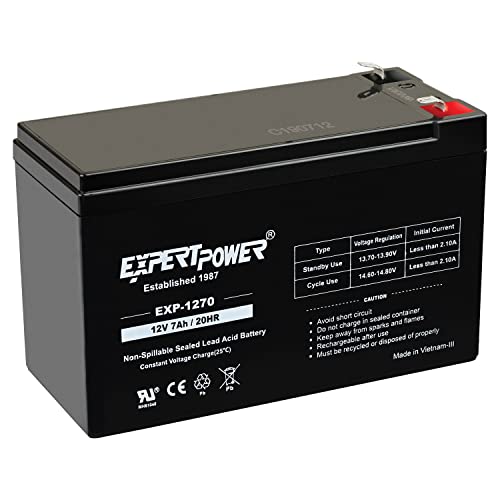
The ExpertPower EXP1270 is a 12-volt, 7 amp-hour rechargeable sealed lead-acid battery, model EXP1270, made by ExpertPower. Its Amazon US product information states dimensions of 5.9 by 2.5 by 3.7 inches and a weight of 4.3 pounds, which is the standard panel-battery footprint: long enough to hold a useful charge, narrow enough for a panel cabinet, and light enough to handle one-handed while you work at the cabinet.
The manufacturer description on the listing is direct about the intended use. It calls the EXP1270 a standard-sized 12-volt battery commonly used in cable boxes and home alarm systems, and lists home alarm systems, home security systems, uninterruptible power supplies, emergency systems and lighting equipment among its applications. The listing also states that the external casing is made with hardened ABS plastic to protect against spills and leaks, and that the battery uses absorbent glass mat technology, capable of delivering high currents on demand. The product information lists the battery cell type as lead acid, the reusability as rechargeable, and a one-year warranty description.
For an alarm owner, those details line up with the four matching checks above. Voltage is 12 volts. Capacity is 7 amp-hours, the standard panel size. The case dimensions match the common panel footprint, subject to the final check against your own old battery. The terminal type stated for this model is F1 spade terminals, so confirm your panel leads are F1 before ordering; if your old battery is an F2 model, resolve the terminal question first rather than bending connectors to fit.
Fitting follows the sequence in the guide above: note the lead positions, transfer red to positive and the other lead to negative, seat the connectors firmly, close the cabinet, and allow the panel to charge and re-test. Mark the installation date on the case. If the keypad fault does not clear after the battery has had a proper charging period, the problem may lie in the panel charging circuit or the leads rather than in the new battery, and that is a job for an alarm installer rather than a second battery swap.
- Amazon US listing: https://www.amazon.com/dp/B003S1RQ2S
- Model: EXP1270
- Voltage and capacity: 12 volts, 7 amp-hours
- Dimensions and weight: 5.9 by 2.5 by 3.7 inches, 4.3 pounds
- Construction: sealed lead-acid, absorbent glass mat, ABS case
Comparison Table
| Product | Voltage | Capacity | Dimensions | Terminals | ASIN |
|---|---|---|---|---|---|
| ExpertPower EXP1270 | 12V | 7Ah | 5.9 x 2.5 x 3.7 in | F1 spade | B003S1RQ2S |
Only one row is shown because only one battery met the verification standard in this session. A smaller-capacity or different-terminal battery is not a like-for-like alternative for most panels, so filling the table with unverified models would not have helped a buyer choose; it would only have hidden the checks that actually matter, which are set out in the guide above.
Frequently Asked Questions
How do I know the panel battery needs replacing?
The usual signs are a low-battery message or fault light on the keypad, periodic beeping that returns after silencing, or a panel that reports a fault after a short power cut. Batteries age even though they are rarely discharged deeply, because they sit on float charge continuously. If the message names the panel battery, start there before suspecting the panel itself.
Can I fit a higher-capacity battery for longer standby?
Only if it physically fits the cabinet, the door closes without strain, and the terminals match. A larger case often will not fit a residential panel cabinet. The standard 7 amp-hour size featured here is the capacity most such cabinets were designed around, so measure carefully before choosing anything larger.
What if my old battery has wider terminals?
Then your panel leads expect the wider spade size. Do not crimp or force F1 connectors to grip, and do not leave a loose connection inside an alarm cabinet. Either choose a verified battery with the matching terminal size or use a proper adapter, and confirm the terminal type from the old battery label before ordering.
How long should the warning take to clear after a swap?
Allow the panel a charging and re-test period, then check the keypad again later the same day. Exact behaviour varies by panel. If a low-battery fault persists after a full charging period with firm connections, have the panel checked, because the charging circuit or a lead may be at fault.
Is this battery only for alarms?
No. The listing also names uninterruptible power supplies, security systems, emergency systems, lighting equipment, scooters and feeders among its uses. This article recommends it specifically as a home alarm panel battery because its voltage, capacity, case size and construction match that application; the same matching checks apply to any other use.
Conclusion
Replacing a home alarm 12V battery is a matching exercise, not a shopping adventure: 12 volts, the capacity on the old label, a case that fits the cabinet, and terminals that match the leads. The ExpertPower EXP1270, ASIN B003S1RQ2S, is the verified standard-size answer here, a 7 amp-hour sealed lead-acid battery whose own listing names home alarm systems as a core use. Measure your old battery, confirm the F1 terminals, swap the leads in the order described, date the new case, and recycle the old battery. That short routine restores the standby cover your alarm was designed to have when the mains supply fails.
More from Amazon
Programs that pair well with the guide above. Offers and eligibility are set by Amazon and may change.
Free shipping on eligible items, Prime Video and more. Eligible new members can start with a free trial.
Start a Prime free trialAudiobooks and podcasts to listen to on the go. Eligible new members can start with a free trial.
Try Audible freeAd-free music streaming. Eligible new subscribers can start with a free trial.
Try Music Unlimited freeA free business account with business pricing and bulk-buying tools for work, shop or home office.
Create a business accountAs an Amazon Associate we earn from qualifying purchases.



Write Your Review
No reviews yet. Be the first to share your experience!