

Key takeaways
- About 1,800–2,500 KV: common for 1/8-scale vehicles using 4S–6S batteries.
- About 2,800–3,800 KV: versatile for 1/10 3S trucks and general off-road driving.
- About 3,500–5,000 KV: suited to lighter 1/10 2S cars, buggies and on-road models.
The best brushless RC cars for most drivers are 1/10-scale 4WD models with a 3S-compatible system, sealed electronics, and a motor in the 2,800–4,000 KV range; choose a 2S 2WD buggy for inexpensive on-road driving, or a 4S–6S 1/8 truck when acceleration and rough-terrain control matter more than running cost.
Our top picks

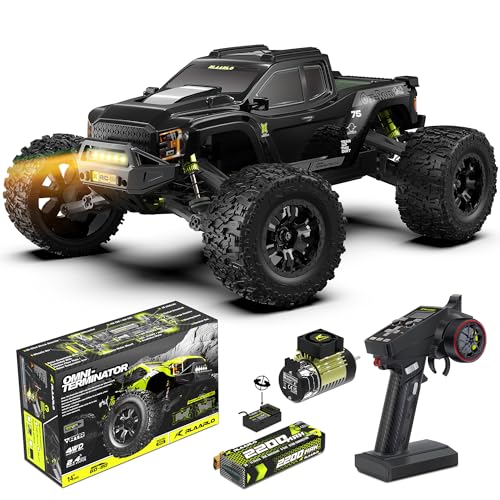

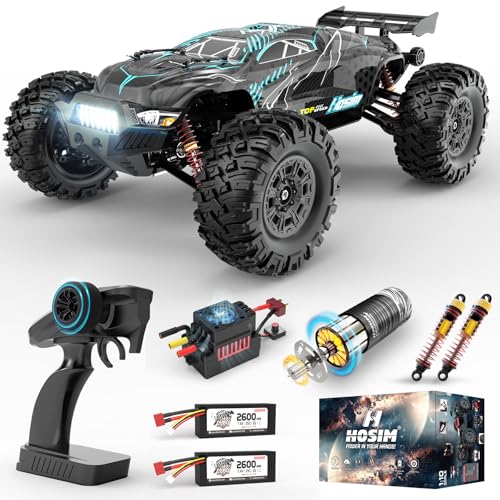
As an Amazon Associate we earn from qualifying purchases at no extra cost to you. Ratings are shown as listed on Amazon.
Best brushless RC cars by driving situation
| Situation | Best configuration | Why it fits | Typical budget in 2026 |
|---|---|---|---|
| First performance RC car | 1/10 4WD, 2S–3S, 3,000–3,800 KV | Manageable speed, good traction, broad parts availability | $250–$450 |
| Smooth pavement and parking lots | 1/10 2WD or 4WD short-course truck, 2S, 3,500–4,500 KV | Lower weight and simpler drivetrain; 2WD is easier to maintain | $180–$400 |
| Grass, gravel and loose dirt | 1/10 4WD stadium truck or monster truck, 3S, 2,800–3,500 KV | Ground clearance and four-wheel traction reduce bogging | $300–$550 |
| Large jumps and demanding terrain | 1/8 4WD truggy or monster truck, 4S–6S, 1,800–2,500 KV | Larger driveline, tires and suspension tolerate higher loads | $500–$900 |
| Lowest ownership cost | 1/10 2WD buggy or truck, 2S, 3,500–4,500 KV | Fewer gears, shafts and bearings to replace | $180–$350 |
How motor KV changes the buying decision
KV means the motor’s approximate unloaded revolutions per minute per volt. A 3,000 KV motor on a nominal 11.1-volt 3S battery has a theoretical unloaded speed of about 33,300 RPM. A 4,500 KV motor on the same battery would approach 49,950 RPM, creating substantially more heat and drivetrain stress. Real speed is lower because of load, gearing, tire size and electrical losses.
Higher KV generally favors light 1/10 cars on smooth surfaces. It delivers brisk throttle response but can overheat on large tires, thick grass or repeated full-throttle runs. Lower KV is usually the safer choice for 1/8 vehicles and off-road use because it produces a better balance of torque, heat control and battery life.
- About 1,800–2,500 KV: common for 1/8-scale vehicles using 4S–6S batteries.
- About 2,800–3,800 KV: versatile for 1/10 3S trucks and general off-road driving.
- About 3,500–5,000 KV: suited to lighter 1/10 2S cars, buggies and on-road models.
Do not compare KV alone. A motor’s can size, ESC current rating, gearing and battery voltage are equally important. Two motors with the same KV can behave very differently if one is a larger, higher-torque design.
2WD versus 4WD: which is better?
Choose 2WD for simplicity and smooth surfaces
2WD cars power either the rear or front wheels, so they have fewer differential gears, driveshafts and bearings. That usually means less maintenance, lower weight and a lower purchase price. Rear-wheel-drive models are especially entertaining on pavement because they can slide under acceleration.
The compromise is traction. A 2WD car can struggle on wet grass, loose gravel and uneven ground. It also requires more throttle control: abrupt acceleration may unload the front wheels or spin the rear tires rather than move the car forward.
Choose 4WD for loose ground and predictable control
4WD sends power to all four wheels and is the stronger choice for dirt, grass, gravel and jumps. It accelerates more consistently and is easier for a new driver to control. Models such as the Traxxas Maxx, ARRMA KRATON and comparable 1/8 or 1/10 trucks illustrate the broad categories: compact 4WD basher, high-power 1/8 truck and general-purpose off-road performance.
Four-wheel drive adds weight and rotating parts. More components mean more bearings to inspect, more drivetrain losses and more parts that can be damaged by impacts. For a small paved area, 4WD may provide capability you do not use.
Battery compatibility matters more than headline speed
A brushless vehicle may be sold as “2S,” “3S,” “4S” or “6S.” The “S” indicates the number of lithium-polymer cells in series. Nominal voltage is approximately 7.4 volts for 2S, 11.1 volts for 3S, 14.8 volts for 4S and 22.2 volts for 6S.
Verify four details before buying a battery:
- Cell count: never install a higher-voltage pack unless the ESC and motor are rated for it.
- Connector: common plugs include IC3/EC3, IC5/EC5, XT60 and XT90. A matching connector is preferable to an improvised adapter.
- Physical size: measure the battery tray, including its length, width and height limits.
- Discharge capability: a pack must supply the vehicle’s current demand without excessive voltage sag or heat.
Runtime depends on capacity and driving style. As a useful estimate, a 5,000 mAh pack used at an average 20 amps provides approximately 0.25 hours, or 15 minutes, before allowing a safety reserve. In practice, expect roughly 12–20 minutes from a 5,000 mAh pack in a fast 1/10 truck and less in a heavy 1/8 vehicle driven aggressively. Carrying two packs is often more useful than buying a much faster model.
On-road versus off-road setup
For pavement, look for a lower ride height, firmer springs, oil-filled shocks and tires with a continuous tread or slick surface. A 2S setup often gives enough speed for a driveway or empty lot while keeping temperatures manageable. Avoid operating fast RC cars near traffic, pedestrians or property where a loss of control could cause damage.
For off-road driving, prioritize ground clearance, flexible suspension arms, sealed bearings and tires with open tread. A 4WD truck with moderate KV is generally more usable than a high-KV car that overheats in grass. Large tires increase speed and ground clearance but also increase motor load; they should not be fitted casually without checking temperatures and gearing.
Waterproofing is useful, not unlimited
“Waterproof electronics” normally refers to the receiver box, ESC and motor being designed to tolerate splashes or shallow water. It does not make the entire vehicle maintenance-free. Bearings, steel shafts, screws and differentials can still corrode, and water can enter through connectors or a damaged receiver-box seal.
After wet running, disconnect the battery, remove the body and blow away water with cool air. Rinse off salt or muddy residue with clean water only when necessary, then dry the vehicle thoroughly. Apply suitable bearing lubricant after it is dry. Never charge a wet battery, and do not immerse a vehicle unless the manufacturer specifically permits it.
Durability and ownership costs
The parts that commonly wear first are tires, wheel hexes, bearings, suspension hinge pins, shock shafts and differential gears. Hard landings can bend steering links or crack suspension arms even on expensive models. Brushless motors themselves are often durable, but overheating shortens the life of motor bearings, magnets and ESC components.
A realistic first-year budget should include two or three battery packs, a compatible balance charger, replacement tires, bearings and a few suspension parts. A $300 vehicle can easily require another $100–$200 for useful equipment and consumables. Generic 1/10 platforms often cost less to keep running because parts are widely available, while high-power 1/8 models consume tires and driveline components faster.
Pre-run setup that prevents avoidable damage
- Inspect wheel nuts, suspension arms and driveshafts before every run.
- Confirm the battery is undamaged and fully balanced before connecting it.
- Set the transmitter’s throttle limit to 50–75% for a new driver or confined space.
- Drive for five minutes, then check motor, ESC and battery temperatures.
- If the motor or ESC is too hot to keep a finger on comfortably, stop and investigate gearing, tire size, ventilation and battery choice.
- Clean dirt from the gears and suspension after the run, and store lithium-polymer batteries at the charger’s recommended storage level.
For most buyers in 2026, the sensible all-round choice is a 1/10 4WD brushless truck that accepts both 2S and 3S batteries. Select 2S and 2WD when your space is paved and maintenance simplicity matters; select a lower-KV 1/8 4WD model when you have room for rough terrain and are prepared for higher battery, tire and repair costs.

Write Your Review
No reviews yet. Be the first to share your experience!