

Key takeaways
- Brushed: Lower purchase and repair cost, gentle throttle response, and simple electronics. Brushes and commutators wear over time, especially in dust and water.
- Brushless sensorless: Higher speed and efficiency with little motor wear. It can feel abrupt at very low speed, which is less suitable for precision crawling.
- Brushless sensored: Smooth low-speed control and strong efficiency, but usually more expensive and more complex. It is useful for competition or drivers who want both crawling precision and speed.
The best RC trucks for off-road fun are the ones matched to your terrain and driving experience: choose a 1/10-scale 4WD brushless truck for speed and rough ground, a crawler for rocks and slow technical driving, or a 1/24-scale model when space, noise, and budget matter most.
Our top picks


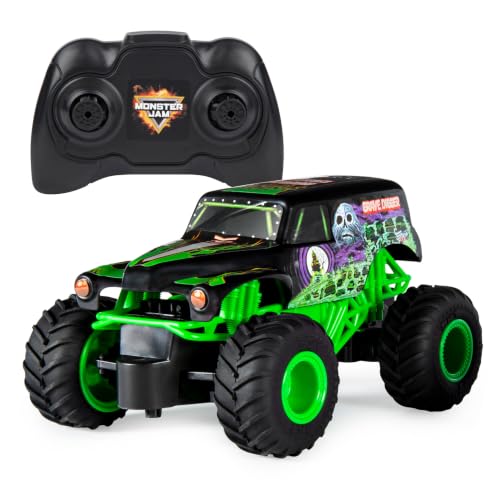
As an Amazon Associate we earn from qualifying purchases at no extra cost to you. Ratings are shown as listed on Amazon.
Best RC trucks by driving situation
| Situation | Best truck type | Useful target specifications | Why it fits |
|---|---|---|---|
| First serious off-road truck | 1/10-scale 4WD brushed basher | 25–35 mph, 3,000–5,000 mAh battery, oil-filled shocks | Forgiving controls, affordable parts, and enough clearance for grass, dirt, and gravel |
| Fast jumps and open dirt | 1/10-scale 4WD brushless truck | 35–60 mph, 3S LiPo support, 8–10 in ground clearance | High acceleration and stronger performance in loose terrain |
| Rocks, roots, and steep climbs | Trail crawler | 4WD, low-range gearing, 45–60° approach angle, 45+ minutes per charge | Precise throttle control and suspension articulation matter more than speed |
| Small yard or indoor driving | 1/24- or 1/18-scale crawler | 6–12 in long, 500–1,500 mAh battery, 10–20 minutes per charge | Quiet, compact, and less likely to damage furniture or landscaping |
| Heavy mud and wet grass | Sealed 4WD basher | Water-resistant electronics, sealed bearings, 3,000–5,000 mAh battery | Designed for rinsing and repeated exposure to splash, provided maintenance follows |
Our practical picks by category
Best all-round starting point: a 1/10 4WD brushed basher
A 1/10-scale stadium truck or short-course truck is the safest recommendation for most beginners. Models such as the Traxxas Slash 4X4 in brushed form and the ARRMA Granite 4×4 MEGA offer a useful balance of stability, replacement-part availability, and manageable speed. Brushed motors are less expensive to replace and tend to deliver smoother, less intimidating acceleration.
Expect roughly 20–35 minutes of driving from a battery in the 3,000–5,000 mAh range, depending on gearing, surface, temperature, and how often you use full throttle. A brushed truck is also easier on driveline components because it normally produces less instant torque than a comparable brushless setup.
Best for speed: a 1/10 4WD brushless basher
Experienced drivers who have open dirt, a large field, or a dedicated RC track should consider a brushless truck. The ARRMA Granite 4×4 BLX and Traxxas Slash 4X4 VXL are familiar examples of the category. Brushless motors have fewer wear parts, run efficiently, and can deliver strong acceleration on 2S or 3S LiPo batteries.
The trade-off is that speed exposes every weakness. A brushless truck can break suspension arms, bend driveshafts, strip gears, or overheat tires after a hard landing. Beginners should start in the lowest speed mode, use a 2S battery where supported, and learn throttle control before fitting a higher-voltage pack.
Best for technical terrain: a trail crawler
For rocks, roots, drainage channels, and steep garden slopes, a crawler is a better choice than a fast basher. The Axial SCX10 III and Traxxas TRX-4 represent the 1/10 trail-crawler class. Their low gearing, high-torque motors, locked or lockable differentials, and carefully controlled suspension make them capable at walking pace.
Crawlers usually consume less energy than speed trucks, so a 5,000 mAh NiMH or LiPo battery can provide approximately 45–90 minutes of intermittent trail driving. Do not compare that figure directly with a basher’s runtime: a crawler spends much less time at full throttle. Portal axles, when fitted, can increase ground clearance, but they also add gears and potential maintenance points.
Best for limited space: a 1/24 crawler
A small crawler such as the Axial SCX24 is a sensible choice for apartment use, a small backyard, or casual driving around indoor obstacles. These trucks are inexpensive to operate and less likely to damage walls, furniture, or plants. Their small tires and light weight, however, make thick grass, loose gravel, and tall roots feel much larger than they would to a 1/10 truck.
Motor types: brushed or brushless?
- Brushed: Lower purchase and repair cost, gentle throttle response, and simple electronics. Brushes and commutators wear over time, especially in dust and water.
- Brushless sensorless: Higher speed and efficiency with little motor wear. It can feel abrupt at very low speed, which is less suitable for precision crawling.
- Brushless sensored: Smooth low-speed control and strong efficiency, but usually more expensive and more complex. It is useful for competition or drivers who want both crawling precision and speed.
Motor size and gearing matter as much as the label. A large pinion gear may increase top speed but also raises motor and electronic speed-control temperatures. After a demanding run, temperatures around 160–180°F can indicate that gearing, tire size, or driving conditions need attention; use the manufacturer’s limits for the specific electronics rather than relying on a universal number.
4WD, 2WD, and suspension travel
Four-wheel drive is the better default for off-road use because it maintains traction when the front wheels climb over uneven ground. It is particularly helpful on wet grass, loose soil, and hills. The disadvantages are extra weight, more rotating parts, and more components to inspect.
Two-wheel drive is lighter, simpler, and often more entertaining on a smooth dirt surface. It also teaches throttle and steering control. However, a 2WD truck may struggle when its driven wheels lose contact with the ground or when the front end encounters deep ruts.
Suspension travel is not simply a case of “more is better.” Long travel helps keep tires on uneven ground, while excessive softness can make a truck roll in corners and bottom out on landings. Oil-filled shocks with adjustable preload are more useful than a large travel figure alone. For a 1/10 truck, approximately 25–40 mm of usable wheel movement is a practical range for general bashing; crawlers use articulation and axle movement differently from high-speed trucks.
Battery runtime: a quick way to estimate it
Battery capacity gives a rough comparison, not a guarantee. A 5,000 mAh battery is 5 Ah. If a truck averages 15 amps during a mixed run, the theoretical runtime is:
5 Ah ÷ 15 A = 0.33 hours, or about 20 minutes.
In practice, the electronic speed control usually cuts power before the battery is completely empty, and acceleration creates brief high-current peaks. A realistic estimate is therefore about 15–25 minutes for a fast 1/10 basher on one 5,000 mAh pack. Crawling at low speed can extend the same battery to 45 minutes or more.
LiPo batteries provide strong power and lower weight but require a balance charger, correct storage voltage, and careful inspection for swelling or damage. NiMH batteries are heavier and less energetic, yet they are simpler for a first-time owner. Never charge either chemistry unattended or with the wrong charger setting.
Waterproofing is not the same as maintenance-free
“Water-resistant” electronics can usually tolerate splash, damp grass, and shallow puddles, but the term does not mean that a truck can be submerged indefinitely. Water can remain inside bearings, motor housings, wheel hexes, and differential cases after the outside appears dry.
After wet driving, remove the battery, shake out standing water, dry the chassis with low-pressure air or a towel, and leave it ventilated. Clean muddy grit before it hardens. Avoid high-pressure water because it can force contamination past seals. A truck used regularly in mud may need bearing replacement several times per season, while a dry-surface truck may go much longer.
Ownership costs and what usually wears first
- Tires: Soft tires provide grip but wear quickly on asphalt and may balloon at high speed.
- Suspension arms and turnbuckles: These commonly take the impact from bad landings and are worth keeping as spares.
- Bearings: Dust and water cause roughness, drag, and heat. Sealed bearings still need inspection.
- Slipper clutches and differential gears: Incorrect adjustment or oversized tires can overload the drivetrain.
- Body mounts and clips: Small, inexpensive parts that are easy to lose during repeated rollovers.
A sensible first purchase budget includes the truck, a compatible battery, a balance charger if required, spare suspension arms, shock oil, thread-locking compound for metal-to-metal screws, and basic hex drivers. Buying the fastest truck available often costs more over time because tires, batteries, and broken driveline parts become more expensive.
Final buying advice
Choose a 1/10 4WD brushed basher if you want the most forgiving introduction. Choose a brushless model when you have room to control speed and are prepared for higher repair costs. Choose a crawler when your terrain is steep, rocky, or technical, and choose a 1/24 model when storage and driving space are limited. Before ordering, verify battery dimensions, connector type, spare-part availability, water-resistance claims, and whether the package includes a charger—those details determine how usable the truck will be after it arrives.








Write Your Review
No reviews yet. Be the first to share your experience!