

Key takeaways
- A dependable seal: A silicone or rubber gasket should sit evenly around the lid and require light, consistent pressure to close. A decorative lid with no gasket is suitable for wrapped snacks or utensils, but not ideal for flour, sugar, or coffee.
- A usable opening: A mouth at least 8–10 cm wide is much easier to scoop from than a narrow jar opening. This matters especially with flour, which tends to compact around corners.
- Stable proportions: A broad base is safer beside a mixer, kettle, or coffee grinder. Tall, narrow canisters use less counter depth but are more likely to tip.
- Easy cleaning: Smooth glazed ceramic, stainless steel, and powder-coated steel resist staining better than unfinished wood or textured finishes.
The best farmhouse kitchen canister set for most standard counters is a three- or four-piece set with powder-coated steel or glazed ceramic bodies, silicone-lined airtight lids, and roughly 1.5–2.5 litre capacity per canister.
Our top picks


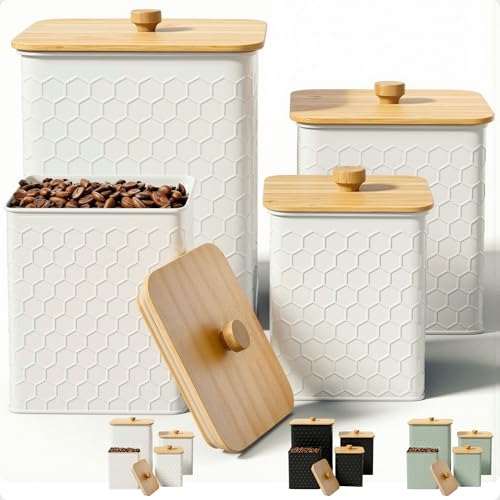
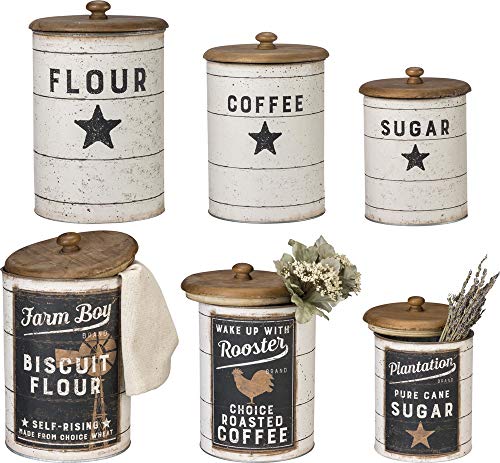
As an Amazon Associate we earn from qualifying purchases at no extra cost to you. Ratings are shown as listed on Amazon.
Quick picks by kitchen situation
| Kitchen situation | Best canister type | Recommended capacity | Why it fits | Likely market range |
|---|---|---|---|---|
| Small counter with limited upper-cabinet clearance | Stackable steel or compact ceramic | 0.9–1.5 litres | Keeps height near 13–16 cm while holding everyday quantities | $25–$60 for a set of three |
| Frequent home baking | Wide-mouth ceramic or glass | 2–3 litres | More practical for measuring cups and flour scoops | $45–$120 for a set of three or four |
| Busy household needing quick identification | Opaque steel with large label panels | 1.5–2.2 litres | Blocks light and makes flour, sugar, and coffee easy to distinguish | $30–$80 for a set of three |
| Display-first farmhouse kitchen | Glazed ceramic with wooden or metal lids | 1.2–2 litres | Best visual match for vintage, cottage, and country décor | $50–$150 for a set of three |
What makes the best farmhouse kitchen canister set?
Farmhouse styling is useful only if the canisters also protect ingredients and work comfortably on the counter. Look for four practical features:
- A dependable seal: A silicone or rubber gasket should sit evenly around the lid and require light, consistent pressure to close. A decorative lid with no gasket is suitable for wrapped snacks or utensils, but not ideal for flour, sugar, or coffee.
- A usable opening: A mouth at least 8–10 cm wide is much easier to scoop from than a narrow jar opening. This matters especially with flour, which tends to compact around corners.
- Stable proportions: A broad base is safer beside a mixer, kettle, or coffee grinder. Tall, narrow canisters use less counter depth but are more likely to tip.
- Easy cleaning: Smooth glazed ceramic, stainless steel, and powder-coated steel resist staining better than unfinished wood or textured finishes.
Material trade-offs: ceramic, steel, glass, or plastic?
Glazed ceramic
Ceramic gives the strongest traditional farmhouse appearance and usually feels substantial on the counter. It blocks light, helping protect coffee and other light-sensitive dry goods. The drawbacks are weight and breakage. A large ceramic flour canister may weigh 1–2 kg before it is filled, so it is less convenient if you regularly move ingredients to a work surface.
Check the underside and rim for a smooth glaze. A porous unglazed interior can retain oils and odors. Ceramic lids also need a gasket or close-fitting seal; weight alone does not make a lid airtight.
Powder-coated or stainless steel
Steel is the most practical choice for everyday counter storage. It is light, opaque, resistant to impact, and easy to wipe clean. Powder-coated finishes are available in cream, sage, black, and muted blue, which suit farmhouse kitchens without requiring a distressed finish.
The weak points are dents, chipped coating, and lid mechanisms. A loose slip lid can look attractive but may allow moisture exchange. For flour and sugar, choose a steel body with a silicone-sealed lid rather than a purely decorative vintage-style lid.
Glass
Glass makes it easy to see how much remains and is generally simple to wash. It is useful for frequently used coffee beans, oats, or sugar. Clear glass is less suitable for long-term coffee storage if the canister sits in direct sunlight, and glass becomes heavy at larger capacities. A glass jar with a clamp and replaceable gasket can seal well, but the hinge and gasket need occasional cleaning.
Plastic
Food-safe plastic is inexpensive and light, making it practical inside a pantry or for households that prefer low breakage risk. It usually looks less convincingly farmhouse on an exposed counter and can absorb odors or scratch over time. If choosing plastic, prioritize a thick, BPA-free container with a replaceable or securely fitted silicone seal.
Capacity and counter-fit calculations
Nominal litres do not translate directly into ingredient weight because different foods have different densities. A useful planning estimate is:
| Ingredient | Typical volume needed | Practical canister size | Approximate capacity |
|---|---|---|---|
| All-purpose flour, 5 lb bag | About 4.4–4.8 litres | Two medium canisters or one large pantry container | 2 × 2.5 litres, or 5 litres |
| Granulated sugar, 4 lb bag | About 1.8–2.1 litres | One large counter canister | 2.2–2.5 litres |
| Ground coffee, 12 oz bag | About 1.0–1.3 litres | One medium canister | 1.2–1.5 litres |
For a typical three-canister arrangement, allow at least 45–60 cm of linear counter space if the canisters sit side by side. A common set with 1.5-litre, 2-litre, and 2.5-litre bodies may occupy approximately 12–15 cm of depth and 15–22 cm of height per piece. Measure the space between the backsplash and the front edge of the counter, then measure the lowest cabinet or shelf above it. Leave at least 2 cm of clearance above each lid so it can be removed without scraping the cabinet.
A 2-litre canister does not need to be filled completely. Leaving 10–15% headspace makes scooping cleaner, but buying a canister that is too small forces partial bags into storage and reduces the benefit of the set.
Head-to-head: the main farmhouse canister formats
Three-piece matching set
A three-piece set labelled for flour, sugar, and coffee gives the most coordinated appearance and is usually the best starting point. The limitation is that equal-sized pieces are not equally efficient: coffee may need only 1–1.5 litres, while flour benefits from 2.5 litres or more. Choose a graduated set if possible.
Four-piece set with a smaller fourth canister
This format adds useful storage for tea, salt, oats, or baking soda without demanding much additional counter length. It is a stronger choice for households that bake regularly. The fourth piece is only valuable if it has a clear purpose; otherwise it adds another lid and surface to clean.
Mix-and-match jars
Combining a large flour container, medium sugar container, and smaller coffee container often produces the best functional result. It may look slightly less uniform, but each ingredient gets an appropriate capacity. Match the finishes and lid colors rather than forcing identical dimensions.
Seal quality and freshness: what to inspect
- Run a finger around the gasket to check for gaps, twists, or flattened sections.
- Close the empty canister and lift it by the lid only if the manufacturer indicates that the seal is designed for this; otherwise, use the body as the lifting point.
- Prefer a replaceable gasket for clamp-top or engineered-seal designs. Silicone eventually loses elasticity, especially when exposed to heat or harsh detergents.
- Do not confuse an airtight seal with moisture-proof storage after opening. Always use a dry measuring cup and close the lid promptly.
- For coffee, store the canister away from the stove and direct sunlight. A seal limits air exchange but does not make a transparent container light-proof.
Cleaning and durability realities
The gasket is usually the first part to need attention. Flour dust and sugar crystals can collect underneath it, preventing a complete seal. Remove the gasket if the design allows, wash it with mild dish soap, rinse thoroughly, and let it dry fully before reinstalling. A damp seal can introduce unwanted moisture into dry ingredients.
Wash a new canister before its first use, then empty and clean it before switching from one ingredient to another. Do not repeatedly top up old flour or coffee with a fresh bag: older residue can affect flavor, attract pantry pests, or hide moisture clumps. Instead, use the oldest ingredient first, wash the container, and refill it.
Check care instructions before putting ceramic, painted steel, wood lids, or gaskets in a dishwasher. High heat can dull decorative finishes, swell wood, and shorten gasket life. For a countertop set intended to last several years, hand-washing the lid and gasket is usually a worthwhile trade-off.
Bottom line
Choose a graduated three- or four-piece set with a 2.2–2.5-litre flour container, a roughly 2-litre sugar container, and a 1.2–1.5-litre coffee container. Pick powder-coated steel for the best balance of durability and low weight, glazed ceramic for the strongest farmhouse look, and glass when visibility matters more than light protection. The most attractive set is not the best choice if its lids are decorative rather than sealed or if its dimensions leave flour and sugar in half-open bags.

Write Your Review
No reviews yet. Be the first to share your experience!