

Key takeaways
- 26 oz vinyl: a reasonable balance of weight, price, and durability.
- 28–30 oz vinyl: better for frequent handling and harsher weather, but heavier to remove.
- Marine-grade or UV-resistant vinyl: preferable for full-time outdoor exposure.
- Reinforced corners and stitching: help prevent tearing where straps and handles load the cover.
- Heat-sealed or well-protected hinge areas: reduce water entry at the most vulnerable seam.
The best hot tub covers for insulation and protection are custom-fit tapered foam covers with at least 5 inches of thick-side insulation, 26–30 oz marine-grade vinyl, reinforced handles, and a reliable wind-lock system.
Our top picks
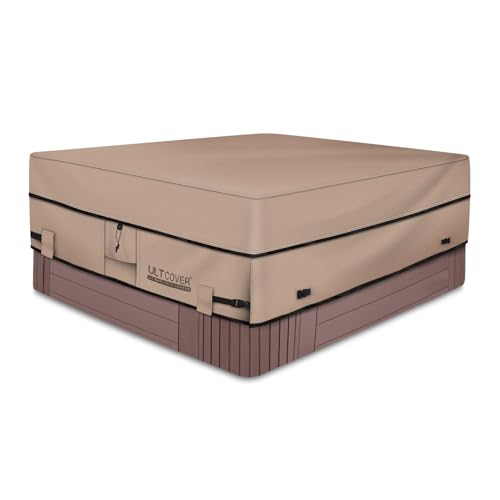


As an Amazon Associate we earn from qualifying purchases at no extra cost to you. Ratings are shown as listed on Amazon.
Quick picks by hot tub situation
| Situation | Best cover type | Specification to target | Typical 2026 price range |
|---|---|---|---|
| Lowest upfront cost | Standard tapered foam cover | 4-inch to 2-inch taper, 26 oz vinyl, 1 lb foam density | $250–$450 |
| Cold or windy climate | High-insulation replacement cover | 6-inch to 4-inch taper, 1.5–2 lb foam, reinforced wind straps | $400–$700 |
| Frequent use and repeated removal | Heavy-duty cover with skirting and reinforced handles | 5-inch to 3-inch taper, 28–30 oz vinyl, double-stitched seams | $450–$750 |
| Snow-prone area | High-density foam cover with strong center hinge | 6-inch to 4-inch taper, 2 lb foam, tight vapor barrier | $500–$800 |
| Odd-shaped or older spa | Custom-made cover | Exact corner radii, hinge position, skirt length, and cutouts | $400–$900+ |
These are general market ranges rather than fixed prices. Size, shipping, upgraded vinyl, foam density, and accessories can change the final cost considerably.
What makes one hot tub cover better insulated than another?
Hot tub covers usually contain two tapered foam panels. The thick edge sits around the outside perimeter, while the thinner edge meets at the center hinge. This shape allows rain and snow to run off, but the foam thickness and density determine how much heat escapes.
A cover described as “5-inch” usually means approximately 5 inches at the outer edge, not across its entire surface. A 5-inch-to-3-inch taper offers noticeably more insulation than a 4-inch-to-2-inch cover, particularly in cold weather. For a well-insulated spa used several times per week, a 5-inch-to-3-inch taper is a sensible baseline. In freezing or persistently windy conditions, consider 6 inches at the thick edge.
Foam density matters as well as thickness
Foam density is commonly listed as 1 lb, 1.5 lb, or 2 lb. Higher-density foam is heavier and generally resists compression better, although it does not automatically make a poorly sealed cover efficient. A practical combination for demanding conditions is 6-inch-to-4-inch foam with 1.5 lb or 2 lb density and a properly sealed vapor barrier.
The vapor barrier is critical. If moisture enters the foam, the panels become heavier, sag, and lose insulating performance. A cover with excellent foam specifications can still fail early if its plastic vapor barrier is punctured or its hinge seal deteriorates.
Vinyl durability: what to look for
The outer shell protects the foam from ultraviolet light, rain, snow, chemicals, and abrasion. Vinyl weight is often expressed in ounces per square yard. For most residential spas, 26 oz vinyl is an acceptable minimum. Choose 28–30 oz vinyl if the cover will be removed often, exposed to strong sunlight, or handled by an assisted lift mechanism.
- 26 oz vinyl: a reasonable balance of weight, price, and durability.
- 28–30 oz vinyl: better for frequent handling and harsher weather, but heavier to remove.
- Marine-grade or UV-resistant vinyl: preferable for full-time outdoor exposure.
- Reinforced corners and stitching: help prevent tearing where straps and handles load the cover.
- Heat-sealed or well-protected hinge areas: reduce water entry at the most vulnerable seam.
Vinyl is not a substitute for maintenance. Clean the cover with mild soap and water, rinse away residue, and use a vinyl protectant only if it is specifically compatible with spa-cover vinyl. Avoid household solvents, abrasive brushes, and products that leave an oily surface, since these can damage the finish or transfer contamination into the spa.
Fit measurements that prevent expensive mistakes
The best hot tub covers fit the spa rather than merely matching its advertised capacity. A “six-person” spa may have substantially different outside dimensions from another six-person model.
Measure these five details
- Length: measure the outside acrylic or cabinet edge from end to end.
- Width: measure the outside edge at the widest point.
- Corner radius: place a straightedge along each side and measure the curve; do not assume every rounded corner is the same.
- Skirt length: measure from the top of the spa to the point where you want the cover skirt to finish. The common range is about 4–6 inches.
- Hinge orientation and cutouts: note steps, handrails, waterfalls, speakers, and controls that could obstruct the cover.
Do not add extra inches “for safety.” A cover that is too large can sag over the cabinet, collect water, catch wind, and interfere with a lifter. A cover that is too small leaves the acrylic exposed and allows heat to escape. For a square or rectangular spa, a useful check is that the cover should overlap the spa perimeter evenly, with the skirt hanging consistently on all sides.
As a worked example, suppose the spa measures 84 by 84 inches outside the cabinet. A cover ordered at 84 by 84 inches may be correct if the manufacturer specifies outside-edge dimensions and the corner radius matches. If the supplier’s sizing system refers to the acrylic shell instead, the required cover could differ. Confirm the reference point before ordering rather than relying on the nominal spa size.
Wind locks and safety features compared
Wind is one of the fastest ways to turn a good cover into a damaged one. Look for adjustable safety straps with buckles that attach to the spa cabinet, not just decorative handles. The straps should hold the cover down without compressing the foam excessively.
- Basic straps: adequate in sheltered yards when adjusted tightly.
- Four-point wind locking: better for exposed decks and moderate wind.
- Six-point or additional corner straps: useful for large covers and open, windy locations.
- Lockable buckles: provide an extra barrier against children opening the cover, but they are not a replacement for proper supervision.
A spa-cover lifter can reduce dragging and folding, but verify compatibility before buying. Hydraulic and assisted lifters make thick covers easier to handle, while simple under-mount or side-mount lifters cost less but need adequate clearance. Repeatedly dragging a cover across decking is likely to wear the underside, skirt, and corner stitching before the top vinyl fails.
Decision matrix: which specification should you choose?
| Your priority | Recommended choice | Why | Trade-off |
|---|---|---|---|
| Lowest purchase price | 4–2 inch taper, 26 oz vinyl | Usually the lightest and least expensive configuration | More heat loss and shorter service life in severe weather |
| Lowest operating cost | 5–3 or 6–4 inch taper, 1.5–2 lb foam | Reduces heat loss when the spa is not being used | Higher purchase price and greater lifting weight |
| Daily or near-daily use | 28–30 oz vinyl with reinforced handles | Better suited to frequent opening and closing | May need a lifter because of the added weight |
| Small deck or tight clearance | Custom dimensions and a compatible lifter | Prevents the cover from hitting walls, rails, or furniture | Custom orders cost more and require careful measurements |
| Heavy snow | High-density foam and strict snow removal | Resists compression better than lightweight foam | No spa cover should be treated as a roof or seating area |
Ownership realities: what wears out first?
The first failure is often not the foam. Common early problems include cracked vinyl at folded corners, torn handles, stretched straps, a damaged hinge seal, and waterlogged foam caused by a small puncture. Sun exposure accelerates vinyl aging, while standing water puts continuous stress on the foam and stitching.
Inspect the cover monthly. Check whether the center is sagging, whether the skirt still hangs evenly, and whether the foam feels unusually heavy. Remove leaves and snow promptly. Never place furniture, pets, or people on the cover, and do not shovel aggressively across the vinyl.
A quality cover may last roughly 5–7 years under favorable conditions, while harsh sunlight, poor drainage, frequent dragging, or saturated foam can shorten that period. Replacing straps, buckles, or handles may extend useful life, but waterlogged foam usually means the cover needs replacement rather than a minor repair.
Bottom line
For most buyers, the best hot tub covers are custom-fit models with a 5-inch-to-3-inch taper, 1.5 lb foam, 26–28 oz UV-resistant vinyl, reinforced handles, and four adjustable wind-lock straps. Upgrade to 6-inch-to-4-inch, higher-density foam for cold or exposed locations. Spend less on a basic 4-inch-to-2-inch model only when the spa is sheltered, used seasonally, and the lower insulation performance is acceptable.

Write Your Review
No reviews yet. Be the first to share your experience!