

Key takeaways
- Small round table or everyday condiments: Look at 10–14 inches. A large tray can crowd place settings and make it harder for diners to reach their plates.
- Four- to six-person table and occasional shared sides: A 14–18-inch model is a flexible starting point. Measure the space between the center and the nearest plates before settling on a diameter.
- Large table or frequent family-style meals: Consider 18–24 inches if the table has enough clear space. A broad surface distributes dishes, but may still be awkward if diners have to reach across it.
- Heavy cookware or loaded serving bowls: Prioritize a published capacity comfortably above the expected load and a rigid base. If no capacity is stated, contact the manufacturer rather than assuming that a bigger tray is stronger.
- Children, uneven floors, or a delicate tabletop: Favor a low profile and a grippy underside. A tall, lightweight tray can wobble or slide more readily when someone turns it off-center.
The right size depends on your table—and what you serve
The best lazy susan for dining table use is usually a low-profile, non-slip turntable about 2–4 inches smaller than the clear tabletop area it needs to occupy. Choose a smooth-bearing model sized for your serving dishes, not just your table: a compact 12-inch tray suits condiments, while a 20–24-inch model can hold several shared dishes on a larger table.
Before buying, check five things: usable diameter, height, stated weight capacity, bearing construction, and material. Product listings often show the outside dimensions but not how much room remains for plates—or whether the tray will sit steadily under a heavy casserole.
Our top picks


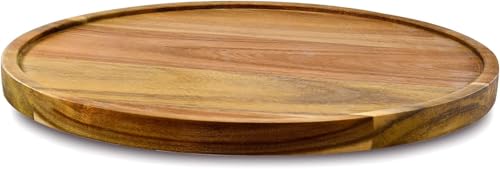
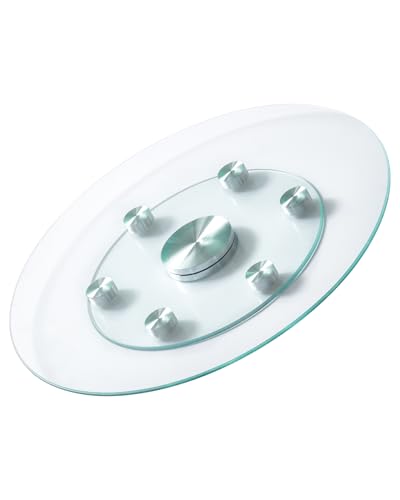
As an Amazon Associate we earn from qualifying purchases at no extra cost to you. Ratings are shown as listed on Amazon.
Compare common sizes and materials
The figures below are practical selection ranges, not guarantees for every product. Capacities vary with bearing design, construction, and how evenly the load is distributed; use the maker’s rating when one is available.
| Typical diameter | Useful for | Typical height | Indicative capacity range | Common materials |
|---|---|---|---|---|
| 10–12 in | Salt, pepper, sauces, and a few small bowls | 0.5–1.5 in | About 5–15 lb | Plastic, bamboo, wood, or metal |
| 14–16 in | Condiments plus a shared side dish | 0.5–2 in | About 10–25 lb | Wood, bamboo, plastic, or glass |
| 18–20 in | Several serving bowls on a medium or large table | 0.75–2.5 in | About 15–35 lb | Wood, bamboo, glass, or metal |
| 22–24 in | Family-style meals with multiple dishes | 1–3 in | About 20–50 lb | Wood, bamboo, glass, or metal |
Choose by table size and serving style
- Small round table or everyday condiments: Look at 10–14 inches. A large tray can crowd place settings and make it harder for diners to reach their plates.
- Four- to six-person table and occasional shared sides: A 14–18-inch model is a flexible starting point. Measure the space between the center and the nearest plates before settling on a diameter.
- Large table or frequent family-style meals: Consider 18–24 inches if the table has enough clear space. A broad surface distributes dishes, but may still be awkward if diners have to reach across it.
- Heavy cookware or loaded serving bowls: Prioritize a published capacity comfortably above the expected load and a rigid base. If no capacity is stated, contact the manufacturer rather than assuming that a bigger tray is stronger.
- Children, uneven floors, or a delicate tabletop: Favor a low profile and a grippy underside. A tall, lightweight tray can wobble or slide more readily when someone turns it off-center.
Size it before you order
Use the table’s clear serving area, not its full width. Measure the open space between place settings, glasses, and any centerpiece. For a round table, the tray’s diameter should generally be no more than about two-thirds of that clear area; for a rectangular table, also check that diners at the ends can reach past it.
Example: A 48-inch round table has roughly 30 inches of open central space after allowing for plates and glasses. A 20-inch tray takes up two-thirds of that space and leaves about 5 inches of clearance on each side. If the table’s place settings sit closer to the center, step down to 16 or 18 inches. This is a fit estimate, not a substitute for laying out your actual dishes.
Then mock up the footprint with cardboard or a paper circle. Put your usual serving bowls on it, including handles and lids. A tray that fits empty may feel crowded once a casserole dish and a sauce bowl are in place.
What makes one turn smoothly?
The rotating platform usually turns on a bearing assembly beneath it. A well-aligned bearing should rotate without grinding, catching, or excessive side-to-side play. Ball-bearing designs are common on larger serving turntables; simpler pivot or low-cost bearing designs may be adequate for light condiments, but can feel less even under an off-center load.
For dining use, smoothness matters most when the tray is loaded. Check whether the product description identifies its bearing type, rated load, and any non-slip feet or base. A grippy underside helps keep the base in place while the top turns. It does not make an overloaded or poorly balanced tray safe.
Do not assume that a tray advertised as “heavy duty” has a high weight rating. If a listing gives no capacity, treat it as a light-duty option unless the maker confirms otherwise. Keep hot cookware within the product’s stated heat limits; wood, plastic, and some finishes can be damaged by direct heat.
Match the material to cleanup and care
- Wood: Warm-looking and sturdy, but usually needs prompt wiping and thorough drying. Avoid soaking it, which can encourage warping or cracks. Follow the maker’s instructions about oiling or finish care.
- Bamboo: Often relatively light and suitable for everyday serving. Like wood, it can swell or split if left wet or put through a dishwasher unless specifically labeled dishwasher-safe.
- Glass: Easy to wipe and visually unobtrusive, but heavier and vulnerable to chips or breakage. Check the edge finish and keep the bearing base stable before loading it with dishes.
- Plastic: Usually affordable and easy to clean. Confirm that it is food-contact safe and whether it is dishwasher-safe; thin trays may flex under heavy bowls.
- Metal: Durable and easy to wipe, but can scratch a tabletop if the underside lacks protection. Check for smooth edges and a non-marking base.
Price depends on size, material, finish, and bearing design. As a broad market guide, basic small models often fall around $10–$25, mid-size wood or bamboo options around $20–$50, and larger or more decorative designs around $40–$100 or more. These are general ranges, not quotes for a particular product.
Ownership: what wears out and how to avoid it
The rotating bearing is the part most likely to become rough, noisy, or loose over time, especially if crumbs and sticky spills get into the mechanism. Keep food and liquid out of the underside, and clean according to the manufacturer’s directions. Don’t spray cleaner or lubricant into the bearing unless the maker recommends it; residue can attract more debris or transfer to the table.
Three common mistakes shorten a lazy susan’s useful life: exceeding its load rating, carrying it by the rotating top while loaded, and placing it on a wet or uneven surface. Lift the base and top together when moving it, distribute heavy dishes around the center, and check that the base sits flat before serving. If the bearing becomes loose or the tray wobbles, stop using it for heavy or hot dishes until it is repaired or replaced.
Quick buying checklist
- Measure clear space between place settings, then test the footprint with a paper template.
- Choose a diameter that holds your usual dishes while leaving room for diners to reach.
- Compare the tray’s height with nearby glasses, plates, and centerpiece items.
- Look for a stated weight capacity that exceeds the combined weight of the dishes and food.
- Check for smooth rotation under load, a stable base, and a surface that suits your cleaning routine.
- Confirm heat and dishwasher limits rather than assuming the material can tolerate either.
For most households, a 14–18-inch model is a practical place to start, while larger family-style tables may call for 18–24 inches. The best lazy susan for dining table serving is the one that fits the real space around your place settings, turns steadily with your typical load, and is easy to care for after dinner.

Write Your Review
No reviews yet. Be the first to share your experience!