

Key takeaways
- Solid wood: Repairable and visually warm, but it expands and contracts with seasonal humidity. Small gaps or changes around the leaf are normal. Avoid placing it directly beside a radiator.
- Wood veneer: A thin real-wood surface over a stable core can be more dimensionally consistent than solid wood. It needs protection from standing water and sharp impacts because deep damage is harder to refinish.
- Engineered wood or laminate: Usually the practical budget choice. It resists everyday stains well, but swollen edges and chipped corners are difficult to repair.
- Glass: Makes a room look lighter and is easy to wipe clean, but fingerprints are conspicuous and compatible extension mechanisms are less common.
- Stone or ceramic tops: Highly resistant to many household spills, but heavy. Confirm that the floor, frame, and extension hardware are designed for the load.
The best extendable dining tables are the ones whose closed size fits your everyday room, whose extended size matches your largest regular gathering, and whose leaf storage does not become a long-term nuisance.
Our top picks

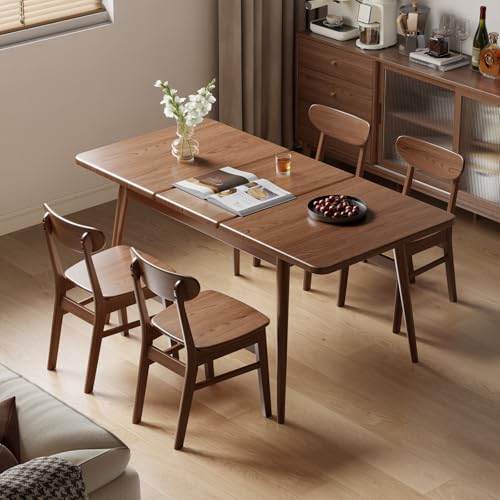

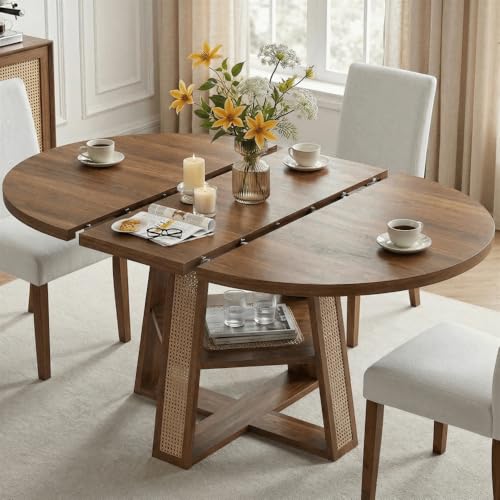
As an Amazon Associate we earn from qualifying purchases at no extra cost to you. Ratings are shown as listed on Amazon.
Best extendable dining tables by situation
| Best for | Recommended table type | Typical closed size | Typical extended size | Typical seating | What to prioritize |
|---|---|---|---|---|---|
| Small apartment or breakfast area | Drop-leaf or butterfly-leaf table | 30–42 in wide by 30–48 in long | 30–42 in by 60–72 in | 2–4 closed, 6 extended | Compact footprint and integrated storage |
| Daily family dining | Center-extension trestle table | 36–42 in by 60–72 in | 36–42 in by 84–96 in | 6 closed, 8–10 extended | Stable base and smooth, frequent operation |
| Large holiday meals | Multiple-leaf dining table | 42 in by 72–84 in | 42 in by 108–120 in | 6–8 closed, 10–12 extended | Leaf capacity and legroom at the ends |
| Low-maintenance ownership | Veneer or engineered-wood table | Usually 36–42 in by 60–72 in | Usually 36–42 in by 84–96 in | 6–10 | Replaceable hardware and a forgiving finish |
How the leading designs compare
Drop-leaf tables: best when floor space matters most
Drop-leaf tables have hinged sections that fold down beside the main top. With both leaves lowered, some models occupy little more than a console—often about 30 to 36 inches wide and 30 to 48 inches long. Raising one or both leaves can produce a 60- to 72-inch dining surface.
This is the most efficient choice for a narrow kitchen, apartment, or multipurpose room. The compromise is seating: the lowered leaves cannot usually support a full place setting, and the hinges and support brackets may feel less substantial than a full-size dining table. Look for solid locking supports, a level tabletop when open, and enough knee clearance beneath the raised sections.
IKEA’s Norden-style gateleg format illustrates the category: folded leaves and built-in storage make it unusually practical for small homes. Similar tables are sold by many manufacturers under gateleg, butterfly-leaf, or drop-leaf descriptions.
Butterfly-leaf tables: best for easy occasional expansion
A butterfly leaf folds in half and stores inside the table. Pulling the ends apart opens a central gap, where the folded leaf unfolds into place. A common configuration measures approximately 60 inches closed, 78 to 84 inches open, and seats six closed or eight extended.
Integrated storage is the main advantage. You do not need to find a closet for a separate leaf, and the leaf is less likely to be lost or damaged. Check the underside before buying: the leaf should ride on sturdy metal runners, the locking mechanism should engage without force, and the two halves should meet without a raised seam.
Center-extension tables: best for frequent use
Center-extension tables use slides beneath the top and add one or more leaves in the middle. A 60- or 72-inch table commonly grows to 84, 96, or 108 inches. Some tables use a synchronized mechanism, allowing both ends to move together; others require each end to be pulled separately.
This is usually the best all-round design for a household that eats at the table every day but hosts guests several times a month. It provides a more conventional, solid-looking top when closed and generally offers better stability than a lightweight drop-leaf model. The disadvantages are greater weight, a higher price, and the possibility that the leaves must be stored separately.
End-extension tables: best for a traditional appearance
End-extension designs add leaves at one or both ends. The tabletop may look particularly seamless when closed, but the end sections can require more lifting and alignment. Because the legs may move outward with the extensions, check whether anyone seated at the ends will encounter a pedestal or leg.
For tables used only a few times a year, this mechanism can be perfectly adequate. For weekly expansion, choose a model with metal extension slides rather than relying on wooden runners that may swell, dry out, or become difficult to operate.
Materials: what changes over time
- Solid wood: Repairable and visually warm, but it expands and contracts with seasonal humidity. Small gaps or changes around the leaf are normal. Avoid placing it directly beside a radiator.
- Wood veneer: A thin real-wood surface over a stable core can be more dimensionally consistent than solid wood. It needs protection from standing water and sharp impacts because deep damage is harder to refinish.
- Engineered wood or laminate: Usually the practical budget choice. It resists everyday stains well, but swollen edges and chipped corners are difficult to repair.
- Glass: Makes a room look lighter and is easy to wipe clean, but fingerprints are conspicuous and compatible extension mechanisms are less common.
- Stone or ceramic tops: Highly resistant to many household spills, but heavy. Confirm that the floor, frame, and extension hardware are designed for the load.
For most homes, a wood-veneer or solid-wood table with a durable clear finish is the best balance. Prioritize the frame and extension hardware over a fashionable surface material: a beautiful top is frustrating if the table rocks or the leaf jams.
Measure the room before choosing a size
Allow at least 36 inches between the table edge and the nearest wall, cabinet, or furniture. Forty-two inches is more comfortable where people need to walk behind seated diners. For a table that is 96 inches long when extended, the minimum practical room length is therefore about 168 inches: 96 inches for the table plus 36 inches at each end.
Width matters too. A 36-inch-wide table can accommodate place settings and shared dishes, but 40 to 42 inches is more comfortable for family-style meals. Do not count the table’s end seats if a wall, sideboard, or leg prevents someone from pulling out a chair.
A useful capacity estimate is 24 inches of table edge per adult. A 72-inch table can therefore seat three people per long side, or six comfortably without relying on the ends. At 84 inches, eight diners become realistic if the table legs do not interfere.
Leaf storage and assembly are buying criteria, not minor details
Integrated leaf storage is convenient, but it adds weight and can reduce clearance beneath the table. Open the table and inspect the storage compartment: leaves should lie flat, be protected from loose metal hardware, and be removable without turning the table upside down.
Separate leaves need a dry, horizontal storage location. Do not lean a large leaf against a wall for years; it can warp. Store it in the same room as the table when possible so both pieces experience similar humidity.
Assembly typically takes 45 to 120 minutes for two people. The difficult parts are aligning the extension slides, attaching a heavy pedestal, and keeping the frame square while tightening bolts. Assemble on a blanket, loosely install all fasteners first, then level the frame before final tightening. After several uses, check the bolts again because movement can settle the joints.
Ownership realities: what wears first
- Extension slides: Dust, crumbs, and overloading can make them stiff. Vacuum accessible tracks and use only the lubricant specified by the manufacturer.
- Leaf alignment: Do not force a partly closed table. Remove the leaf, clear the track, and check for a displaced support before applying pressure.
- Finish: Wipe spills promptly with a soft, slightly damp cloth. Avoid abrasive pads, soaking the top, and household cleaners containing bleach or ammonia.
- Uneven floors: A table that rocks may need adjustable glides rather than tightened extension hardware. Over-tightening can distort the frame.
- Heat and moisture: Use trivets and coasters. Even a durable finish can blush, crack, or discolor under hot cookware or prolonged moisture.
Final buying recommendation
Choose a drop-leaf table if your room is small and expansion is occasional. Choose a butterfly-leaf table if you want compact storage and quick setup. Choose a center-extension table if you will expand it regularly for family meals or guests. For the most versatile purchase, look for a 36- to 42-inch-wide table that is 60 to 72 inches closed, 84 to 96 inches extended, seats six in daily use and eight when expanded, and uses sturdy metal slides with either integrated or properly supported leaf storage.
The best extendable dining tables are not necessarily the longest or most elaborate. They are the tables whose closed dimensions suit everyday life, whose extended dimensions fit the room with chairs pulled out, and whose mechanism you will still be willing to operate years after assembly.

Write Your Review
No reviews yet. Be the first to share your experience!