

Key takeaways
- Remove packed grass from the deck after every difficult session; trapped moisture accelerates corrosion.
- Inspect blades for bends and cracks rather than sharpening a visibly damaged blade.
- Grease spindles, caster pivots, and hitch points at the interval specified in the manual.
- Use fresh fuel and the correct stabilizer when the machine will sit for more than a few weeks.
- Check tire pressure before mowing; uneven pressure changes deck height and increases belt load.
- Walk the field first and remove wire, cable, large rocks, and fallen branches.
Best Field Mowers for Tough, Overgrown Grass
The best field mowers for tough, overgrown grass are usually tow-behind rough-cut mowers for large, open areas, walk-behind brush mowers for uneven or fenced ground, and heavy-duty zero-turn or tractor-mounted decks when you need a finished cut as well as clearing power.
Choosing between them depends less on the advertised horsepower than on five practical questions: how wide a path you need to cut, whether the ground is smooth or rough, how often the mower will be used, where it will be stored, and whether your vehicle can safely tow or operate it.
Our top picks

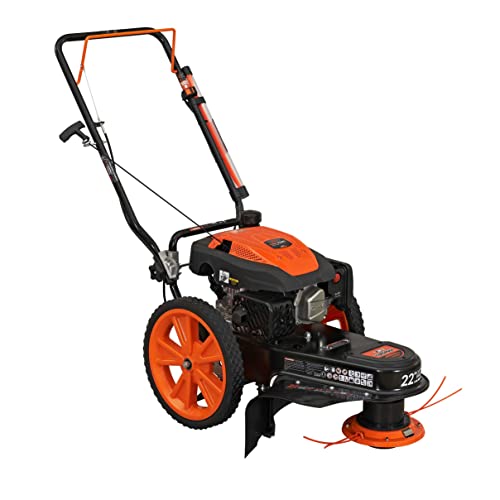


As an Amazon Associate we earn from qualifying purchases at no extra cost to you. Ratings are shown as listed on Amazon.
Quick picks by mowing situation
| Situation | Best mower type | Useful target specification | Main compromise |
|---|---|---|---|
| Large, open field used several times a year | Tow-behind rough-cut mower | 44–60-inch deck, 10–20 horsepower, 2-inch-plus blade overlap | Requires a suitable tow vehicle and wide storage |
| Uneven ground, paths, banks, or small paddocks | Walk-behind brush mower | 24–30-inch deck, 8–14 horsepower, large pneumatic tires | Slower and more physically demanding |
| Regular mowing where appearance matters | Heavy-duty zero-turn mower | 48–60-inch fabricated deck, 23–35 horsepower, adjustable discharge | Less tolerant of hidden rocks, stumps, and woody growth |
| Existing compact tractor with a three-point hitch | Rotary cutter | 48–72-inch deck, approximately 18–35 PTO horsepower | Needs tractor hydraulics, PTO protection, and adequate lift capacity |
| Very tight storage and occasional clearing | Compact walk-behind rough-cut mower | 20–24-inch deck, folding handle, under 180 pounds | Small cutting width makes large fields time-consuming |
How the main mower types compare
Tow-behind rough-cut mowers
These are often the most efficient choice for one- to five-acre fields. A 60-inch deck covers roughly 1.25 times the area of a 48-inch deck on each pass, although real productivity also depends on turning, obstacles, and grass density. Many use two or three blades and are designed to leave a coarse finish rather than a lawn-like surface.
Look for a deck made from at least 10-gauge steel, a protected belt or gearbox, replaceable spindle bearings, and a height range of approximately 2–5 inches. Larger models may accept a lawn tractor, garden tractor, or utility vehicle, but the tow vehicle must have enough braking ability for the combined weight on slopes.
A tow-behind mower is a poor choice if you need to maneuver around trees or if the field contains frequent ditches. It also adds hitching, greasing, belt inspection, and storage demands.
Walk-behind brush mowers
Walk-behind brush mowers are easier to place precisely and can handle ground that is too confined for a trailer-style unit. Their large tires and relatively slow blade speed help them cross uneven ground, while a swinging blade system can reduce damage from occasional small obstructions.
They are best for tall grass, weeds, brambles, and light woody stems within the manufacturer’s stated limit. Do not assume that a brush mower is a stump grinder: hidden metal, rocks, and thick saplings can bend blades, damage the crankshaft, or throw debris.
Handle layout matters. A height-adjustable handle, positive parking brake, dead-man control, and reverse or neutral position make hillside work safer and less tiring. Electric-start engines are worthwhile when the mower is heavy or used intermittently, because old fuel often makes pull-starting frustrating.
Heavy-duty zero-turn mowers
A commercial-style zero-turn is the fastest option when the grass is maintained frequently and the surface is reasonably clear. Fabricated decks, serviceable spindles, high-back seats, and dual hydrostatic transmissions generally withstand repeated work better than light stamped-deck machines.
However, a zero-turn mower is not automatically a field mower. Tall, wet grass can overload the deck, and exposed blades are vulnerable to rocks and roots. Choose a model with a high deck-lift range, a discharge chute that does not clog easily, and an engine with enough torque reserve rather than selecting solely by deck width.
Three-point rotary cutters
If you already own a compatible compact tractor, a rotary cutter can be the most economical long-term solution. The tractor supplies traction and lift, while the cutter handles rough vegetation over a broad path. A slip clutch or shear-bolt protection is important because it limits driveline damage when the blades encounter an obstruction.
Confirm the tractor’s PTO horsepower, rear lift capacity, hydraulic clearance, and turning radius. A 72-inch cutter may be too much for a small tractor even if it can physically lift the deck. On slopes, tractor weight, tire configuration, and rollover protection matter as much as cutter width.
What to prioritize before buying
Cutting width versus access
Wider is faster only when the field is open. Measure gates, shed doors, bridges, and the narrowest route to the mowing area. Allow at least 4 inches of clearance on each side of a machine for comfortable passage; more is preferable if the route requires turning.
For example, a 48-inch mower traveling at 3 miles per hour has a theoretical coverage rate of about 1.45 acres per hour. At 70% real-world efficiency for turns and overlaps, expect approximately 1 acre per hour. A 60-inch mower at the same speed produces about 1.8 theoretical acres per hour, or roughly 1.25 acres per hour in practical conditions.
Terrain and height adjustment
For rough ground, prioritize tire diameter, deck clearance, and a height adjustment that does not require crawling under the machine. Pneumatic tires absorb bumps better, but they can puncture; foam-filled or semi-pneumatic tires reduce downtime at the expense of ride softness.
A 3–5-inch cutting height is a sensible starting range for neglected grass. Begin high, then make a second lower pass if necessary. Removing more than one-third of the grass height in one pass can overload the machine and leave heavy windrows.
Engine power and towing
Engine size should match vegetation density, deck width, and speed. As a broad buying guide, 8–14 horsepower suits many walk-behind brush mowers, 10–20 horsepower is common for compact tow-behind units, and larger tow-behind machines may need 20 horsepower or more. These figures are not substitutes for the manufacturer’s requirements.
For towing, check the mower’s total weight, tongue weight, hitch height, and maximum recommended speed. A lawn tractor may pull a small mower on level ground but lack the brakes, traction, or stability for a heavy unit on a slope. Never use a small riding mower as a substitute for a properly rated utility vehicle when the combination is heavy or the terrain is steep.
Ownership costs and maintenance realities
General 2026 market ranges are approximately $1,000–$3,000 for a capable walk-behind brush mower, $1,500–$5,000 for a tow-behind rough-cut mower, and $5,000–$15,000 or more for a commercial-grade zero-turn mower. Tractor implements vary widely because the tractor is a separate investment.
The parts that wear first are usually blades, blade bolts, belts, spindle bearings, tires, and skid shoes. Budget for replacement blades and a spare belt before the first season. A mower that cuts only a few annual acres may still need fresh fuel, battery charging, belt inspection, and lubrication between uses.
- Remove packed grass from the deck after every difficult session; trapped moisture accelerates corrosion.
- Inspect blades for bends and cracks rather than sharpening a visibly damaged blade.
- Grease spindles, caster pivots, and hitch points at the interval specified in the manual.
- Use fresh fuel and the correct stabilizer when the machine will sit for more than a few weeks.
- Check tire pressure before mowing; uneven pressure changes deck height and increases belt load.
- Walk the field first and remove wire, cable, large rocks, and fallen branches.
A common mistake is lowering the deck immediately to produce a neat finish. With overgrown grass, this can stall the engine, clog the discharge, and bury the deck in wet clippings. A high first pass followed by a lower finishing pass is usually faster and kinder to the drivetrain.
Storage footprint and buying decision
Measure the complete stored dimensions, not only the deck. A 60-inch tow-behind mower may need approximately 72 inches of practical doorway width once the hitch and side clearance are included. Walk-behind models with folding handles may fit in a 30-inch-wide shed opening, but confirm that folding does not require removing cables or controls.
If you mow weekly and have clear, maintained ground, choose a fabricated-deck zero-turn. If you clear tall growth only a few times per year, a walk-behind brush mower usually avoids the cost and storage burden of a large rider. For open acreage and an appropriate tow vehicle, a tow-behind rough-cut mower offers the best balance of coverage and price. If a compact tractor is already available, match a rotary cutter to its PTO rating and lift capacity before considering another engine-powered machine.
Bottom line
The best field mowers are not simply the widest or most powerful models. Select the narrowest machine that covers the area efficiently, has enough clearance and torque for the vegetation, can be safely transported or towed, and will fit through the storage route. For most property owners, that means a walk-behind brush mower for difficult access, a tow-behind rough-cut mower for open fields, or a properly matched rotary cutter when a tractor is already part of the equipment fleet.

Write Your Review
No reviews yet. Be the first to share your experience!