

Key takeaways
- The best heavy duty sewing machines for tough fabrics are the Juki TL-2010Q for serious straight-stitch work, the Janome HD3000 for a dependable all-purpose mechanical machine, the Singer Heavy Duty 4452 for budget buyers, and the Brother ST371HD when you…
The best heavy duty sewing machines for tough fabrics are the Juki TL-2010Q for serious straight-stitch work, the Janome HD3000 for a dependable all-purpose mechanical machine, the Singer Heavy Duty 4452 for budget buyers, and the Brother ST371HD when you need both heavy-fabric capability and decorative stitches.
“Heavy duty” does not mean the same thing on every model. Some machines use a stronger motor and metal internal components; others mainly add a dark-colored body, a faster top speed, or extra presser feet. For denim, canvas, workwear repairs, bags, and multiple fabric layers, the important questions are whether the machine maintains needle penetration, gives you precise stitch control, leaves room under the presser foot, and has enough throat space to handle bulky projects.
Our top picks
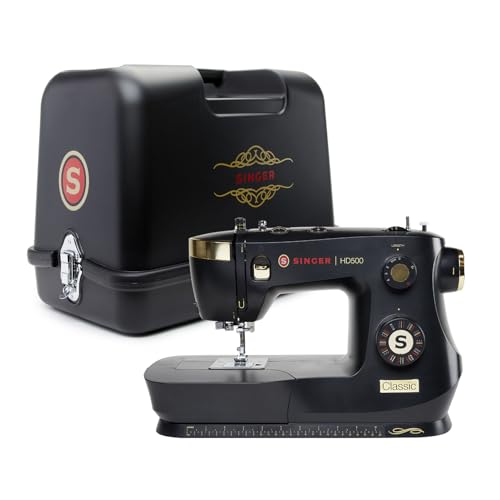

As an Amazon Associate we earn from qualifying purchases at no extra cost to you. Ratings are shown as listed on Amazon.
Quick comparison: the leading heavy-duty choices
| Machine | Best use | Stitch selection | Maximum stitch length | Weight | Notable clearance or workspace |
|---|---|---|---|---|---|
| Juki TL-2010Q | Frequent straight-stitch sewing, canvas, denim, quilting | 1 straight stitch | 6 mm | Approx. 11.5 kg / 25.4 lb | Approx. 8.5 in to the right of the needle |
| Janome HD3000 | General household sewing with regular heavy-fabric projects | 18 built-in stitches | 4 mm | Approx. 7.2 kg / 15.9 lb | High presser-foot lifter; removable free arm |
| Singer Heavy Duty 4452 | Budget repairs, garments, hems, and occasional bags | 32 built-in stitches | 4.0 mm | Approx. 7.1 kg / 15.7 lb | High presser-foot lifter; removable free arm |
| Brother ST371HD | Beginners wanting utility stitches and simple controls | 37 built-in stitches | 5 mm | Approx. 6.0 kg / 13.2 lb | Wide table included; removable free arm |
Published specifications can vary slightly by country and revision. Weight and stitch counts are useful for comparison, but they do not prove that one machine will sew every fabric better. Motor torque, feed-dog traction, needle choice, thread tension, and the operator’s technique matter just as much.
Best overall for thick layers: Juki TL-2010Q
The Juki TL-2010Q is the strongest choice when your priority is controlled straight stitching rather than a large collection of decorative patterns. Its long 6 mm stitch length, speed control, needle-up/needle-down function, adjustable presser-foot pressure, and generous throat space make it particularly suitable for denim quilts, canvas bags, upholstery-weight materials, and long seams.
Its advantage is control. A slider lets you reduce sewing speed when crossing a bulky seam, while a foot controller and thread-trimming controls help when you sew repeatedly. The machine’s extended work area is also more useful than a small free arm when handling a large tote, quilt, or jacket panel.
Choose it if you sew tough fabrics weekly or want a machine that behaves more like a compact industrial straight-stitch machine. Do not choose it as your only machine if you regularly need zigzag, blind-hem, stretch, or buttonhole stitches. Its typical market price is substantially higher than basic mechanical heavy-duty models.
Best balanced mechanical machine: Janome HD3000
The Janome HD3000 is a practical middle ground. It provides 18 stitches, a four-step buttonhole, adjustable stitch length and width, a metal internal frame, and a high presser-foot lifter. It is better suited than a straight-stitch-only machine to ordinary clothing, repairs, home accessories, and occasional denim or canvas work.
For two or three layers of medium-weight denim, it should be a comfortable choice with the correct needle and thread. Four or more layers at a flat-felled seam can be a different matter: the machine may need a slower speed, a hump-jumper or leveling tool, and manual assistance over the thickest point.
The HD3000 is a good fit for an experienced beginner who wants mechanical controls rather than a computerized display. It is also a sensible ownership choice when you need one machine for both everyday fabric and periodic heavy projects.
Best budget option: Singer Heavy Duty 4452
The Singer Heavy Duty 4452 is attractive because it combines a low-to-mid market price with a fast maximum sewing speed, 32 stitches, a one-step buttonhole, and a range of included accessories. It is capable of handling denim hems, canvas seams, household repairs, and several layers when set up correctly.
Its fast speed is useful for long straight seams, but it can work against precision. New users should use the foot pedal gently or reduce speed by sewing in short controlled bursts. The machine’s utility depends heavily on the needle and thread: a universal needle and lightweight polyester thread are not the right combination for thick canvas.
Buy the 4452 when budget matters and heavy-fabric sewing is occasional rather than industrial-level. It is less compelling for someone who needs a large throat space, very fine speed control, or daily work on dense materials.
Best for beginners who want more stitch variety: Brother ST371HD
The Brother ST371HD offers 37 stitches, straightforward controls, a wide table, and a lighter body than the Juki or Janome. It is easier to move and stores well in a small sewing area. The extra stitch choices are useful for simple stretch seams, decorative edges, and garment repairs.
It can sew denim and light-to-medium canvas, but “heavy duty” should not be interpreted as a guarantee for continuous upholstery or multiple layers of webbing. Its lighter construction and smaller working area are trade-offs for portability and accessibility.
This is the most approachable option for a beginner who expects to sew ordinary garments most of the time and only occasionally works with tougher fabric.
How the key specifications affect tough-fabric sewing
Motor power and torque
Manufacturers do not consistently publish comparable motor-wattage figures, so advertised wattage is a poor buying shortcut. Look instead for stable penetration at low speed, a metal frame, adjustable presser-foot pressure, and a machine that does not stall when the needle enters a seam crossing.
A fast machine is not automatically powerful. Speed describes how quickly the needle cycles without load; torque describes how confidently it continues under load. For thick fabric, controlled low-speed torque is more valuable than maximum stitches per minute.
Stitch control
For denim and canvas, useful controls include adjustable stitch length up to about 4–6 mm, selectable needle position, reverse stitching, and a speed limiter or smooth foot pedal. A longer stitch can reduce perforation in heavy cloth, while a shorter stitch is useful for curved seams and reinforcement.
Presser-foot clearance
High lift matters when inserting several layers under the foot, but it does not mean the machine can sew through any thickness. If the foot is forced upward by a bulky seam, feed becomes uneven and the needle can deflect. Level the foot as it approaches a ridge, reduce speed, and rotate the handwheel through the first stitches.
Throat space
Throat space is the distance from the needle to the machine’s right-hand body. More space makes large canvas panels and quilted items easier to support. It does not increase penetration power, but it reduces dragging and bunching, which can affect stitch quality and strain the needle.
Decision matrix: choose by project and experience
| Your situation | Best match | Why |
|---|---|---|
| Under roughly $250, occasional denim repairs | Singer Heavy Duty 4452 | Broad stitch selection and useful speed for a relatively accessible price |
| Beginner, small workspace, mixed fabrics | Brother ST371HD | Lighter to move, simple controls, and more utility stitches |
| Regular garments, repairs, and bags | Janome HD3000 | Balanced mechanical controls and sturdier all-purpose design |
| Frequent canvas, denim quilts, or long straight seams | Juki TL-2010Q | Large workspace, 6 mm stitch length, and precise straight-stitch control |
Setup for denim and canvas
- Install a jeans or denim needle. Start around size 90/14 for medium denim and move to 100/16 or 110/18 for heavier material, provided the machine manual permits it.
- Use a strong polyester or topstitching thread. Very heavy thread may require a larger needle, adjusted tension, and a compatible bobbin setup.
- Test on the actual number of layers, including seam allowances and lining. A flat sample is not enough if the finished project has folded corners.
- Select a stitch length around 3–4 mm for ordinary construction, increasing it when a dense line of perforations could weaken the material.
- Sew slowly over bulky transitions. Turn the handwheel for the first stitch over a ridge rather than forcing the pedal.
- Replace a needle after skipped stitches, a bent tip, unusual noise, or roughly eight to ten hours of demanding sewing.
Ownership realities and common mistakes
Needles are usually the first consumable to wear, followed by bobbins, presser-foot soles, belts, and occasionally the hook or feed-dog area after prolonged use. Clean lint from the bobbin compartment and feed dogs regularly, especially after canvas or fuzzy denim. Oil only where the manual specifies; modern machines may have sealed areas that should not be lubricated by the owner.
Common failures blamed on the motor are actually caused by a dull needle, incorrect threading, a bobbin inserted in the wrong direction, excessive presser-foot pressure, or pulling the fabric. Do not sew over pins, and do not assume a larger needle solves every problem: it can leave oversized holes or damage delicate layers.
Final recommendation
Choose the Juki TL-2010Q for demanding straight-stitch work and the largest practical workspace. Choose the Janome HD3000 for the best all-round mechanical balance. Choose the Singer Heavy Duty 4452 when price and stitch variety matter most. Choose the Brother ST371HD for a lighter, beginner-friendly machine that can handle occasional tough fabrics but is not intended to replace an industrial machine.

Write Your Review
No reviews yet. Be the first to share your experience!