

Key takeaways
- Choose the best gun cleaning mats by matching coverage to the firearm you clean most often, then prioritize a non-slip, oil-resistant surface and a raised edge. Pick a compact 16–20-inch mat for pistols and travel, a 24–30-inch model for a versatile home setup, or a…
The best gun cleaning mats for most owners are oil-resistant, non-slip mats with raised edges, a size matched to the firearm, and enough built-in organization to keep small parts from disappearing; a compact 16-by-12-inch mat suits pistols, while a 43-by-16-inch or larger mat is better for rifles and shotguns.
Our top picks
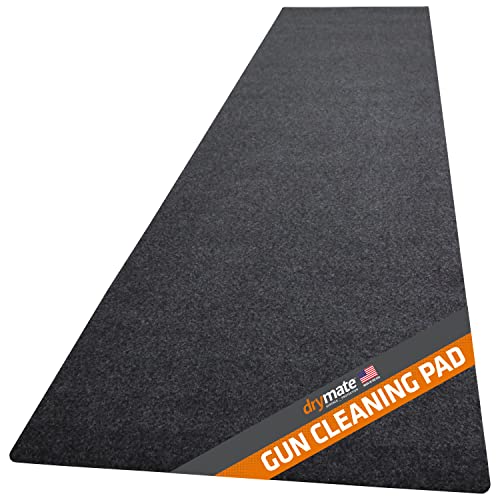
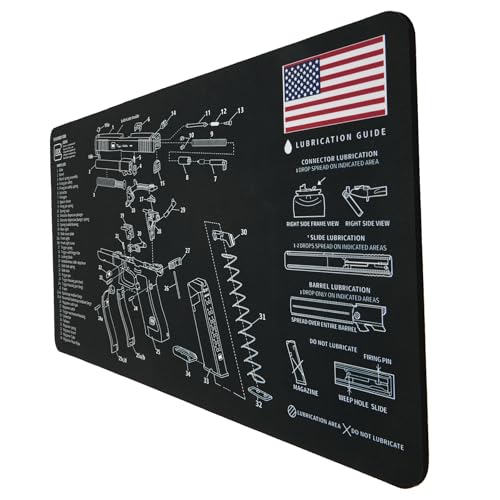
As an Amazon Associate we earn from qualifying purchases at no extra cost to you. Ratings are shown as listed on Amazon.
Best gun cleaning mats by situation
| Cleaning setup | Recommended mat size | Best material and features | Why it fits |
|---|---|---|---|
| Occasional pistol cleaning | 16–20 x 10–14 inches | Neoprene or nitrile-coated fabric; raised lip; small parts tray | Easy to store and large enough for a handgun, magazine, and basic tools |
| Frequent handgun maintenance | 24–30 x 12–16 inches | Oil-resistant rubber surface; printed parts diagram; tool loops | Provides working room without taking over a kitchen table or bench |
| AR-style rifle or full-size rifle | 36–44 x 16–20 inches | Thick, solvent-resistant top; raised perimeter; long tool-storage area | Supports the receiver, upper, bolt carrier group, and cleaning rod in one layout |
| Shotgun or long bolt-action rifle | 48–54 x 16–20 inches | Rubber-backed fabric or molded rubber; reinforced edges; roll-up design | Reduces the chance that a barrel or stock extends onto an unprotected surface |
| Travel or range-bag use | 12–18 x 10–14 inches | Thin synthetic rubber, foldable or rollable, under 2 pounds | Prioritizes portability over maximum parts organization |
What separates a useful gun cleaning mat from a simple desk pad?
Oil- and solvent-resistant construction
A cleaning mat should tolerate gun oil, grease, carbon remover, and occasional solvent contact without becoming sticky, swollen, or discolored. Neoprene-backed fabric is comfortable and protects a finished surface, but its printed fabric layer may absorb spills if the coating is thin. Nitrile rubber and molded silicone generally provide easier wipe-down maintenance. Silicone resists many common chemicals well, although it can be less grippy with very smooth parts.
Do not assume that “waterproof” means “solvent-proof.” Strong bore solvents and chlorinated cleaners can damage printed surfaces, foam backing, adhesives, and some plastics. Follow the mat manufacturer’s chemical guidance, and wipe spills promptly rather than leaving wet patches under a firearm.
Raised edges and spill control
A perimeter lip is valuable when a bottle tips or a patch becomes saturated with oil. A practical lip is about 0.25 to 0.5 inch high: enough to contain a small spill without making it difficult to slide parts across the surface. Raised edges cannot replace careful handling, however. A large spill can still run through seams or off the workbench, and solvents may attack the edge material.
Thickness and surface protection
For routine cleaning, a mat around 2–4 millimeters thick is usually a sensible balance. Thin mats pack easily but offer less cushioning for a receiver or slide. Very thick foam feels protective, yet it may retain oil, hold grit, or make small springs harder to see. The underside should remain flat and non-slip; a mat that creeps across the bench is frustrating and can pull parts into an unsafe position.
Head-to-head: compact mat versus full-length mat
A compact mat wins on storage and portability. It is appropriate for a pistol, revolver, or small optic and can sit on a narrow desk. Its limitation is organization: a slide, frame, magazine, tools, lubricant, and cleaning rod may quickly occupy the entire surface.
A full-length mat provides a more orderly workflow. A rifle can remain aligned from stock to muzzle, and long tools have room to lie flat. The trade-off is that it needs a bench, table, or floor area roughly 4 feet long. A long mat is also more cumbersome to clean and carry, especially if it has a rigid tray or thick backing.
For many households, a medium mat around 24–30 inches long is the best compromise. It handles most handguns and can support the upper or action of many rifles while keeping storage manageable.
Tool storage: helpful feature or unnecessary bulk?
Built-in storage is useful when it keeps commonly misplaced items visible: pins, springs, brushes, hex keys, punches, and small bottles. Look for shallow molded compartments or elastic loops rather than deep pockets that hide parts. A removable tray is particularly practical because it can be carried to the bench separately and washed or wiped out.
Printed diagrams can help newer owners remember orientation, but they are not a substitute for the firearm’s manual. Diagrams may represent one model or generation and can be wrong for a similar-looking variant. Treat them as layout aids, not disassembly instructions.
Tool holders also add bulk and cleaning work. If you already use a dedicated toolbox, a flat mat with a clean, uninterrupted surface may be the better choice. A mat should not force you to place solvent bottles above the firearm where a knock could create a larger spill.
Decision matrix for choosing the right mat
| Your priority | Choose | Avoid |
|---|---|---|
| Lowest practical cost | Thin medium-size rubber or coated-fabric mat | Oversized mats with rigid trays you will not use |
| Beginner-friendly organization | Printed layout, shallow parts tray, tool loops, raised edge | Completely smooth mat with no visual separation |
| Small apartment or limited bench space | 16–24-inch rollable mat with a flat underside | Heavy molded mats that cannot be stored vertically |
| Weekly or high-frequency cleaning | Thick, wipe-clean nitrile, silicone, or coated rubber surface | Absorbent fabric and exposed foam edges |
| Transport to the range | Foldable mat under approximately 2 pounds with a carry strap | Rigid organizers and mats with fragile bonded layers |
| Long rifles or shotguns | 43–54-inch mat with full-length coverage | Small pistol mats used with the muzzle or stock on bare furniture |
How much coverage do you need?
Measure the working footprint, not just the firearm’s overall length. Leave room for tools and a clean area for parts. A useful calculation is:
Required mat length = firearm working length + tool area + handling margin.
For example, if an assembled rifle’s cleaning footprint is 34 inches, you want 6 inches for brushes and lubricant, and another 4 inches so the ends do not sit at the edge, the target is 44 inches. That points toward a 43–54-inch mat rather than a 30-inch model. For a 9mm pistol requiring about 9 inches of working length, adding 4 inches for tools and 3 inches of margin gives an approximately 16-inch minimum; a 20-by-12-inch mat will feel less cramped.
Setup and maintenance that extend mat life
- Make the firearm safe first. Point it in a safe direction, remove the magazine, open the action, and visually and physically check the chamber according to the manufacturer’s instructions. Keep ammunition away from the cleaning area.
- Place absorbent material under messy operations. A disposable patch or shop towel can protect the mat when using excessive solvent, even if the mat is chemically resistant.
- Use separate zones. Keep dirty parts on one side, cleaned parts on another, and tools above or beside the firearm. This reduces the chance of reinstalling a contaminated part.
- Wipe the mat after every session. Remove carbon and oil before folding or rolling it. Residue can transfer to clothing, cases, and the next firearm.
- Store it dry and loosely rolled. Tight folding can create permanent creases in rubber-backed fabric and stress bonded layers. Never store a damp mat in a sealed bag.
Durability problems to watch for
The first failure point on inexpensive mats is often the backing: it can curl, separate, or become tacky after repeated exposure to oils. Printed graphics may fade before the working surface fails. Elastic tool loops stretch, shallow trays crack when cold, and glued raised edges can lift if aggressive solvents pool against them.
Inspect the mat periodically for loose backing, exposed foam, peeling edges, or a surface that has become slippery. Replace it if it no longer lies flat or if chemicals can reach the furniture underneath. A clean, plain mat with durable materials usually outlasts a feature-heavy mat whose pockets and bonded parts are rarely used.
Bottom line
Choose the best gun cleaning mats by matching coverage to the firearm you clean most often, then prioritize a non-slip, oil-resistant surface and a raised edge. Pick a compact 16–20-inch mat for pistols and travel, a 24–30-inch model for a versatile home setup, or a 43–54-inch mat for rifles and shotguns. Tool storage and printed guides are worthwhile for beginners, while frequent users may prefer a simple, thick surface that cleans quickly and survives repeated solvent exposure.

Write Your Review
No reviews yet. Be the first to share your experience!