

Key takeaways
- Mallards: The most flexible foundation for mixed spreads. Choose relaxed swimmers, alert drakes, and a few hens rather than identical poses.
- Gadwall: Gray tones and fine barring can disappear in poor light, so strong body contrast and a clean silhouette are useful.
- Wigeon: A distinctive head shape and bright forehead markings help, especially when birds are circling high.
- Pintails: The long neck and pointed tail are important at distance. Short, bulky pintail substitutes lose much of the species cue.
- Teal: Smaller bodies are valuable around the edge of a spread, but a few teal should not be expected to fill the visual role of standard-size ducks.
- Field geese or ducks: Use full-body or shell designs with upright feeding and relaxed standing poses. Floating decoys often look undersized on dry ground.
The best duck decoys are the ones that match your target species, hunting distance, water conditions, and transport limits—not necessarily the largest or most expensive set.
Quick Picks by Hunting Situation
| Situation | Best decoy approach | Why it works | Typical budget |
|---|---|---|---|
| First spread on a tight budget | 12–18 durable mallard-style floaters | Versatile species profile, simple rigging, easy to replace | $120–$300 |
| Small farm pond or narrow creek | 6–12 standard-size floaters plus 2–4 smaller decoys | Leaves open landing space and avoids crowding | $100–$280 |
| Large water or visible migration corridor | 24–48 floaters with several species and a motion decoy | Provides scale and movement that can be seen at distance | $350–$1,000 |
| Frequent walk-in hunts | Lightweight hollow-body decoys with compact bags | Lower load weight matters more than ultra-heavy construction | $180–$500 |
| Species-specific field setup | Full-body or shell decoys matched to the local duck | Better posture and silhouette on dry ground | $250–$900 |
What Separates the Best Duck Decoys?
Duck decoys must communicate three things from a distance: species, size, and relaxed behavior. Paint detail matters, but silhouette and posture usually matter first. A mallard drake should have a recognizable green-head profile, while gadwall, wigeon, teal, and pintail need distinct body proportions and coloring to prevent an undifferentiated “gray duck” spread.
Our top picks


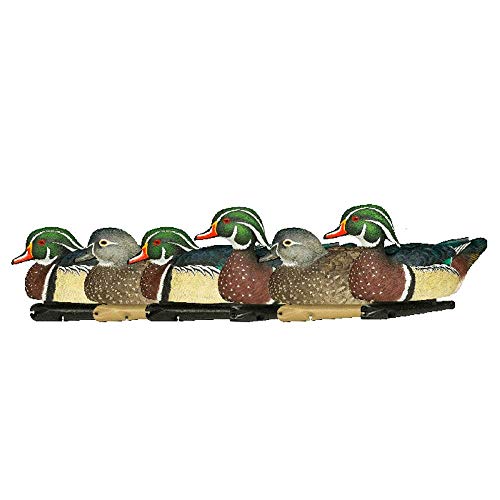
As an Amazon Associate we earn from qualifying purchases at no extra cost to you. Ratings are shown as listed on Amazon.
For most hunters, the strongest all-purpose setup combines standard-size mallard-style floaters with a smaller group of teal, wigeon, gadwall, or pintail decoys appropriate to the area. Species realism is most valuable when local birds have a clear visual choice between a mixed spread and an empty-looking shoreline.
Species realism and posture
- Mallards: The most flexible foundation for mixed spreads. Choose relaxed swimmers, alert drakes, and a few hens rather than identical poses.
- Gadwall: Gray tones and fine barring can disappear in poor light, so strong body contrast and a clean silhouette are useful.
- Wigeon: A distinctive head shape and bright forehead markings help, especially when birds are circling high.
- Pintails: The long neck and pointed tail are important at distance. Short, bulky pintail substitutes lose much of the species cue.
- Teal: Smaller bodies are valuable around the edge of a spread, but a few teal should not be expected to fill the visual role of standard-size ducks.
- Field geese or ducks: Use full-body or shell designs with upright feeding and relaxed standing poses. Floating decoys often look undersized on dry ground.
Head-to-Head: Decoy Construction Types
| Construction | Typical size | Typical weight | Strengths | Trade-offs |
|---|---|---|---|---|
| Hollow molded floater | 13–16 in. long | 0.8–1.5 lb | Good balance of price, buoyancy, and transport | Can look uniform if every pose is identical |
| High-density foam floater | 14–17 in. long | 1.5–2.5 lb | Excellent flotation and resistance to catastrophic leaks | Heavier and often more expensive |
| Lightweight foam-filled floater | 12–16 in. long | 0.7–1.3 lb | Convenient for long walks and large spreads | Surface dents and paint wear can appear sooner |
| Shell decoy | 15–20 in. long | 0.8–1.8 lb | Stacks efficiently and creates convincing field volume | Not suitable as a normal water floater |
| Full-body field decoy | 18–28 in. long | 2–5 lb | Strong three-dimensional appearance on land | Bulky, slower to deploy, and harder to carry in quantity |
Hollow molded floaters are usually the best starting point. Foam-filled models make more sense where rough handling, submerged vegetation, or freezing conditions make a puncture especially costly. Shells are efficient when the spread is mostly carried in a vehicle, while full-bodies earn their space in agricultural fields where ducks can inspect the spread at close range.
Float Stability, Paint, and Motion
A decoy that tips, dives, or spins unnaturally can undermine an otherwise realistic spread. Look for a broad waterline, a low center of gravity, and a keel that keeps the body oriented into modest wind. Deep keels improve stability but add bulk. Removable keels pack more efficiently, although they create another connection point to inspect.
Paint durability depends on more than the advertised finish. The first areas to wear are usually bill edges, tail tips, keel contact points, and places where decoys rub together in a bag. Matte paint is generally preferable to a glossy surface because it avoids sharp reflections in direct sun.
Motion systems can help on calm water, but they should supplement—not replace—a convincing spread. A water agitator, jerk cord, or swimming-style decoy can create ripples and break the unnatural stillness of foam bodies. Battery-powered units commonly provide roughly 4–12 hours of intermittent operation, depending on motor load, temperature, and battery type. Cold weather reduces practical runtime, so carry a spare power source and keep connections dry.
Choosing a motion system
- Jerk cord: Lowest cost and no battery dependency. It works well when the hunter can periodically create movement from a concealed position.
- Water agitator: Best for calm ponds and small pockets. It creates ripples but may look excessive in strong wind.
- Swimming decoy: Adds directional movement and a wake. It requires more setup time, battery management, and open water.
- Rotary-wing device: Its use is regulated differently by location and season. Check current local rules before relying on one.
How Many Decoys Do You Need?
More decoys are not automatically better. On a small pond, six to twelve well-spaced birds can look more natural than forty crowded together. On a broad reservoir or open field, a larger footprint helps birds recognize the spread from farther away.
As a practical starting calculation, assume each standard floater occupies about 2 square feet of visible water when spaced naturally. A 12-decoy pocket spread therefore needs approximately 24 square feet of usable water, plus an open landing zone. A 36-decoy spread needs about 72 square feet and benefits from at least two groups rather than one tight cluster.
Leave a clear landing area. A useful rule is to reserve an opening roughly 10–20 feet wide for small-water setups and 20–40 feet wide on larger water, adjusting for wind, shoreline shape, and the approach direction birds favor.
Packability and Rigging Details That Matter
Weight adds up quickly. Eighteen decoys weighing 1.2 pounds each already total 21.6 pounds before adding anchors, lines, a motion unit, and the bag. If a walk-in route is long, dropping the average decoy weight from 1.5 pounds to 1 pound saves 9 pounds on a 18-decoy spread.
For individual lines, 24–36 inches is practical for shallow water, while 4–6 feet gives more flexibility in deeper water or changing levels. A durable anchor should be heavy enough to hold the decoy in the expected wind without forcing the body underwater. Foldable or strap-style anchors pack more efficiently than large fixed weights.
Texas-style rigs are fast to deploy and retrieve, especially when the whole spread is stored on a single line. Individual lines offer more precise spacing and make it easier to remove or reposition one bird. Whichever system you choose, inspect crimps, swivels, knots, and line junctions at the start of every season.
Ownership Reality: What Wears First
- Keels and anchor eyes: Repeated dragging across gravel or frozen ground can loosen them. Carry replacement clips and swivels.
- Paint at contact points: Let decoys dry before stacking them tightly. Damp friction accelerates scuffing.
- Decoy bags: Wet bags trap moisture against paint and promote odor. Empty and dry them after every outing.
- Motion-unit seals and connectors: Rinse mud and vegetation away, remove batteries between hunts, and store electrical parts dry.
- Foam damage: Do not leave decoys compressed under heavy gear for long periods; dents can permanently change their posture.
Wash mud, algae, and salt residue off with clean water, then air-dry completely. Avoid harsh solvents, stiff wire brushes, and high heat. For paint touch-ups, use a flat outdoor coating compatible with the decoy material and keep repairs limited to worn areas rather than repainting every surface.
Best Buying Strategy for Different Budgets
With approximately $100–$200, buy a dozen reliable standard-size floaters and spend the remaining budget on strong lines, anchors, and a dry storage bag. A $250–$500 budget allows a mixed spread with two or three species, varied poses, and either a jerk cord or modest water-motion device. Above $500, prioritize a better transport system, foam-filled durability where needed, and species-specific field decoys rather than simply buying more identical floaters.
The best duck decoys for most hunters are a manageable core set with realistic species profiles, stable keels, subdued paint, and rigging that can be deployed quickly. Build that foundation first, then add smaller teal, field shells, or motion equipment only when the hunting location and local birds justify the extra weight and cost.
Frequently Asked Questions
Are expensive duck decoys always more realistic?
No. Higher-priced decoys often provide better paint, more varied poses, stronger materials, or improved keels, but correct species shape and sensible spacing matter more than price alone.
Should all decoys in a spread be the same brand?
No. Mixing brands can create useful variation in body angle, paint tone, and posture. Keep the species proportions believable and avoid combining dramatically different sizes without a reason.
How many species should a beginner use?
Start with one primary species and one locally common secondary species. A smaller, coherent spread is easier to place realistically than a large collection of inaccurate or uncommon birds.

Write Your Review
No reviews yet. Be the first to share your experience!