

Key takeaways
- Door seals wear first. A dirty or warped gasket lets cold air escape and makes the compressor run more often. Wipe it with mild soapy water and inspect for gaps.
- Frost reduces freezer capacity. Defrost when ice becomes thick enough to interfere with shelves or the door. Do not chip ice with a knife; a punctured refrigerant line can ruin the appliance.
- Overpacking blocks circulation. Leave space around interior vents and avoid pushing containers against the rear wall.
- Heat raises energy use. Keep the refrigerator away from radiators, ovens, direct sunlight, and poorly ventilated enclosures.
- Leveling affects the door. Adjust the front feet so the cabinet is stable and the door closes reliably.
- Small shelves limit container choice. Measure the interior opening, not just total capacity, before buying meal-prep containers or beverage bottles.
The best compact refrigerators for small spaces are the Danby DAR026A2BDB for an apartment or office, the Frigidaire EFR321 for maximum capacity on a budget, and the GE GDE03GGKBB when you need a separate freezer compartment.
A compact refrigerator is not judged by cubic feet alone. Exterior depth, usable shelf area, freezer design, door swing, noise, and energy consumption determine whether it actually works in a bedroom, studio, dormitory, home office, or small kitchen.
Our top picks

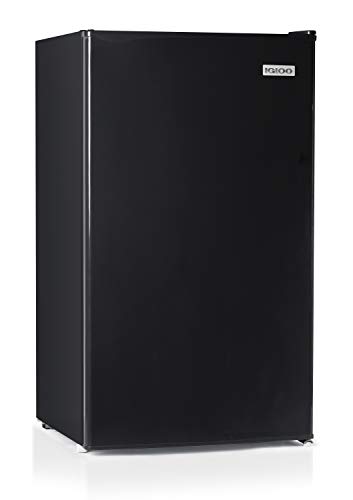


As an Amazon Associate we earn from qualifying purchases at no extra cost to you. Ratings are shown as listed on Amazon.
Best compact refrigerators at a glance
| Model | Approx. exterior dimensions (W × D × H) |
Total capacity | Freezer space | Approx. weight | Best for |
|---|---|---|---|---|---|
| Danby DAR026A2BDB | 17.7 × 19.7 × 27.5 in | 2.6 cu. ft. | About 0.2 cu. ft. chiller section | About 58 lb | Quiet personal refrigerator with a small footprint |
| Frigidaire EFR321 | About 19.1 × 17.5 × 31.1 in | 3.2 cu. ft. | About 0.2 cu. ft. | About 50 lb | Maximum capacity at a moderate price |
| GE GDE03GGKBB | 18.75 × 19.75 × 33.875 in | 3.1 cu. ft. | About 0.93 cu. ft. | About 65 lb | People who need a genuinely useful freezer |
| Midea WHS-87LB1 | About 19.4 × 19.5 × 33 in | Approximately 2.4 cu. ft. | Small internal freezer compartment | About 50 lb | Simple, upright storage in a narrow room |
Dimensions and capacities can vary slightly by production revision and retailer listing. Treat the table as a planning guide, then confirm the manufacturer’s installation drawing before ordering.
Our picks by situation
Best overall for a small room: Danby DAR026A2BDB
The Danby DAR026A2BDB is a strong all-around choice when floor space matters more than freezer capacity. Its roughly 17.7-inch width is easier to accommodate beside a desk, under a counter overhang, or in a compact kitchenette than many three-cubic-foot models. The interior is intended primarily for drinks, lunch ingredients, dairy, and produce, with a small freezer or chiller area rather than a full frozen-food compartment.
Its main advantage is proportion: it is shorter than many upright compact refrigerators while still providing more useful refrigerated storage than a minibar. A reversible door is particularly helpful in a tight room, because the hinges can usually be moved to suit the layout. Confirm that feature and the required clearance for your specific version.
Best for the most refrigerated storage: Frigidaire EFR321
The Frigidaire EFR321 provides about 3.2 cubic feet in a relatively narrow cabinet. It is a sensible budget choice for one person who wants room for meal ingredients, several containers, and tall bottles without moving up to a full-size refrigerator.
The trade-off is freezer usefulness. Its small freezer section is better for ice trays, frozen meals, or a few bags of frozen food than for long-term storage. Since the unit is about 31 inches tall, measure the space above it as well as the floor area; ventilation and door access are more important than fitting the cabinet itself.
Best freezer: GE GDE03GGKBB
The GE GDE03GGKBB is the best fit when frozen storage is a daily requirement. Its separate upper freezer provides close to one cubic foot, a major difference from the tiny chiller boxes found in many compact refrigerators. The refrigerator section remains suitable for drinks, leftovers, and basic groceries.
This model is wider, taller, and heavier than the smallest personal refrigerators. It also has two doors, so measure the full swing path rather than only the cabinet width. Choose it for a kitchenette, guest suite, or home office where the extra freezer is worth sacrificing some floor space.
Best for a simple upright layout: Midea WHS-87LB1
The Midea WHS-87LB1 is a practical option for users who want a conventional upright refrigerator layout without a large appliance. Its roughly 19.4-inch width and 33-inch height make it better suited to a narrow vertical space than to a low under-counter opening.
It is most appropriate for refrigerated food and occasional frozen items. Check the exact freezer configuration before purchase, because compact models with similar names can have different interior arrangements in different markets.
How the important specifications compare
Exterior dimensions and usable capacity
Width is often the limiting measurement, but depth can create the biggest daily annoyance. A refrigerator that projects several inches beyond surrounding cabinets may obstruct a hallway or prevent a door from opening fully. Leave at least 1 inch behind the cabinet where the manufacturer requires airflow, and allow additional space at the hinge side if the door cannot open beyond 90 degrees.
Usable capacity is lower than the advertised number because shelves, door bins, the compressor housing, and freezer walls take up room. A 2.6-cubic-foot refrigerator with adjustable shelving can be more useful than a poorly arranged 3.2-cubic-foot unit if you mostly store tall bottles and meal containers.
Freezer space
Small internal freezer compartments are usually not equivalent to a separate freezer. They may have difficulty holding temperature when packed tightly, and frost can reduce usable space. Choose a two-door model such as the GE when you regularly store frozen vegetables, ice cream, or multiple frozen meals. Choose a single-door model when the freezer is only for ice and occasional convenience food.
Noise
Compact refrigerators are commonly rated in the low- to mid-40-decibel range, but manufacturer noise specifications are not always published consistently. In a kitchen, compressor cycling is rarely noticeable. In a bedroom or recording space, vibration may matter more than the headline decibel figure.
Place the refrigerator on a hard, level surface, keep the rear tubing from touching the wall, and avoid resting objects on the cabinet. These steps reduce rattling. A unit that becomes noticeably louder over time may have a dirty condenser area, an unstable foot, or a fan or compressor problem.
Energy use
Many compact refrigerators use roughly 200 to 350 kilowatt-hours per year, although the actual figure depends on size, ambient temperature, freezer use, and the energy label for that model. A useful cost calculation is:
Annual electricity cost = annual kWh × your electricity rate.
For example, a refrigerator rated at 250 kWh per year costs about $75 annually at an electricity rate of $0.30 per kWh. A model using 320 kWh would cost about $21 more per year at the same rate. The cheapest purchase price is not always the lowest ownership cost if the appliance will run continuously for many years.
Measure the installation space before buying
- Measure width at the narrowest point. Check baseboards, trim, wall outlets, and adjacent cabinets.
- Measure depth to the obstruction. Include the power plug and leave the manufacturer’s rear ventilation gap.
- Measure height and overhead clearance. A cabinet may fit while the door cannot open because of a shelf or countertop.
- Map the door swing. Add room for the door, handle, and the person loading the refrigerator.
- Check the electrical outlet. Use a properly grounded wall outlet rather than an extension cord or overloaded power strip.
As a practical example, if a space is 20 inches wide, a refrigerator listed as 19.75 inches wide leaves only 0.25 inch total side clearance. That may be enough for the cabinet but insufficient for leveling, airflow, or opening the door beside a wall. A model under 18 inches wide is safer when the opening is genuinely tight.
Ownership realities that listings often omit
- Door seals wear first. A dirty or warped gasket lets cold air escape and makes the compressor run more often. Wipe it with mild soapy water and inspect for gaps.
- Frost reduces freezer capacity. Defrost when ice becomes thick enough to interfere with shelves or the door. Do not chip ice with a knife; a punctured refrigerant line can ruin the appliance.
- Overpacking blocks circulation. Leave space around interior vents and avoid pushing containers against the rear wall.
- Heat raises energy use. Keep the refrigerator away from radiators, ovens, direct sunlight, and poorly ventilated enclosures.
- Leveling affects the door. Adjust the front feet so the cabinet is stable and the door closes reliably.
- Small shelves limit container choice. Measure the interior opening, not just total capacity, before buying meal-prep containers or beverage bottles.
Which compact refrigerator should you choose?
| Your priority | Recommended direction | Why |
|---|---|---|
| Under 18 inches wide | Danby DAR026A2BDB or another narrow 2.5- to 2.7-cu.-ft. model | Better chance of fitting without sacrificing all refrigerated storage |
| Lowest purchase cost | Basic single-door 2.5- to 3.2-cu.-ft. model | Fewer components and usually less freezer capacity to maintain |
| Frequent frozen-food use | GE GDE03GGKBB or another two-door compact refrigerator | Separate freezer space is more practical than an icebox compartment |
| Bedroom or quiet office | A compact model with a published low-noise rating and solid leveling feet | Vibration control matters as much as compressor noise |
| Lowest long-term electricity cost | Compare annual kWh, not only price or capacity | A modest efficiency difference accumulates every year |
For most small-space buyers, start with the available width and door clearance, then decide whether freezer space is essential. That order prevents the common mistake of choosing the largest capacity model only to discover that its door blocks a walkway or its compressor cannot ventilate properly.

Write Your Review
No reviews yet. Be the first to share your experience!