

Key takeaways
- Everyday full-frame photography: a 35mm f/1.8 lens gives a natural view for travel, family photos, interiors, and street work.
- Low-cost general-purpose shooting: a 50mm f/1.8 lens is usually the smallest and least expensive route to a bright aperture and attractive background blur.
- Head-and-shoulder portraits: an 85mm f/1.8 lens provides flattering perspective without requiring an extreme working distance.
- Small rooms and environmental portraits: a 24mm or 35mm prime is more practical than an 85mm lens.
- Landscape and architecture: 20mm to 28mm lenses capture more of a scene, while 35mm primes encourage simpler, more selective compositions.
- APS-C cameras: a 23mm to 35mm lens provides a useful normal-to-wide view; a 50mm to 56mm lens behaves roughly like a 75mm to 85mm full-frame portrait lens, depending on the camera’s crop factor.
The best prime lenses are chosen by matching focal length and aperture to your subject, then checking autofocus, mount compatibility, minimum focus distance, size, and handling—not by choosing the lens with the widest aperture alone.
Our top picks


As an Amazon Associate we earn from qualifying purchases at no extra cost to you. Ratings are shown as listed on Amazon.
Quick picks by shooting situation
- Everyday full-frame photography: a 35mm f/1.8 lens gives a natural view for travel, family photos, interiors, and street work.
- Low-cost general-purpose shooting: a 50mm f/1.8 lens is usually the smallest and least expensive route to a bright aperture and attractive background blur.
- Head-and-shoulder portraits: an 85mm f/1.8 lens provides flattering perspective without requiring an extreme working distance.
- Small rooms and environmental portraits: a 24mm or 35mm prime is more practical than an 85mm lens.
- Landscape and architecture: 20mm to 28mm lenses capture more of a scene, while 35mm primes encourage simpler, more selective compositions.
- APS-C cameras: a 23mm to 35mm lens provides a useful normal-to-wide view; a 50mm to 56mm lens behaves roughly like a 75mm to 85mm full-frame portrait lens, depending on the camera’s crop factor.
How focal length changes the photograph
Focal length determines how much of the scene fits in the frame and how far you must stand from the subject. It does not directly create perspective compression; your camera position does. However, longer lenses make it easier to stand farther away, which often produces a more flattering portrait perspective.
| Focal length | Best suited to | Main advantage | Common limitation |
|---|---|---|---|
| 20–24mm | Landscape, architecture, interiors, foreground-rich travel photos | Wide coverage in confined spaces | Faces near the edge can look stretched |
| 28–35mm | Street, documentary, travel, environmental portraits | Natural perspective with useful context | Less background separation than longer lenses |
| 50mm | Everyday photography, food, detail, low-light scenes | Compact, bright, and versatile | Can feel narrow indoors on full-frame cameras |
| 85mm | Portraits, events, detail, subject isolation | Flattering working distance and blur | Needs more room and may be less flexible while traveling |
| 105–135mm | Formal portraits, stage work, compressed landscapes | Strong separation and compressed backgrounds | Large, heavier, and harder to use indoors |
Recommended prime lenses by mount
Sony E-mount full frame
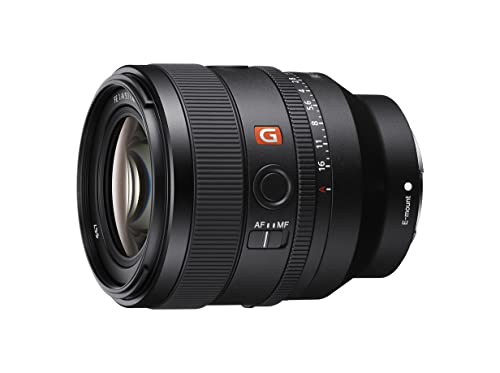
The Sony FE 35mm F1.8 is a balanced choice for photographers who want a fast everyday lens without the size of a professional f/1.4 model. The Sony FE 50mm F1.8 is a budget-friendly option, although its autofocus design and general refinement are more modest than premium alternatives. For portraits, the Sony FE 85mm F1.8 offers a useful combination of low weight, bright aperture, and fast autofocus.
Third-party options expand the range. Sigma’s 35mm F1.4 DG HSM Art and 85mm F1.4 DG DN Art deliver more light and stronger blur, but they are substantially larger and heavier. They make sense for photographers who frequently shoot portraits, weddings, or low-light subjects rather than occasional users who prioritize portability.
Canon RF-mount
The Canon RF 35mm F1.8 Macro IS STM is unusually versatile because it combines a bright aperture, image stabilization, and close focusing. Its 0.17m minimum focus distance is useful for food, small products, and detail shots. The Canon RF 50mm F1.8 STM is compact and affordable, making it an easy first prime for an EOS R-series camera. For portraits, the Canon RF 85mm F2 Macro IS STM focuses relatively close and includes stabilization, though its f/2 aperture is not as bright as an 85mm f/1.8.
Check compatibility before buying older EF lenses. An EF lens can be used on many Canon RF cameras with the appropriate Canon adapter, but it adds length and weight. RF lenses are designed for the newer mount and cannot be used on an EF DSLR without an optical solution that is generally impractical.
Nikon Z-mount
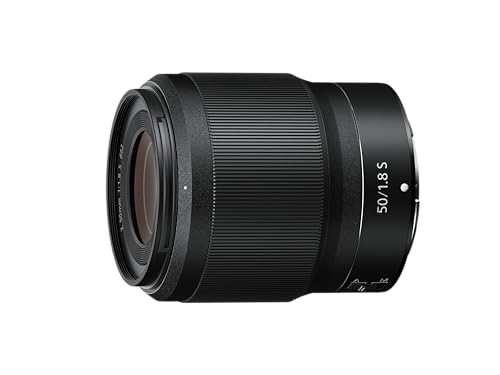
The Nikon NIKKOR Z 40mm f/2 is one of the most practical compact primes for full-frame Z cameras. Its slightly wider-than-50mm view works well for everyday photography, while the f/2 aperture remains useful indoors. The NIKKOR Z 50mm f/1.8 S prioritizes optical quality and edge-to-edge sharpness, making it a strong choice for careful landscape, product, and general-purpose work. The NIKKOR Z 85mm f/1.8 S is a dependable portrait option with strong subject separation and a comfortable working distance.
Nikon F-mount lenses require the FTZ or FTZ II adapter on Z cameras. Autofocus compatibility varies by lens, so verify the exact model before assuming an older lens will focus automatically.
Fujifilm X-mount
Fujifilm’s APS-C system changes the way focal lengths are interpreted. The XF23mmF2 R WR behaves approximately like a 35mm lens on full frame and is well suited to street and travel photography. The XF35mmF2 R WR behaves approximately like a 53mm lens and is a compact everyday option. For portraits, the XF56mmF1.2 R WR provides an approximately 85mm-equivalent view and a very bright aperture, but it is larger and more specialized than the 35mm or 23mm options.
Aperture, autofocus, and minimum focus distance
A wider aperture such as f/1.4 or f/1.8 admits more light and can produce a shallower depth of field. That is valuable for dim interiors and portraits, but it also makes focusing less forgiving. At close portrait distances, an f/1.4 lens may render one eye sharp while the other falls outside the depth of field. An f/2 or f/2.8 lens can be easier to handle while still giving noticeable background separation.
Autofocus performance depends on more than the advertised aperture. Look for quiet stepping motors, accurate eye detection, and consistent tracking if you photograph children, pets, events, or moving subjects. Manual-focus-heavy landscape and architectural work places greater value on focus-ring control, optical sharpness, and low distortion.
Minimum focus distance matters when a prime will also be used for food, products, flowers, or details. A lens that focuses at 0.17m can frame small objects far more tightly than one limited to 0.8m. Do not confuse minimum focus distance with maximum magnification: the latter tells you how large the subject appears on the sensor and is the more useful specification for close-up work.
Size and weight: the trade-off many buyers miss
| Lens | Mount | Focal length / aperture | Minimum focus distance | Weight | Best use |
|---|---|---|---|---|---|
| Canon RF 35mm F1.8 Macro IS STM | Canon RF | 35mm, f/1.8 | 0.17m | 305g | Travel, everyday, close detail |
| Canon RF 50mm F1.8 STM | Canon RF | 50mm, f/1.8 | 0.30m | 160g | Budget portraits and general use |
| NIKKOR Z 40mm f/2 | Nikon Z | 40mm, f/2 | 0.29m | 170g | Compact everyday photography |
| NIKKOR Z 50mm f/1.8 S | Nikon Z | 50mm, f/1.8 | 0.40m | 415g | High-quality general and landscape work |
| Sony FE 85mm F1.8 | Sony E | 85mm, f/1.8 | 0.80m | 371g | Portraits and subject isolation |
| Fujifilm XF35mmF2 R WR | Fujifilm X | 35mm, f/2 | 0.35m | 170g | Compact APS-C everyday lens |
The table shows why a specification advantage can create a practical disadvantage. A professional 50mm f/1.4 may gather more light, but a 160g 50mm f/1.8 is more likely to stay on the camera during a full day of walking. A compact lens also places less strain on small camera bodies and smaller bags.
A decision guide before you buy
- Choose 35mm if: you photograph people in their surroundings, travel, interiors, or street scenes and want one lens that remains useful in cramped spaces.
- Choose 50mm if: you want the lowest-cost path to a bright prime, usually carry one lens, and do not need a particularly wide view indoors.
- Choose 85mm if: portraits are a regular part of your work and you have enough room to step back. It is less convenient for small rooms and casual travel.
- Choose a wide prime if: your landscapes involve strong foregrounds, your architecture work requires broad coverage, or you regularly shoot inside small rooms.
- Choose f/1.4 over f/1.8 or f/2 if: low-light work and maximum background blur justify extra cost, weight, and more demanding focus. Otherwise, the smaller lens may be the better ownership choice.
Ownership realities and common mistakes
Prime lenses have fewer moving optical elements than zooms, but they are not maintenance-free. Dust on the front element usually has little visible effect; aggressive cleaning is more likely to damage coatings than ordinary dust is to reduce image quality. Use a blower first, then a clean lens cloth or appropriate lens tissue only when necessary. Keep rear caps fitted whenever the lens is detached.
The parts most likely to show wear are the mount contacts, focus ring, aperture or control ring, and autofocus motor after heavy use. Avoid carrying the camera by a long lens, protect the mount from side impacts, and use a padded bag rather than allowing the lens to knock against hard equipment. Weather resistance is not the same as waterproofing: sealed lenses still need protection from heavy rain, sand, and condensation.
A frequent buying mistake is selecting a lens for its blur potential without checking working distance. An 85mm lens may be excellent outdoors but frustrating in a narrow bedroom. Another is ignoring the crop factor when switching systems. Before ordering, confirm the exact mount, sensor format, autofocus support, stabilization behavior, filter size, and whether your camera requires an adapter.
Final recommendation
For most photographers buying a first prime, a 35mm or 50mm f/1.8–f/2 lens offers the best balance of price, size, autofocus, and image quality. Choose 85mm when portraits are the priority, a 23–28mm equivalent when space is limited or landscapes dominate, and a premium f/1.4 lens only when its extra light and subject separation will be used often enough to justify the added bulk.







Write Your Review
No reviews yet. Be the first to share your experience!