

Key takeaways
- First reflections: Place panels on the side walls where sound from the speakers or performer first reaches the listener. A mirror held against the wall can help locate these points: if the listener can see a speaker in the mirror, that spot is a candidate.
- Ceiling reflection: A suspended 2- or 4-inch “cloud” above a desk, microphone or listening position can control a strong vertical reflection.
- Rear wall: Use thicker broadband absorption or carefully selected diffusion behind the listener. A bare close rear wall often creates distracting slap and comb filtering.
- Corners: Bass traps work best across the full corner or from floor to ceiling. Thin flat panels placed in the middle of a corner usually do little for deep bass.
- Air gaps: Mounting a 2-inch panel 2 inches away from the wall generally improves lower-frequency absorption compared with mounting it flush.
The best acoustic panels for most home rooms are 2-inch-thick porous panels with an NRC around 0.85–1.00, installed with a 2–4-inch air gap at the first-reflection points; thinner decorative panels usually reduce a little high-frequency sparkle but do much less for audible echo.
Our top picks



As an Amazon Associate we earn from qualifying purchases at no extra cost to you. Ratings are shown as listed on Amazon.
Quick picks by room and objective
| Situation | Recommended panel type | Useful specification | Typical coverage | General market range |
|---|---|---|---|---|
| Small bedroom office, calls and video | Fabric-wrapped mineral wool or fiberglass | 2 inches thick; NRC 0.80–1.00 | 6–10 panels, usually 2 × 4 ft | $250–$700 total |
| Small music room, 100–150 sq. ft. | Broadband porous panels plus corner bass traps | 2–4 inches; NRC about 0.85–1.10 | 15–25% of wall area | $500–$1,500 |
| Medium mixing room, 150–250 sq. ft. | 2-inch reflection panels and 4-inch low-frequency panels | 2 inches at side walls; 4 inches in corners | 20–30% of wall area | $900–$2,500 |
| Living room where appearance matters | Printed or slatted acoustic panels used selectively | 1–2 inches; verify tested absorption data | 4–10 panels | $300–$1,500 |
These are planning ranges rather than guarantees. Room volume, wall construction, furniture and panel spacing all affect the result. Brands such as GIK Acoustics, Auralex, ATS Acoustics, Primacoustic and Vicoustic offer products in several of these categories, but the material, thickness and tested performance matter more than the logo.
What NRC tells you—and what it does not
NRC, or Noise Reduction Coefficient, is a rounded average of absorption at 250, 500, 1,000 and 2,000 Hz. A panel with an NRC of 0.90 absorbs much more midrange sound than a bare painted wall, but that number is not a universal percentage reduction in room noise. It also says little about deep bass, sound isolation or how the panel performs when installed differently from the laboratory setup.
For speech, vocals and general echo control, an NRC of 0.75 or higher can be useful. For a recording or mixing room, look for approximately 0.85–1.00 and examine the full frequency chart where available. A panel that claims strong absorption only above 1,000 Hz may make a room less bright while leaving low-midrange muddiness intact.
Do not confuse absorption with soundproofing. Acoustic panels reduce reflections inside the room. They do not stop voices, traffic or loud music passing through a wall. Isolation requires mass, airtight construction, decoupling and often professional building work.
Material and thickness: the real head-to-head
Fiberglass and mineral wool
These rigid porous cores are the most versatile choice for broadband absorption. At 2 inches thick, they are effective through much of the speech and music midrange. At 4 inches, they absorb farther into the low-midrange, especially when mounted with an air gap. Mineral wool and fiberglass panels are commonly wrapped in acoustically transparent fabric and framed for protection.
Choose this category when the goal is less flutter echo, clearer speech, improved vocal recording or more reliable monitoring. Check that the fabric allows air through it; a decorative, tightly laminated covering can reduce absorption.
Acoustic foam
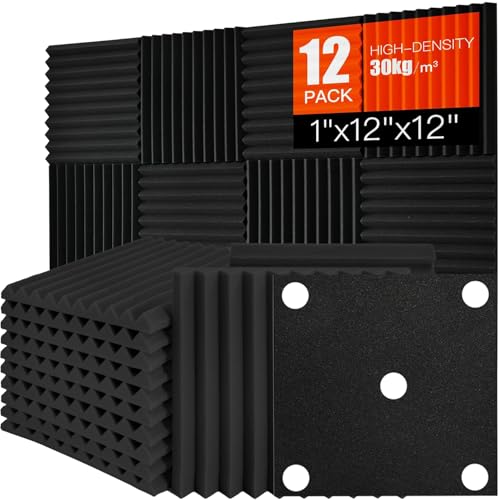
Foam is lightweight, easy to cut and often inexpensive. It can be useful for controlling high-frequency reflections in a small area, but common 1- or 2-inch foam products are less effective at low and low-mid frequencies than thicker fiber panels. Foam can also deteriorate from ultraviolet exposure, heat or poor-quality adhesives.
Foam is reasonable for a temporary setup or limited high-frequency treatment. It is rarely the best sole treatment for a music room, podcast room or home theater.
Wood-slat and perforated decorative panels
Slatted panels can look excellent and combine a hard front surface with an absorptive backing. Their performance depends heavily on the slat spacing, backing material and air cavity. Some mainly scatter or soften reflections rather than absorb broadly. Treat them as a design-led option, not proof of acoustic performance.
Diffusers
Diffusers scatter sound rather than remove it. They can help a larger room retain some liveliness while reducing a strong focused reflection, but they need sufficient distance from the listener and usually work best after basic absorption is in place. They are not substitutes for broadband panels in a small, echoey room.
How much panel area do you need?
A practical starting point is to cover about 15–25% of the room’s total wall area for general echo control. Recording and mixing spaces may need 20–35%, with thicker treatment in corners. Avoid covering every surface with thin absorption: an over-damped room can sound unnaturally dull while bass problems remain.
Here is a simple planning calculation. Suppose a room is 12 by 10 feet, with 8-foot walls. The four-wall area is:
2 × (12 + 10) × 8 = 352 square feet.
At a 20% starting target, you would plan approximately 70 square feet of treatment. A 2-by-4-foot panel covers 8 square feet, so nine panels provide 72 square feet. In practice, you might use eight 2-inch panels at reflection points and one or two 4-inch corner panels, rather than buying nine identical panels.
This calculation is a coverage target, not a promise of a specific reverberation time. Door openings, windows, carpet, sofas and bookcases already contribute absorption, so a furnished room may need fewer panels than an empty one.
Placement matters more than a high headline NRC
- First reflections: Place panels on the side walls where sound from the speakers or performer first reaches the listener. A mirror held against the wall can help locate these points: if the listener can see a speaker in the mirror, that spot is a candidate.
- Ceiling reflection: A suspended 2- or 4-inch “cloud” above a desk, microphone or listening position can control a strong vertical reflection.
- Rear wall: Use thicker broadband absorption or carefully selected diffusion behind the listener. A bare close rear wall often creates distracting slap and comb filtering.
- Corners: Bass traps work best across the full corner or from floor to ceiling. Thin flat panels placed in the middle of a corner usually do little for deep bass.
- Air gaps: Mounting a 2-inch panel 2 inches away from the wall generally improves lower-frequency absorption compared with mounting it flush.
For a small room, start with first reflections and the ceiling before treating every wall. Add corner treatment only after listening or measuring again; otherwise, it is easy to spend money on panels in less useful locations.
Decision matrix: which specification fits your situation?
| Your priority | Best starting choice | What to avoid | Why |
|---|---|---|---|
| Lowest cost for less speech echo | Several 2-inch fiber panels at key reflection points | Covering walls with very thin foam | Targeted coverage gives more useful absorption per dollar |
| Podcast or video calls in a small room | 2-inch panels behind and beside the microphone, plus a ceiling panel if needed | Only treating the wall behind the camera | Nearby side and ceiling reflections can still reach the microphone |
| Music production or mixing | 2-inch broadband panels plus 4-inch corner traps and measurement | Foam-only treatment | Mix decisions are affected by low-mid and bass response |
| Rental apartment | Framed panels on removable hooks or freestanding absorbers | Permanent adhesive mounting | Reduces wall damage and allows repositioning |
| Design-sensitive living space | Fabric-wrapped art panels or slatted panels with published data | Choosing solely from appearance | Decorative construction does not automatically mean broadband absorption |
Ownership details that product listings omit
Fabric collects dust, pet hair and cooking residue before the acoustic core fails. Vacuum it gently with a brush attachment every few months, and follow the maker’s cleaning instructions. Do not saturate fiber panels: moisture can stain fabric, weaken frames and encourage odor or microbial growth. For a spill, blot rather than scrub and allow the panel to dry completely.
The parts most likely to wear first are mounting hardware, fabric corners and adhesive-backed foam. Freestanding panels can be knocked over, while ceiling clouds place extra demands on anchors and cables. Use hardware rated for the panel’s weight and the wall or ceiling structure; do not rely on a small adhesive strip for a heavy framed absorber.
Expect color fading near strong sunlight, especially with dark or saturated fabrics. Keep panels away from heaters and sprinklers, and check the manufacturer’s fire-performance information before installing them in a commercial or sleeping space. If a panel smells strongly after unpacking, ventilate it and consult the manufacturer rather than sealing it in a poorly ventilated room.
Common buying mistakes
- Buying the highest NRC without checking thickness or frequency data.
- Assuming more panels always produce a better room; over-absorption can make speech and music sound unnaturally lifeless.
- Using thin foam to solve bass buildup.
- Mounting every panel flush to the wall when an air gap would improve performance.
- Ignoring the ceiling and corners.
- Expecting acoustic treatment to block noise from neighbors or roads.
Bottom line
For most home and studio applications, choose fabric-wrapped fiberglass or mineral wool, at least 2 inches thick, with independently published absorption data and an NRC near 0.85 or higher. Use roughly 15–25% wall coverage as a starting point, leave air gaps where possible, and reserve 4-inch panels or corner traps for low-mid and bass control. The best acoustic panels are not necessarily the most colorful or the ones with the largest NRC claim: they are the panels whose thickness, placement and frequency response match the room’s actual problem.

Write Your Review
No reviews yet. Be the first to share your experience!