

Key takeaways
- Use a clean, dry ball. Mud and grit act like abrasive material against the impact fabric.
- Inspect the center panel, corners, pole sleeves, and anchor points every few sessions.
- Do not drag an assembled frame across concrete; it stresses joints and can abrade the lower net.
- Dry the net completely before storage to reduce mildew and odor.
- Replace a visibly weakened impact panel rather than continuing to hit drivers into it.
- Use ground stakes or sandbag-style weights outdoors, even on calm days.
The best golf hitting nets are the ones that match your available space, practice frequency, ball speed, and tolerance for setup time: a compact 7-by-7-foot net suits occasional chipping and irons, while a deeper 10-by-10-foot enclosure is safer for drivers and more consistent outdoor use.
Our top picks



As an Amazon Associate we earn from qualifying purchases at no extra cost to you. Ratings are shown as listed on Amazon.
Quick picks by situation
| Situation | Best net type | Useful target size | Why it fits |
|---|---|---|---|
| Small indoor room or garage | Compact impact net with side barriers | 6.5–8 ft wide, 7–8 ft high, 3–4 ft deep | Uses less floor space while retaining protection against moderate misses |
| Beginner practicing short and mid-irons | Entry-level fiberglass-frame net | 7–8 ft wide by 7–8 ft high | Affordable coverage without paying for a premium return system |
| Frequent outdoor practice | Reinforced enclosure with replaceable impact panel | 8–10 ft wide, 8–10 ft high, 4–6 ft deep | More forgiving of driver speed, wind movement, and repeated impacts |
| Low-handicap player hitting drivers | Heavy-duty net with deep pocket and side protection | 10 ft wide by 8–10 ft high, at least 5 ft deep | Reduces rebound risk and gives more margin for face-angle errors |
| Fast setup and frequent relocation | Pop-up net with carry bag | 7–8 ft wide by 7–8 ft high | Typically assembles in minutes and stores in a compact case |
What separates the best golf hitting nets
Overall dimensions and usable coverage
Advertised width is only part of the story. A net measuring 8 feet wide may have a narrow central pocket and limited side curtains, leaving little protection for a pulled iron or pushed driver. Look for the usable capture area: the width and height of the impact fabric plus the side and roof panels that stop deflected balls.
For most adults, a 7-by-7-foot net is a practical minimum for controlled iron practice. An 8-by-8-foot design offers a better margin for ordinary misses. Players hitting drivers should generally move toward a 10-foot-wide enclosure, especially indoors where a ball striking a wall, light fitting, or garage door can cause expensive damage.
Depth and rebound control
Depth affects both safety and ball behavior. Shallow nets can work when the ball enters near the center, but a ball that hits the mesh at an angle may rebound toward the golfer. A deeper pocket, sloped baffle, or suspended back panel absorbs more energy and lets the ball fall rather than return at chest height.
For indoor use, prioritize a deep impact pocket and a floor-level ball stop over a very wide but shallow frame. Outdoors, extra depth also helps the structure remain stable when the ball strikes off-center.
Impact material and stitching
Most golf nets combine knotless nylon or polyester mesh with a denser impact screen or reinforced central panel. The center panel wears first because every shot lands in roughly the same area. Dense polyester can provide a durable, economical impact surface, while premium systems may use multilayer or replaceable impact panels designed for high shot volumes.
Inspect the seam between the impact panel and the surrounding net. Heavy webbing, double stitching, and reinforced corner loops matter more than a vague claim such as “professional grade.” A replaceable center panel can make a higher-priced net cheaper to own over several seasons.
Head-to-head: common net categories
Compact pop-up nets
Pop-up nets from brands such as SKLZ and GoSports are attractive for beginners because they are light, portable, and comparatively inexpensive. Many are approximately 7–8 feet wide and high, with a shallow base. They are well suited to wedges, short irons, and moderate practice sessions.
The trade-off is limited side protection and a smaller impact zone. They are not the best choice for repeated driver practice unless the player is confident in consistent contact and the net includes a substantial side barrier.
Framed backyard enclosures
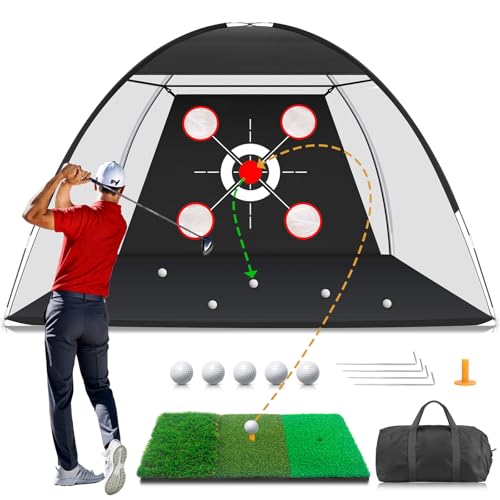
Framed systems use fiberglass or steel poles with a separate net and often include a target sheet. They usually provide more depth and a clearer ball-collection area than a basic pop-up net. The Rukket Sports Haack series is an example of this general category, with models intended for backyard practice and portable assembly.
These systems are a strong middle choice for golfers who practice several times per week. Fiberglass frames reduce weight, while steel components can improve rigidity but make carrying and storage more demanding. Check whether the target cloth is a visual aid only or part of the impact structure; it should not be the sole barrier behind the ball.
Premium return and simulator nets
Net Return’s Pro Series and Spornia’s larger golf enclosures represent the premium end of the market. These products generally emphasize fast ball return, stronger framing, broader side protection, and materials intended for frequent use. Some Spornia models are built as enclosed bays rather than simple front nets, which is useful for golfers who want more protection from shanks.
The premium price is easier to justify when several people use the net, when practice happens most days, or when replacing an impact panel would be inconvenient. It is harder to justify for a beginner who only practices a few times each month.
Indoor versus outdoor requirements
| Requirement | Indoor priority | Outdoor priority |
|---|---|---|
| Clearance | Allow at least 2 ft behind the net and verify ceiling height for the club and swing | Allow space behind and beside the frame for wind movement |
| Protection | Use side barriers and a floor mat; protect walls, windows, lights, and garage doors | Use a deep pocket, roof panel, ground stakes, and weighted or anchored legs |
| Frame | Lightweight frame is convenient if it must be folded after every session | Steel or reinforced fiberglass is preferable for repeated setup and wind exposure |
| Storage | Dry storage prevents mildew and protects the impact fabric from abrasion | Take the net down during strong wind, rain, or snow unless the manufacturer specifically permits permanent installation |
Measure the complete setup, not just the net. A golfer using a 45-inch driver needs room to swing without touching a wall or ceiling, and the ball should sit far enough from the screen that a mishit cannot reach the frame at full speed. Indoor practice should also use real golf balls only when the enclosure is rated for them; foam or limited-flight balls reduce risk but do not reproduce normal ball flight.
How much net do you need?
A simple coverage check can prevent a costly mismatch. Suppose a net has an 8-foot-wide opening and the golfer stands 8 feet away. A shot starting 5 degrees offline travels approximately 0.7 feet sideways over that distance, before accounting for curvature or equipment error. That sounds comfortable, but a 10-degree miss moves about 1.4 feet, and a shank can start far outside the normal swing path. Side curtains therefore matter more than the nominal opening suggests.
For a right-handed golfer, place the net so there is extra clearance on the right side for a push or hosel strike. Left-handed users should reverse that arrangement. If several golfers share the setup, size for the widest likely miss rather than the best player’s normal contact.
Durability and ownership costs
The net usually does not fail all at once. The first warning signs are stretched mesh, frayed stitching around the central target, bent connectors, and a pocket that no longer hangs evenly. Repeatedly hitting the same spot accelerates wear, so rotate the target or shift the net slightly when the design allows it.
- Use a clean, dry ball. Mud and grit act like abrasive material against the impact fabric.
- Inspect the center panel, corners, pole sleeves, and anchor points every few sessions.
- Do not drag an assembled frame across concrete; it stresses joints and can abrade the lower net.
- Dry the net completely before storage to reduce mildew and odor.
- Replace a visibly weakened impact panel rather than continuing to hit drivers into it.
- Use ground stakes or sandbag-style weights outdoors, even on calm days.
As a general market guide, basic portable nets commonly cost about $100–$250, sturdier backyard enclosures about $250–$600, and premium heavy-duty or simulator-oriented systems about $600–$1,500 or more. A $300 net used three times per week for two years provides roughly 312 sessions, or about $0.96 per session before replacement parts. A $150 net used once per month for two years costs about $6.25 per session. The cheaper purchase is not automatically the better value if it lacks the durability or coverage your practice pattern requires.
Setup checklist for safer practice
- Measure ceiling height, swing clearance, and the full floor footprint.
- Assemble the frame on level ground and confirm that every sleeve and connector is fully seated.
- Attach the impact net without twisting it; uneven tension can redirect balls and stress seams.
- Add side barriers, a roof panel, and a floor mat before hitting at full speed.
- Begin with short chips, then half-swings, while checking for gaps, rebound, or frame movement.
- Anchor the structure outdoors and stop using it if wind makes the frame sway or lift.
Bottom line
Choose a compact 7-by-7-foot net for limited indoor space and controlled iron practice, an 8-by-8-foot framed enclosure for regular all-purpose use, or a 10-foot-wide, deep premium enclosure for drivers and frequent outdoor sessions. The most important specifications are not the brand name alone: verify the usable impact area, side coverage, pocket depth, frame stability, replaceable center panel, and storage requirements before buying.

Write Your Review
No reviews yet. Be the first to share your experience!