

Key takeaways
- Secure the enclosure: A heavy box can become a dangerous projectile during sudden braking. Use proper mounting points and avoid blocking emergency equipment.
- Protect the cone: A grille is worthwhile in a cargo area where tools, groceries or pets could strike the driver.
- Control vibrations: Rattling trim can make a clean system sound distorted. Apply suitable automotive damping to panels rather than increasing subwoofer gain.
- Check wiring periodically: Loose terminals, undersized power cable and poor grounds create heat, intermittent operation and amplifier shutdowns.
- Avoid excessive bass boost: Bass boost consumes amplifier headroom quickly and can cause clipping or over-excursion.
- Keep the enclosure dry: Moisture can swell MDF, corrode terminals and damage the suspension. A sealed fiberglass or marine-oriented enclosure may be preferable in exposed installations.
Best Car Subwoofers for Powerful, Clean Bass
The best car subwoofer is the largest model that fits your available space, matches your amplifier’s RMS output and impedance, and can be installed in an enclosure with the correct internal air volume—not simply the one with the highest advertised wattage.
For most vehicles, a sealed 10-inch or 12-inch subwoofer is the safest starting point. Choose a shallow 8- or 10-inch model when trunk or under-seat space is limited, a ported enclosure when maximum output matters more than compactness, and a powered subwoofer when you need a simpler installation with a built-in amplifier.
Our top picks
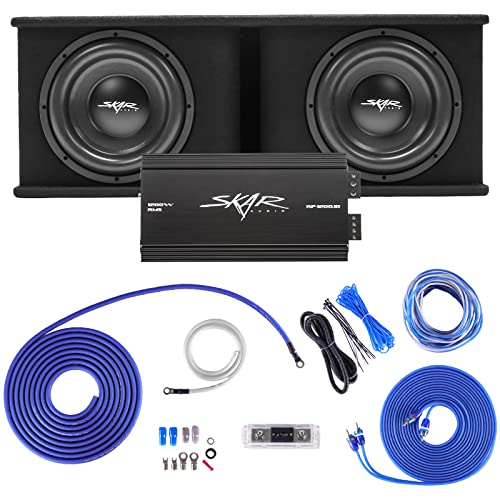
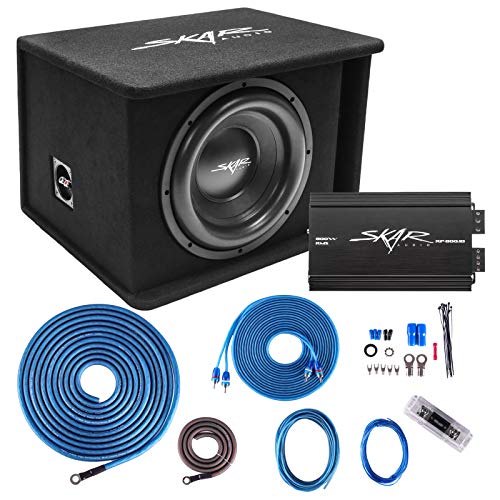


As an Amazon Associate we earn from qualifying purchases at no extra cost to you. Ratings are shown as listed on Amazon.
Best car subwoofers by situation
| Situation | Best choice | Why it fits | Typical budget |
|---|---|---|---|
| Limited space under a seat or behind a rear seat | Shallow 8- or 10-inch subwoofer | Reduced mounting depth and a smaller sealed enclosure | $150–$400 for the driver; $300–$700 powered |
| Balanced daily-driver system | 10-inch, 300–500-watt RMS subwoofer in a sealed box | Controlled bass, moderate space requirement and easy amplifier matching | $250–$650 for driver, enclosure and amplifier |
| Strong bass for a sedan or hatchback | 12-inch, 500–750-watt RMS subwoofer | More cone area and low-frequency output without requiring two subs | $400–$900 for a complete system |
| Maximum output in a large trunk or SUV | 12- or 15-inch subwoofer in a ported enclosure | Higher efficiency and louder bass when enclosure space is available | $600–$1,500 or more |
| No aftermarket amplifier or complicated wiring | Powered subwoofer | Combines the subwoofer and amplifier in one enclosure | $250–$800 |
What to match before buying
Subwoofer size and available space
A larger cone generally moves more air, but size alone does not determine sound quality. An 8-inch subwoofer can provide useful low-end reinforcement in a small cabin, while a quality 10-inch model often gives the best compromise between depth, output and enclosure size. A 12-inch model is better suited to listeners who want bass that remains forceful at higher volume.
Measure the installation area in three dimensions. Include clearance for the enclosure walls, speaker grille, terminal cup, amplifier wiring and hatch or seat movement. For a replacement subwoofer, also measure the cutout diameter and mounting depth. A driver may fit the hole but still contact the rear wall, window mechanism or seat frame.
| Size | Typical mounting depth | Typical sealed-box volume | Useful RMS range | Best use |
|---|---|---|---|---|
| 8 inch | 3.5–6.0 inches | 0.3–0.7 cubic feet | 150–400 watts | Under-seat systems and compact cars |
| 10 inch | 4.5–7.0 inches | 0.6–1.25 cubic feet | 250–600 watts | Balanced daily listening |
| 12 inch | 5.0–8.0 inches | 1.0–2.0 cubic feet | 400–1,000 watts | High-output sedan and SUV systems |
| 15 inch | 7.0–10.0 inches | 1.8–3.5 cubic feet | 600–1,500 watts | Large enclosures and competition-style output |
These are planning ranges rather than universal requirements. Always prioritize the enclosure volume specified by the particular driver.
RMS power, not peak power
RMS power indicates the continuous power a subwoofer is designed to handle. Peak or “maximum” figures are less useful for choosing an amplifier. A practical pairing is an amplifier that produces approximately 75% to 125% of the subwoofer’s RMS rating at the correct impedance.
For example, a 500-watt RMS subwoofer with a 2-ohm final load is a good match for an amplifier producing roughly 400–600 watts RMS at 2 ohms. An amplifier rated at 1,000 watts does not automatically make the system better; without careful gain setup, it can damage the voice coil or cause mechanical over-excursion.
Impedance and voice-coil configuration
Single-voice-coil and dual-voice-coil subwoofers are available in several impedance options, commonly 2 or 4 ohms. A dual 4-ohm voice-coil model can usually be wired to a 2-ohm or 8-ohm final load. A dual 2-ohm model can commonly be wired to 1 ohm or 4 ohms.
Choose the subwoofer and amplifier together. Two dual-voice-coil drivers can create several wiring possibilities, but not every amplifier is stable at every load. Confirm the final impedance before purchasing, and never assume that a lower-ohm connection is safe for the amplifier.
Recommended types and well-known examples
Best for shallow installations: JL Audio 10TW3-D4
The JL Audio 10TW3-D4 is a slim 10-inch dual 4-ohm subwoofer designed for installations where a conventional woofer is too deep. Its roughly 400-watt RMS rating makes it suitable for a compact dedicated amplifier. It is a strong choice for a pickup truck, coupe or SUV side panel, but it still needs a properly designed enclosure; “shallow” does not mean it can operate effectively in any empty cavity.
Best all-around high-output option: Rockford Fosgate P3D4-12
The Rockford Fosgate Punch P3D4-12 is a 12-inch dual 4-ohm subwoofer rated around 600 watts RMS. It is intended for a substantial enclosure and amplifier, making it better for a trunk or SUV than for an under-seat installation. Its extra cone area provides stronger output than most 10-inch systems, but the required box size and amplifier capacity add weight and cost.
Best for a value-oriented system: Kicker CompR 10- or 12-inch
Kicker’s CompR range offers dual-voice-coil configurations and several size options, making it easier to build around a common mono amplifier. A 10-inch model suits a smaller sealed enclosure, while a 12-inch version is more appropriate when the vehicle has room for a larger box. Check the exact RMS rating of the selected size and impedance before matching the amplifier.
Best for a simple installation: powered subwoofer
A powered subwoofer combines a driver, enclosure and amplifier. This is the practical choice when you want more low bass from a factory audio system without dedicating much cargo space to separate components. Compact powered units are usually less powerful than a full-size subwoofer and mono-amplifier system, but they can be easier to secure, wire and remove.
Sealed versus ported enclosures
A sealed enclosure is compact, forgiving and generally produces tight, controlled bass. It is the better choice when trunk space is limited or when music includes acoustic, rock and vocal-heavy recordings. Sealed systems also have fewer enclosure-design variables, although they still require the correct internal volume and a properly sealed cabinet.
A ported enclosure uses a tuned opening to increase output around a selected frequency. It can sound louder and more efficient, particularly with electronic, hip-hop and soundtrack material, but it is larger and more sensitive to design errors. The port must have sufficient area and the tuning frequency must suit the driver. Do not substitute a random ported box simply because its external dimensions appear to fit.
A practical sizing and amplifier calculation
Suppose the vehicle can accommodate a sealed enclosure measuring 28 by 14 by 14 inches externally. That is 5,488 cubic inches, or about 3.18 cubic feet gross. After subtracting two 0.75-inch-thick walls, internal bracing and the driver’s displacement, the usable volume may be approximately 2.3–2.6 cubic feet.
That space is usually excessive for one 10-inch driver, appropriate for some 12-inch drivers, and potentially suitable for a 15-inch driver depending on its specification. If the enclosure must share space with luggage, a smaller 10- or 12-inch design may be the better real-world choice. A box that reduces daily cargo capacity is often a poor upgrade even if it produces more bass.
For a 600-watt RMS, dual 4-ohm subwoofer wired to a 2-ohm final load, select a mono amplifier capable of approximately 450–750 watts RMS at 2 ohms. Set the gain using the head unit’s clean maximum volume and an appropriate test signal rather than turning the gain until the bass “sounds loud.”
Ownership details that affect sound and reliability
- Secure the enclosure: A heavy box can become a dangerous projectile during sudden braking. Use proper mounting points and avoid blocking emergency equipment.
- Protect the cone: A grille is worthwhile in a cargo area where tools, groceries or pets could strike the driver.
- Control vibrations: Rattling trim can make a clean system sound distorted. Apply suitable automotive damping to panels rather than increasing subwoofer gain.
- Check wiring periodically: Loose terminals, undersized power cable and poor grounds create heat, intermittent operation and amplifier shutdowns.
- Avoid excessive bass boost: Bass boost consumes amplifier headroom quickly and can cause clipping or over-excursion.
- Keep the enclosure dry: Moisture can swell MDF, corrode terminals and damage the suspension. A sealed fiberglass or marine-oriented enclosure may be preferable in exposed installations.
Final buying checklist
Before choosing among the best car subwoofers, measure the space, identify the required enclosure volume, select the desired sealed or ported design, and decide how much cargo room you can sacrifice. Then match the subwoofer’s RMS rating and voice-coil configuration to an amplifier’s output at the correct final impedance. For most drivers, a well-installed 10- or 12-inch subwoofer with a properly matched amplifier will deliver cleaner, more satisfying bass than a larger model forced into an unsuitable box.

Write Your Review
No reviews yet. Be the first to share your experience!