

Key takeaways
- Large enough to clear small gaps and uneven paving; approximately 2.5–3 inches is useful for a carry-on.
- Set into partially recessed housings rather than extending far beyond the shell.
- Mounted with screws or accessible fasteners instead of permanently sealed assemblies.
- Quiet and smooth when spun by hand, without sideways wobble.
- Replaceable through the manufacturer or a luggage repair service.
Best Hardside Luggage for Durable Travel
The best hardside luggage for durable travel is usually a polycarbonate spinner with reinforced corners, replaceable wheels, and dimensions that stay within your airline’s carry-on limit; ABS is the better choice when low price and light weight matter more than long-term impact resistance.
Polycarbonate vs. ABS: Which Shell Material Holds Up Better?
Hardside luggage is not equally durable. The shell material affects impact resistance, flexibility, weight, price, and how the case looks after repeated trips.
Our top picks

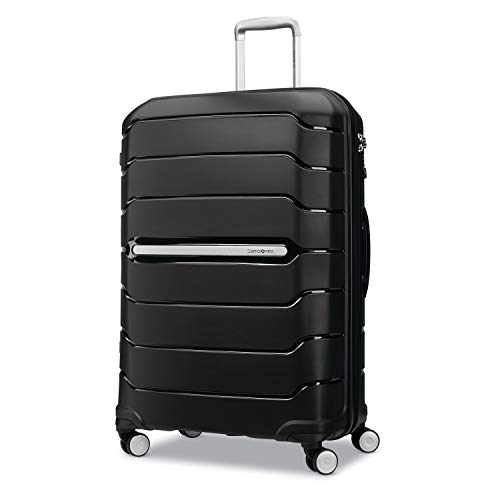


As an Amazon Associate we earn from qualifying purchases at no extra cost to you. Ratings are shown as listed on Amazon.
| Material | Typical weight for a 20–21 inch case | Impact resistance | Scratch resistance | Typical market price | Best for |
|---|---|---|---|---|---|
| ABS | 6.5–8.5 lb | Fair; can crack in cold weather or under severe impact | Fair; glossy finishes show marks quickly | $50–$140 | Occasional trips and tight budgets |
| Polycarbonate | 6.5–9.5 lb | Very good; flexes before splitting | Fair to good, especially with a textured finish | $120–$350 | Frequent flyers and checked-bag use |
| Polycarbonate blend | 7–10 lb | Good, but depends heavily on the formula | Fair to good | $90–$250 | Travelers wanting a middle ground |
ABS, or acrylonitrile butadiene styrene, is inexpensive and can produce a light suitcase. Its limitation is brittleness: a thin ABS shell may crack instead of flexing when dropped or squeezed. It can still be a sensible choice for a few leisure trips per year, particularly in a carry-on that stays with you.
Polycarbonate is generally the stronger choice for frequent travel. It bends slightly under pressure and is less likely to fracture from a hard drop. A textured or matte finish also hides scuffs better than a highly polished shell. However, “polycarbonate” does not guarantee quality. A very thin shell with weak corner construction may perform worse than a thicker, well-built ABS case.
For maximum durability, look for a case made from 100% polycarbonate rather than one merely advertised as having a polycarbonate surface. Check whether the corners have molded reinforcement, whether the frame or zipper is substantial, and whether replacement wheels and handles are available.
Best Choices by Travel Situation
| Your situation | Recommended choice | Why | Features to prioritize |
|---|---|---|---|
| One or two trips per year | Mid-size ABS spinner | Keeps the initial cost low | Reinforced corners, smooth zipper, warranty |
| Monthly flights | Mid-range polycarbonate carry-on | Better resistance to repeated impacts | Textured shell, replaceable wheels, sturdy handle |
| Frequent checked luggage | Thick polycarbonate checked case | Checked baggage receives more abuse | Corner guards, recessed hardware, strong frame |
| Strict airline weight limits | Lightweight polycarbonate or quality ABS | Leaves more capacity for clothing | Under 7 lb for a carry-on, efficient interior |
| Rough sidewalks and train stations | Two-wheel or large spinner design | Larger wheels roll over gaps more easily | Wheel clearance, sealed bearings, stable handle |
Carry-On Size: Measure the Complete Outside Dimensions
For many flights within the United States, a common carry-on limit is 22 x 14 x 9 inches, including wheels and handles. Many international airlines use limits near 55 x 40 x 20 centimeters, although some allow slightly more or less. Low-cost carriers may impose smaller limits, especially for bags included with the cheapest fare.
A case labeled “20-inch carry-on” may exceed an airline’s limit once its wheels, corner guards, and telescoping handle housing are included. Before buying, compare the manufacturer’s external dimensions with the airline’s published maximums. Do not rely only on the packing compartment dimensions.
A useful buffer is at least 0.5 inch on each dimension for a frequently used carry-on. This does not guarantee acceptance, because enforcement varies, but it reduces the chance that a rigid case will fail a sizing frame.
A simple capacity calculation
Suppose a carry-on’s packing compartment measures approximately 19 x 13 x 8 inches. Its theoretical rectangular volume is:
19 × 13 × 8 = 1,976 cubic inches.
Because curved corners, dividers, wheels, and the central handle rails occupy space, usable packing volume may be closer to 70–80% of that figure: approximately 1,380–1,580 cubic inches. This is enough for several days of clothing, but packing cubes and bulky shoes can reduce practical capacity quickly. A wider case is not always better if it exceeds the airline’s depth limit.
Spinner Wheels: The Part Most Likely to Wear First
Four-wheel spinners are convenient because they can roll beside you in any direction, but their small wheels and exposed housings receive more impact than the wheels on a traditional two-wheel case. The wheel assembly is often the first component to develop problems, particularly after being dragged over rough pavement.
For better durability, look for wheels that are:
- Large enough to clear small gaps and uneven paving; approximately 2.5–3 inches is useful for a carry-on.
- Set into partially recessed housings rather than extending far beyond the shell.
- Mounted with screws or accessible fasteners instead of permanently sealed assemblies.
- Quiet and smooth when spun by hand, without sideways wobble.
- Replaceable through the manufacturer or a luggage repair service.
Dual-wheel assemblies can feel more stable and distribute load better than a single narrow wheel. They also add weight and may reduce interior clearance. If you mostly use airports and smooth hotel floors, a high-quality spinner is convenient. If you regularly use cobblestones, gravel, or broken sidewalks, a two-wheel case with larger wheels may last longer, although it must be tilted while moving.
Interior Design and Hardware Matter More Than Pocket Count
A durable shell cannot compensate for a weak zipper or handle. A wide telescoping handle may flex less than a narrow one, but it can take up more packing space. Test whether the handle locks firmly at every position and whether it rattles when extended.
Double-coil zippers are usually more resistant to snagging than very fine lightweight zippers. A zipper with a lockable pull is useful, but an integrated combination lock does not make the case theft-proof. It primarily prevents casual opening; airport inspection authorities may still open luggage when required.
Inside, a full zippered divider helps contain clothing but adds weight. Compression panels can improve organization, though they do not create extra capacity. A simple lined interior with a washable divider is often easier to maintain than a heavily padded design.
Ownership Realities: What Wears Out and How to Extend Service Life
Scuffs are normal, particularly on checked luggage. Surface marks do not necessarily indicate structural damage. Inspect the case after each trip for cracks near corners, loose wheel screws, bent handle tubes, zipper separation, and shell distortion that prevents the halves from closing evenly.
- Wipe the shell with mild soap, warm water, and a soft cloth. Avoid abrasive cleaners that can dull the finish.
- Remove grit from wheel housings before storing the case. A small brush or compressed air can help.
- Do not overload until the shell bows outward; this places stress on the zipper and corner seams.
- Keep the handle fully retracted when lifting the case. The telescoping tubes are not intended to act as a carrying handle.
- Store the luggage dry and slightly open if it has been exposed to rain or damp clothing.
- Use a luggage strap only as a secondary aid; it cannot repair a damaged zipper or cracked shell.
For a rough value comparison, a $240 polycarbonate case used on 40 trips costs about $6 per trip before repairs. A $90 ABS case used on 10 trips costs $9 per trip. The less expensive suitcase can still be the better purchase if you travel infrequently, while the higher upfront cost becomes more reasonable for regular use.
Bottom Line
Choose polycarbonate when you fly often, check luggage, or want the best protection against hard impacts. Choose ABS when your travel is occasional, your budget is limited, and the case will usually remain in your possession. Whichever material you select, verify the full external dimensions, keep the weight comfortably below the airline limit, and treat replaceable wheels and a dependable handle as more important than extra pockets or a glossy finish.

Write Your Review
No reviews yet. Be the first to share your experience!