

Key takeaways
- For a tight budget: choose a stationary or simply folding bassinet with a replacement-sheet supply. Spend less on music, vibration, and decorative features, and more on mattress fit, stable legs, and a clear manual.
- For a small bedroom: measure the bassinet’s widest point, not only the mattress. A swivel base can occupy more floor area than a rectangular model even when its sleeping surface is compact.
- For a first-time caregiver: favor visible assembly markings, a small number of parts, and a plainly labeled weight and developmental limit. Complicated mechanisms create more opportunities for missed locks or incorrect height settings.
- For frequent daily movement: wheels are worthwhile only if they lock firmly and roll without lifting the frame. A 30-pound bassinet can be awkward on stairs even when its wheels work well on a flat floor.
- For occasional use: prioritize folded dimensions, washable fabric, and a mattress that does not need a special proprietary setup each time.
The best bassinets are the ones that keep a firm, flat sleep surface level with the baby’s head, have breathable—not padded—sides, fit securely beside your bed, and remain useful until the manufacturer’s weight or developmental limit is reached.
Our top picks

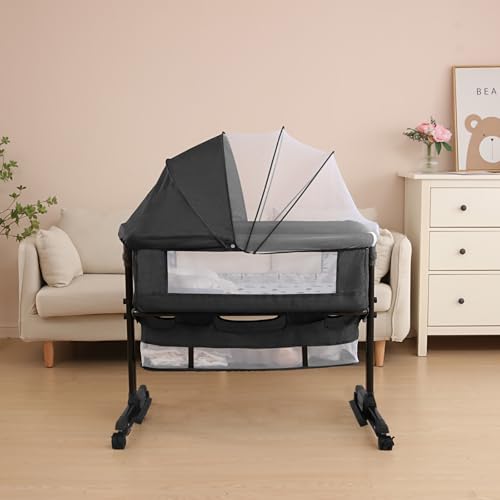

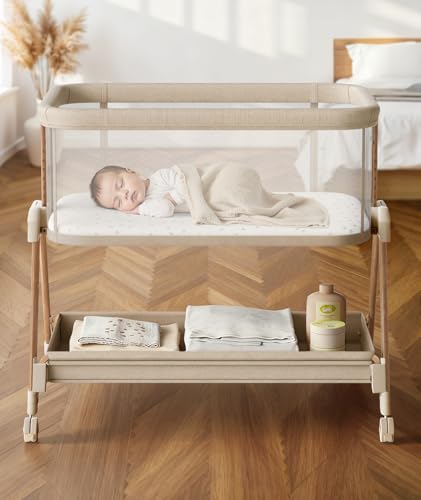
As an Amazon Associate we earn from qualifying purchases at no extra cost to you. Ratings are shown as listed on Amazon.
Quick picks by sleeping situation
| Situation | Best bassinet type | What to prioritize | Typical usable period |
|---|---|---|---|
| Small bedroom or apartment | Compact bedside bassinet | Footprint under about 40 by 25 inches, lockable wheels, adjustable height | Until rolling, pushing up, or the stated weight limit |
| Frequent room-to-room moves | Lightweight folding bassinet | Under 25 pounds, one-piece folding frame, removable washable cover | Usually the first few months |
| Night feeding beside the bed | Height-adjustable bedside sleeper | Firm mattress, secure attachment system, low side that does not create a gap | Often up to 20–30 pounds, depending on model |
| Travel or occasional visits | Portable travel bassinet | Under 15 pounds, compact folded size, simple cleaning, stable base | Short-term or supervised travel use within limits |
| Premium design and easy access | Swivel bedside bassinet | 360-degree rotation, strong brake system, clearly marked height settings | Typically limited by rolling, sitting, pushing up, or weight |
What makes a bassinet safe and comfortable?
Look for a sleep space with a firm, flat, level mattress and a fitted sheet made for that specific mattress. The mattress should not visibly sag under normal use, and there should be no gap where the mattress meets the sides. Avoid adding a topper, positioner, pillow, loose blanket, bumper, or aftermarket padding.
Breathable sides are useful because they improve visibility and airflow, but “breathable” does not mean the sides should be soft, quilted, or heavily padded. Mesh panels should be securely attached, without tears or stretched openings large enough for a hand or limb to become trapped. A fully mesh wall is not a substitute for a firm mattress or correct assembly.
Follow the manufacturer’s limit for weight and development. Many bassinets are intended for babies up to roughly 20 to 30 pounds, but rolling, pushing up, sitting, kneeling, or attempting to climb may require earlier discontinuation. The lower limit is not a target: a newborn’s fit should be assessed using the manufacturer’s instructions, not by placing extra padding around the baby.
Head-to-head: the main bassinet designs
Bedside bassinets
A bedside sleeper is usually the most practical choice for overnight use. Height adjustment lets the sleep surface align with a bed, while wheels or a swivel mechanism can make access easier. The important distinction is whether the product is designed to attach securely to the adult bed or merely sits next to it. For an attaching model, use every required strap, check that the mattress remains level, and inspect the gap after changing bed height or moving the frame.
Halo Bassinest models are known for their rotating bedside design and multiple height settings. They are attractive for parents who want to pivot the sleep space toward the bed, but the wide base requires sufficient floor clearance. Chicco Close to You is a wheeled, height-adjustable bassinet-style product with a higher profile and storage-oriented design; measure both doorways and the area around the bed before choosing it. Maxi-Cosi Iora is a folding bedside sleeper with adjustable height and a travel-oriented design, making it more suitable for homes where storage matters.
Compact folding bassinets
These are often the best balance for smaller rooms. A folding frame can be moved for cleaning or stored during the day, but check whether folding requires removing the mattress and fitted sheet. A frame that folds quickly but leaves a cover permanently compressed may wear faster at the creases.
BabyBjörn Cradle is a lightweight, compact option with breathable fabric sides and a rocking motion. Its lower weight capacity than many full-size bedside bassinets makes it better for the early months rather than long-term use. The gentle rocking feature should never be treated as a replacement for a flat, stationary sleep surface when the baby is unattended; use it exactly as directed.
Travel bassinets
Portable models are convenient for visiting relatives or moving between floors, but portability usually means less storage, a smaller mattress, or a lower weight limit. Confirm that the product is intended for unsupervised sleep rather than lounging, play, or supervised naps. A travel bassinet should be placed on the floor or another manufacturer-approved stable surface—not on a bed, sofa, table, or counter.
Comparison of useful specifications
The figures below illustrate the trade-offs among real product categories and selected established models. Specifications can vary by generation and regional version, so verify the label and current manual before buying.
| Option | Approximate product weight | Height or size characteristic | Weight limit characteristic | Best fit |
|---|---|---|---|---|
| BabyBjörn Cradle | About 13 lb | Compact footprint; rocking frame | About 17 lb | Lightweight early-use sleep space |
| Halo Bassinest Swivel Sleeper | About 30–35 lb, model dependent | Multiple bedside height settings; rotating design | Often around 20 lb, model dependent | Bedside access with a larger floor base |
| Maxi-Cosi Iora | About 22 lb | Five height positions on many versions; folds for storage | About 20 lb | Adjustable bedside use and travel between rooms |
| Chicco Close to You | About 33 lb | Height-adjustable wheeled frame | About 30 lb, according to version | Higher bedside position and easy repositioning |
| Basic stationary bassinet | About 10–20 lb | Fixed height; commonly around 35–40 in long | Often 15–25 lb | Lowest-cost, least complicated setup |
How to choose by room, budget, and frequency of use
- For a tight budget: choose a stationary or simply folding bassinet with a replacement-sheet supply. Spend less on music, vibration, and decorative features, and more on mattress fit, stable legs, and a clear manual.
- For a small bedroom: measure the bassinet’s widest point, not only the mattress. A swivel base can occupy more floor area than a rectangular model even when its sleeping surface is compact.
- For a first-time caregiver: favor visible assembly markings, a small number of parts, and a plainly labeled weight and developmental limit. Complicated mechanisms create more opportunities for missed locks or incorrect height settings.
- For frequent daily movement: wheels are worthwhile only if they lock firmly and roll without lifting the frame. A 30-pound bassinet can be awkward on stairs even when its wheels work well on a flat floor.
- For occasional use: prioritize folded dimensions, washable fabric, and a mattress that does not need a special proprietary setup each time.
Assembly and setup: the checks that matter
- Identify every locking point. Open the frame fully until each hinge, leg, and height button clicks or visibly locks. Do not rely on the cover to hide an incompletely opened frame.
- Install only the supplied mattress and sheet. Press around all four edges. If you can insert more than a very thin finger-width gap, stop using the setup until the fit is corrected.
- Set the height before placing the baby inside. On a bedside model, the sleep surface should remain flat. Check both ends of the mattress after raising or lowering the frame.
- Secure bedside attachments as directed. Straps must be tight, and the bassinet must not pull away from the adult bed when gently tested. Recheck after moving the bed or changing its base.
- Test wheels and brakes. Lock every caster before use. If the bassinet rocks, rolls, or twists when a brake is engaged, do not use it until repaired or replaced.
Ownership realities: cleaning, wear, and replacement costs
The fitted sheet and mattress cover usually show wear first. Plan on having at least two properly fitted spare sheets so one can be washed while the other is in use. Follow the care label: some covers can be machine washed, while others require a specific temperature or air-drying method. Do not use a waterproof layer that changes the mattress fit unless the manufacturer supplies or approves it.
Inspect mesh seams, hook-and-loop fasteners, wheels, mattress edges, and folding joints monthly and after every move. Sun exposure, frequent washing, and repeated folding can weaken fabric. Rust, bent tubing, missing hardware, torn mesh, a compressed mattress, or a cover that no longer stays tight are reasons to stop using the product.
Secondhand bassinets can be economical, but obtain the exact model manual and check for recalls, missing straps, altered mattresses, and unknown storage conditions. Never assume a universal replacement mattress is safe merely because its listed dimensions appear close.
Bottom line
Choose a bedside model such as a Halo Bassinest, Maxi-Cosi Iora, or Chicco Close to You when bedside access and height adjustment are your priorities. Choose a BabyBjörn Cradle or another compact folding design when low weight and room-to-room portability matter more than a long weight range. For any model, the deciding features should be a firm fitted mattress, intact breathable sides, secure locks or attachments, a stable base, and a clearly understood stopping point—not decorative extras.
This article provides general product information, not individual medical or safety advice. For questions about a baby’s sleep environment, positioning, or special health needs, consult a pediatrician or qualified child-safety professional.

Write Your Review
No reviews yet. Be the first to share your experience!