

Key takeaways
- Best for a typical all-electric home: EcoSmart ECO 27, provided the electrical panel can support its approximately 112.5-amp maximum draw.
- Best for moderate electric demand: Rheem RTEX-18 or RTEX-24, selected according to the number of simultaneous showers and fixtures.
- Best for a large household using natural gas: Rinnai RU199iN, a high-output condensing heater with built-in recirculation controls.
- Best gas option when installation space is limited: Navien NPE-240A2, which combines high maximum output with flexible venting and recirculation features.
- Best for a remote sink or occasional-use bathroom: A small 120-volt point-of-use electric heater, usually in the 2.5- to 6-gallon equivalent category, rather than a whole-home tankless system.
The best tankless water heaters depend on your fuel supply and peak demand: choose an electric unit for simpler installation and point-of-use efficiency, or a gas condensing model when several high-flow fixtures may run at once.
Our top picks
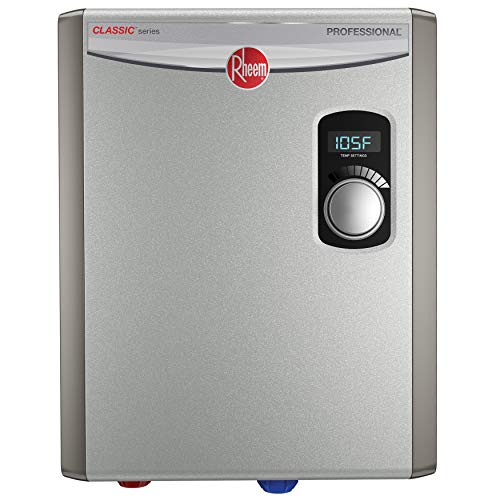
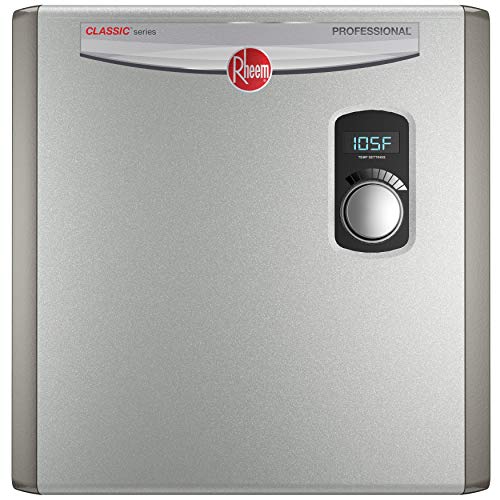

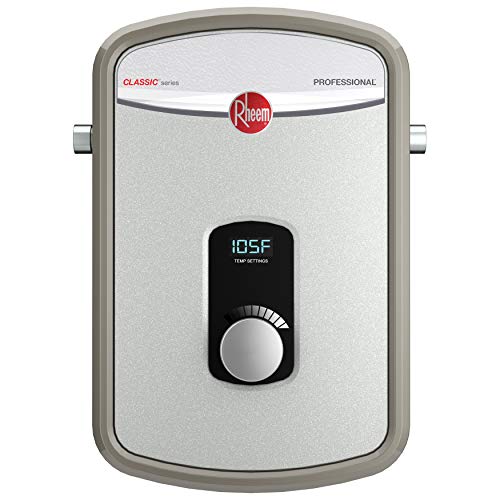
As an Amazon Associate we earn from qualifying purchases at no extra cost to you. Ratings are shown as listed on Amazon.
Quick picks for different homes
- Best for a typical all-electric home: EcoSmart ECO 27, provided the electrical panel can support its approximately 112.5-amp maximum draw.
- Best for moderate electric demand: Rheem RTEX-18 or RTEX-24, selected according to the number of simultaneous showers and fixtures.
- Best for a large household using natural gas: Rinnai RU199iN, a high-output condensing heater with built-in recirculation controls.
- Best gas option when installation space is limited: Navien NPE-240A2, which combines high maximum output with flexible venting and recirculation features.
- Best for a remote sink or occasional-use bathroom: A small 120-volt point-of-use electric heater, usually in the 2.5- to 6-gallon equivalent category, rather than a whole-home tankless system.
These recommendations are starting points, not substitutes for a load calculation. A heater advertised as “whole-house” may still be unable to supply two wintertime showers plus a bathtub at the same time.
Electric versus gas tankless water heaters
Electric heaters warm water with resistance elements. They have no combustion chamber, gas line, chimney, or gas vent, so installation is often simpler where adequate electrical capacity already exists. Their drawbacks are high instantaneous amperage and a tendency to deliver less flow at a large temperature rise.
Gas heaters use a burner and normally require a dedicated gas line, combustion-air provisions, condensate management if the unit is condensing, and approved venting. They generally provide more hot-water flow for large homes, but the installation can cost considerably more. Gas models also need annual attention to the intake, exhaust, condensate drain, and combustion-related components.
| Category | Electric whole-home unit | Gas condensing unit |
|---|---|---|
| Typical maximum input | 18 to 36 kW | 150,000 to 199,000 BTU/h |
| Common peak flow range | 4.0 to 8.0 GPM at a 45°F rise | 7.5 to 11.0 GPM at a 45°F rise |
| Electrical requirement | Usually 2 to 3 double-pole circuits; 100 to 150 amps may be needed | Usually a 120-volt receptacle; confirm the model’s circuit requirements |
| Venting | None | Dedicated intake and exhaust venting; condensing models also need a drain |
| Installation footprint | Often about 15 to 25 inches wide and 15 to 25 inches tall | Often about 14 to 18 inches wide and 23 to 26 inches tall |
| Typical equipment price | About $400 to $1,000 | About $1,000 to $2,500 |
| Typical installed project range | About $1,000 to $3,500, depending mainly on electrical work | About $2,500 to $6,000 or more, depending on gas and venting work |
Flow figures vary with incoming-water temperature, outlet temperature, pressure, and the manufacturer’s test conditions. Use them to compare capacity, not as a promise of identical performance in every climate.
Head-to-head comparison of leading choices
EcoSmart ECO 27
The ECO 27 is a compact electric model rated at up to 27 kW, with a published maximum flow around 6.5 GPM under favorable conditions. At a 45°F temperature rise, a more realistic planning figure is about 5 to 6 GPM. It can suit a two-bathroom home in a moderate climate, but cold groundwater or simultaneous high-flow fixtures can reduce that margin quickly.
The main installation question is not wall space; it is the electrical service. The unit can require roughly 112.5 amps at full output and commonly needs three 40-amp double-pole breakers, subject to local code and the exact installation. An older 100-amp panel may need an upgrade before this heater is practical.
Rheem RTEX-18 and RTEX-24
These electric models are sensible when demand is moderate and the home has limited spare panel capacity. The RTEX-18 is approximately an 18 kW class heater, while the RTEX-24 is approximately 24 kW. Plan on roughly 3.5 to 4.5 GPM for the RTEX-18 and 4.5 to 5.5 GPM for the RTEX-24 at a 45°F rise, with lower output in colder incoming water.
They are better suited to one shower plus a sink, or carefully managed two-fixture use, than to a large family running multiple showers and laundry simultaneously. Verify the required breaker count, wire size, and service capacity with an electrician before purchase.
Rinnai RU199iN
The RU199iN is a natural-gas, condensing tankless heater with input up to about 199,000 BTU/h and a maximum flow near 11 GPM under favorable conditions. At a 70°F rise, its usable flow is closer to 8 GPM, and a cold-climate installation may require more conservative planning.
It is a strong choice for a large household because its gas input supports substantially more flow than most residential electric units. The trade-offs include gas-line sizing, concentric or separate venting, condensate disposal, combustion-air requirements, and potentially a recirculation setup if long waits at distant taps are a concern.
Navien NPE-240A2
The NPE-240A2 is another high-output condensing gas model, rated around 199,900 BTU/h with maximum flow in the approximately 11 GPM class. Its internal recirculation capability can reduce waiting time when configured correctly, although recirculation can increase energy use if it runs continuously.
This model makes the most sense in a larger home where gas infrastructure and professional installation are available. It is unnecessary overcapacity for a small apartment with one shower and one kitchen sink.
How to size a tankless water heater
Start with the highest-demand combination that could realistically occur at the same time. Typical flow assumptions are:
- Low-flow shower: 1.5 to 2.0 GPM
- Standard shower: 2.0 to 2.5 GPM
- Kitchen faucet: 1.5 to 2.2 GPM
- Bathroom faucet: 0.5 to 1.5 GPM
- Bathtub filler: 4 to 6 GPM, depending on the fixture
Then calculate temperature rise:
Temperature rise = desired hot-water temperature − incoming-water temperature.
For example, two 2.0-GPM showers and a 1.5-GPM kitchen faucet require 5.5 GPM. If groundwater enters at 50°F and the heater is set to 120°F, the required rise is 70°F. A model that produces 8 GPM only at a 45°F rise may deliver substantially less than 5.5 GPM at this colder condition.
For electric heaters, an approximate sizing relationship is:
Required electrical power in kW ≈ 0.146 × flow in GPM × temperature rise in °F.
That example requires about 56 kW, far beyond a normal single residential electric unit. In practice, the household must reduce simultaneous flow, use lower-flow fixtures, choose gas, or install multiple electric units. This calculation explains why an electric heater that appears powerful on its label may not replace a high-output gas system in a cold climate.
Decision matrix
| Home situation | Most suitable direction | Why | Watch out for |
|---|---|---|---|
| One or two occupants, one bathroom | 18 to 24 kW electric | Lower equipment cost and no venting | Panel capacity and cold-water performance |
| Two bathrooms, moderate climate | 24 to 27 kW electric or 150,000 BTU/h gas | Can cover normal use with some scheduling | Bathtub fillers and simultaneous showers |
| Three or more bathrooms or frequent simultaneous use | 180,000 to 199,000 BTU/h condensing gas | Higher flow at large temperature rises | Gas-line, venting, condensate, and service requirements |
| No gas service and an older electrical panel | Point-of-use units, panel upgrade, or a hybrid plan | Avoids buying a heater the service cannot power | Electrical upgrade may erase the apparent savings |
| Vacation home or rarely used outbuilding | Small electric point-of-use heater | Simple installation and no standing tank losses | Freeze protection and electrical shutoff procedures |
Ownership costs and maintenance
Tankless heaters avoid the standby losses of a storage tank, but they are not maintenance-free. Hard water can form scale on the heat exchanger, restricting flow and reducing heat transfer. Manufacturers commonly recommend flushing with an approved descaling solution about once a year; homes with very hard water may need it more often.
The components most likely to need attention are inlet screens, flow sensors, ignition parts on gas models, isolation valves, filters, and scale-covered heat exchangers. Gas units also have combustion fans, vent connections, condensate traps, and flame-sensing components. Keep the area around air intakes and exhaust terminals clear of leaves, snow, lint, and stored chemicals.
A common mistake is setting the heater unnecessarily hot and then mixing in large amounts of cold water. A setting near 120°F is often more efficient and reduces scald risk, but households should follow local requirements and consider a tempering valve where appropriate. Another mistake is installing a recirculation loop that runs continuously; demand-controlled or scheduled recirculation can reduce wasted energy and water.
Bottom line
Choose a 18- to 27-kW electric unit when your household demand is moderate and your panel can support it. Choose a 150,000- to 199,000-BTU/h condensing gas model when several fixtures may run together or winter groundwater is very cold. Before buying, calculate peak GPM, temperature rise, gas or electrical capacity, venting, condensate drainage, and service access. Those installation realities matter more than a heater’s maximum flow number printed on its product page.

Write Your Review
No reviews yet. Be the first to share your experience!