

Key takeaways
- People with limited floor space but a permanent exercise area.
- Users who already own a compatible reformer or mat setup.
- Experienced users who value adjustable spring positions and a compact footprint.
Best Pilates Towers for Home Workouts
The best Pilates tower for home workouts is the one that matches your ceiling height, available floor and wall space, preferred spring resistance, installation limits, and willingness to assemble or permanently mount equipment.
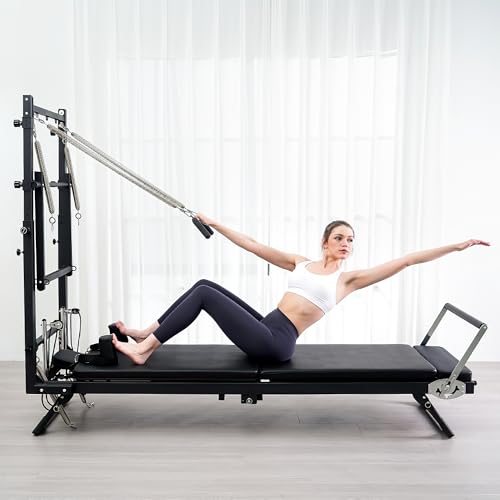
A Pilates tower adds vertical springs, a push-through bar, and often a pull-up or roll-down bar to a mat or reformer setup. It can support a broad range of controlled exercises, but “best” depends less on the longest accessory list than on whether the tower can be installed safely and adjusted to suit the people using it.
Our top picks


As an Amazon Associate we earn from qualifying purchases at no extra cost to you. Ratings are shown as listed on Amazon.
Best Pilates Towers by Home Situation
| Home situation | Best tower type | Useful target specifications | Typical market range |
|---|---|---|---|
| Small room or rental apartment | Wall-mounted tower with a folding or removable bar | Wall width of about 24–32 in; roughly 80–95 in of clear height; 20–30 in projection | $700–$1,500 |
| Dedicated home studio | Full Cadillac or tower-frame system | About 80–100 in wide, 80–96 in high, and 35–45 in deep | $1,500–$4,000+ |
| Renter who cannot drill into walls | Freestanding tower or reformer-and-tower combination | Base footprint around 30–40 in wide; 75–100 lb or more; adjustable feet or leveling system | $1,200–$4,000+ |
| Existing reformer owner | Compatible wall tower or half-trapeze conversion | Exact matching width, carriage clearance, spring hooks, and manufacturer-approved mounting | $800–$2,500 |
These are planning ranges rather than universal product specifications. Always confirm the manufacturer’s dimensions, mounting instructions, and required clearance before ordering.
Best Pilates Tower for a Small Room: Wall-Mounted Design
A wall tower is usually the most space-efficient choice because the frame occupies wall area instead of taking up the full footprint of a freestanding Cadillac. Balanced Body’s Wall Tower is a well-known example of this category, while Merrithew offers wall-mounted Cadillac-style equipment for users who want a studio-oriented system.
Choose a wall-mounted tower when you have a structurally suitable wall and at least several feet of clear space in front of it. The wall should be capable of supporting dynamic loads, not merely the static weight of the frame. A masonry wall or properly reinforced timber-stud wall is preferable; drywall alone is not an acceptable mounting surface.
Measure more than the tower’s advertised width. Include space for the push-through bar, springs, straps, and your body as it moves through exercises. A narrow 28-inch tower can still require approximately 6–8 feet of usable room depth for comfortable movement. Keep furniture, ceiling fans, and sharp-edged objects outside the movement area.
Who should choose it?
- People with limited floor space but a permanent exercise area.
- Users who already own a compatible reformer or mat setup.
- Experienced users who value adjustable spring positions and a compact footprint.
The main disadvantage is installation. A professional installer is worthwhile if you are uncertain about stud locations, masonry anchors, ceiling height, or load-bearing construction.
Best Freestanding Pilates Tower: Stability and Flexibility
A freestanding tower or Cadillac-style frame is the better choice when drilling into a wall is impossible or when several people will use the equipment. It can also be repositioned, although moving a large frame is not a one-person task in many homes.
Freestanding systems from established Pilates manufacturers such as Balanced Body, Merrithew, and Peak Pilates are generally aimed at studio-style use. Their frames commonly use powder-coated steel, multiple spring attachment points, and replaceable straps or ropes. Some are sold as complete trapeze tables; others combine a tower with a reformer or mat platform.
Check the base carefully. A tall frame with a narrow footprint may feel unstable during lateral movement, especially on thick carpet. Leveling feet, a rigid crossbar, and a stated user-weight capacity matter more than decorative finish. If the specifications do not state a capacity or recommend anchoring, ask the manufacturer before buying.
Best Pilates Tower and Reformer Combination
A tower-reformer combination is the most versatile option for a dedicated workout room, but it is also the most expensive and space-intensive. The Balanced Body Allegro 2 can be configured with tower equipment, and Merrithew’s reformer range includes models and packages designed to add Cadillac or tower functionality. Compatibility is not universal: carriage height, frame width, spring clips, and safety clearances must match.
This setup is suitable for someone who expects to train several times per week and wants both horizontal reformer work and vertical tower exercises. It is less suitable for occasional users who will need to fold, disassemble, or move the equipment after every session.
A simple value calculation
Suppose a $2,000 tower is used three times weekly for three years. That is approximately 468 sessions, producing an equipment cost of about $4.27 per session before maintenance. At one session weekly over the same period, the cost rises to about $12.82 per session. The more frequently you expect to use the tower, the more reasonable it becomes to pay for better adjustability, smoother hardware, and replaceable parts.
Spring Resistance and Adjustability Matter More Than the Number of Accessories
Pilates towers typically use several spring strengths rather than one universal resistance. A useful home setup often includes at least four springs in mixed resistance levels, such as two lighter and two heavier springs. Exact color codes differ between manufacturers, so do not assume that a “blue” or “red” spring has the same resistance across brands.
Look for multiple spring attachment heights, clearly marked adjustment points, and carabiners that can be operated without awkward twisting. A tower with only two attachment positions may be adequate for basic sessions but limiting for users of different heights or experience levels.
- Beginners: prioritize clear attachment markings, moderate spring options, stable bars, and accessible instructional material.
- Experienced users: prioritize a wider adjustment range, a reliable push-through bar, and compatibility with your existing straps and springs.
- Multiple users: choose fast, tool-free adjustments and enough height positions to accommodate different body sizes.
Ceiling Height and Installation Checklist
Before purchasing, measure from the finished floor to the lowest obstruction, not simply to the ceiling. Account for beams, sloped ceilings, lighting, and ceiling fans. A tower intended for upright movement may need roughly 80–96 inches of vertical clearance, while a push-through bar and overhead straps may require additional clearance depending on the exercise.
- Measure the proposed wall or floor footprint.
- Mark the tower’s height on the wall with painter’s tape.
- Extend the frame’s expected projection into the room.
- Lie down and raise your arms and legs to identify nearby obstructions.
- Confirm stud spacing, wall construction, and the manufacturer’s anchor requirements.
- Check the delivery route, including door widths, stairways, and elevator limits.
A ceiling height that technically fits may still be impractical if you cannot safely stand, mount springs, or move the bar into position.
Accessories Worth Paying For
Useful included accessories usually include a push-through bar, roll-down bar, safety strap, handles, foot loops, springs, and ropes or webbing straps. A padded mat or platform can improve comfort, but it should not substitute for a stable frame.
Do not pay extra for accessories you will not use. The most valuable additions are often replacement springs, extra handles, a safety strap, and manufacturer-specific mounting hardware. Generic springs or carabiners may have different lengths, ratings, or attachment shapes and can change how the equipment behaves.
Durability, Cleaning, and Common Ownership Problems
Springs, ropes, webbing, and padded upholstery are the parts most likely to wear first. Inspect springs for corrosion, stretched coils, gaps, or damaged hooks. Replace any spring that looks deformed rather than trying to repair it. Examine straps for fraying and check carabiners for gates that no longer close fully.
Wipe handles and metal surfaces with a lightly damp cloth after use, then dry them. Use a manufacturer-approved cleaner on vinyl or upholstery; strong solvents can damage coverings and stitching. Keep springs away from prolonged humidity and direct sunlight.
Common mistakes include leaving springs under tension for long periods, attaching incompatible accessories, mounting into drywall without structural reinforcement, and failing to recheck bolts after the first few sessions. Follow the supplied manual and stop using equipment that shifts, squeaks unusually, or develops loose hardware.
Final Buying Recommendation
For a small permanent workout area, choose a properly installed wall tower with several spring positions and a safety strap. For a rental or multipurpose room, choose a freestanding system only if you can store and move its substantial frame safely. For frequent training and maximum exercise variety, a reformer-and-tower combination from an established manufacturer such as Balanced Body or Merrithew is the strongest long-term option.
Before exercising, learn the equipment’s adjustments from the manual or a qualified Pilates instructor. Pilates equipment is not a substitute for medical care; anyone managing pain, recovering from an injury, or unsure whether particular movements are appropriate should consult a qualified health professional.

Write Your Review
No reviews yet. Be the first to share your experience!