

Key takeaways
- Magnetic (vehicle) probe: buried 3 to 12 inches deep near the drive, it reacts to the change in the magnetic field caused by large metal objects. Dakota Alert describes the DCPA-4K Plus probe as sensing vehicles up to roughly 10 feet away, and reviewers note that it ignores people, deer, wind and moving branches. The trade-off is that it will not warn of a person on foot, a bicycle or a motorbike with little metal.
- Passive infrared (PIR) motion sensor: senses heat and movement. It catches vehicles and people, but animals, swaying vegetation and sun on a warm day can cause false alerts. SafeWise lists the YoLink SpeakerHub with a 40 ft detection range, the 1byone with 24 ft, the eMACROS with 30 ft, and the Dakota DCMA-4K Plus with up to 100 ft that can be adjusted down to 25 to 50 ft.
- Other options: Dakota’s receiver also pairs with rubber road hoses and photoelectric beams, according to SafeWise, which suit gates and narrow entries.
For a long driveway of several hundred feet, the Dakota Alert DCPA-4K Plus (a buried magnetic probe that detects vehicles only) or the DCMA-4K Plus (a motion version that also catches people on foot) is the strongest fit, thanks to a stated wireless range of up to one mile. Mid-length driveways with trees or hills are commonly handled by the half-mile class, such as the HTZSAFE kit or the solar eMACROS, and shorter drives can use a budget kit like the 1byone. Rated range is a best case measured in clear line of sight, so the layout of your property matters more than the number on the box.
Our top picks

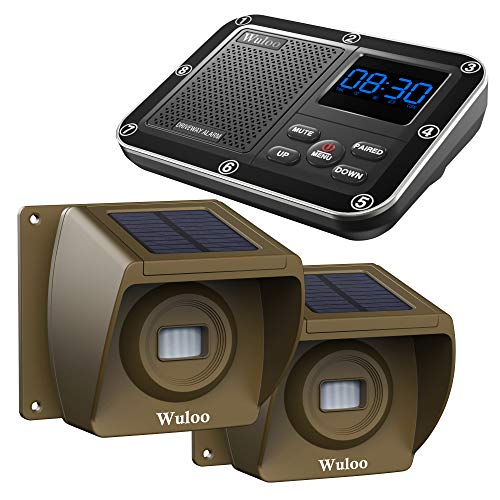


As an Amazon Associate we earn from qualifying purchases at no extra cost to you.
Sensor type: vehicle probe or motion detector
Driveway alarms use two main kinds of sensor, and picking the wrong one is the most common source of regret.
- Magnetic (vehicle) probe: buried 3 to 12 inches deep near the drive, it reacts to the change in the magnetic field caused by large metal objects. Dakota Alert describes the DCPA-4K Plus probe as sensing vehicles up to roughly 10 feet away, and reviewers note that it ignores people, deer, wind and moving branches. The trade-off is that it will not warn of a person on foot, a bicycle or a motorbike with little metal.
- Passive infrared (PIR) motion sensor: senses heat and movement. It catches vehicles and people, but animals, swaying vegetation and sun on a warm day can cause false alerts. SafeWise lists the YoLink SpeakerHub with a 40 ft detection range, the 1byone with 24 ft, the eMACROS with 30 ft, and the Dakota DCMA-4K Plus with up to 100 ft that can be adjusted down to 25 to 50 ft.
- Other options: Dakota’s receiver also pairs with rubber road hoses and photoelectric beams, according to SafeWise, which suit gates and narrow entries.
Wireless range: what the numbers mean
The stated range is the distance between the sensor’s transmitter and the indoor receiver. Dakota lists up to one mile (5,280 feet) for its 4K Plus series, while several retailers quote slightly lower figures such as 5,000 or 4,000 feet. The half-mile class (about 2,640 feet) covers the HTZSAFE and eMACROS kits. The YoLink SpeakerHub is listed at 1,320 feet and the 1byone at 1,000 feet.
Reviewers repeatedly caution that these are maximum, line-of-sight figures. Trees, hills, metal buildings and interference reduce the real distance. One reviewer reports the Mighty Mule FM231, rated at 400 feet, working closer to 300 feet in practice. In contrast, an owner of an eMACROS kit reportedly held signal through more than 700 feet of dense tree cover. Plan for a margin of at least double the actual distance if the path is wooded or hilly.
At a glance: main options
| Model | Sensor | Best for | Key stated specs | Limits |
|---|---|---|---|---|
| Dakota Alert DCPA-4K Plus | Buried magnetic probe | Very long drives with animals or foot traffic around | Up to 1 mile range; vehicles only; transmitter uses three CR123A batteries, about 12 months of life per Dakota; receiver supports up to 16 sensors; two Form C relay outputs; operates from -30 to 120 F; one-year warranty | Premium tier; does not detect people; probe must be buried |
| Dakota Alert DCMA-4K Plus | PIR motion (other sensor types supported) | Long drives where people on foot also matter | Up to 1 mile range, detection up to 100 ft, up to 16 sensors, 12 alarm tones, AC-powered receiver | Premium tier; setup is more involved; animals can trigger PIR |
| HTZSAFE half-mile kit | PIR motion | Value for 500 to 1,200 ft drives | About 1/2 mile rating; reviewers report reliable triggers through 1,200 ft of dense forest and one hill | Rated range holds best with clear line of sight |
| eMACROS solar half-mile | PIR motion, solar powered | Rural drives without nearby power | 30 ft detection, 2,640 ft range, solar with rechargeable battery, up to 16 sensors | Limited customisation; one review notes sensitivity dropping over time |
| TECKNET solar RGB | PIR motion, solar | Multiple entry points | 2,600 ft range; colour-coded LED shows which sensor triggered | Same PIR limits |
| YoLink SpeakerHub | PIR motion | Smart-home users | 40 ft detection, 1,320 ft range, app alerts, up to 200 sensors; hub is mains-powered with no battery backup | Shorter range |
| 1byone | PIR motion | Short to medium drives on a tight budget | 24 ft detection, 1,000 ft range, 36 chime options, supports up to 5 sensors | Short range for long drives |
| Mighty Mule FM231 | Magnetic | Shorter vehicle-only setups | Rated 400 ft | Reviewer reports about 300 ft in practice |
Layout advice for long driveways
Place the transmitter near the entrance
The farther the sensor sits from the house, the more the range matters. Put it at the road end, where vehicles first enter, rather than halfway along. If trees block the line to the house, mount the transmitter higher on a post and the receiver near a window facing the drive.
Account for obstacles
Hills, metal outbuildings and dense forest all cut the signal. Where the path is blocked, a second receiver or a repeater-style placement near the midpoint can help. Dakota states that one sensor can pair with an unlimited number of receivers, and a receiver accepts up to 16 sensors, so you can add a workshop receiver without new hardware.
Avoid false alarms
For rural property with deer, a magnetic probe is the quieter choice. If you use PIR, aim it across the drive rather than along it, away from road traffic and tree branches, and lower the sensitivity if the unit offers it.
Trade-offs by budget tier
- Budget: kits like 1byone cover about 1,000 feet of line of sight with a plug-in receiver. They suit a short rural drive but may fall short in woods.
- Mid-range: the half-mile kits (HTZSAFE, eMACROS, TECKNET) are the sweet spot for most long driveways, often with two sensors and solar options.
- Premium: the Dakota Alert 4K Plus series, with the longest range, expandable receivers, relay outputs for lights or sirens, and a choice of sensor types.
Fit, installation and care notes
- Burying the probe: follow the maker’s instructions for depth and orientation. Before digging, contact your local underground utility locating service so you do not hit buried lines.
- Power: solar units need open sky. In shaded drives choose battery or mains transmitters, and check winter output.
- Weather: Dakota lists the 4K Plus sensor for -30 to 120 F operation. Check temperature ratings for other kits against your climate.
- Batteries: replace transmitter batteries on a schedule, since a dead sensor looks the same as a quiet drive. Dakota cites about 12 months for CR123A cells.
- Mains wiring: receivers plug into an outlet. If you want relays to switch lights or a siren, use a licensed electrician for any fixed wiring and follow the manual.
- Privacy and local rules: point sensors at your own property and not at a neighbour’s.
Testing the range before you commit
Because real range varies so much, a sensible routine is to pair the sensor and receiver indoors, then move the transmitter to its planned spot and walk or drive past it while someone watches the receiver. If alerts are missed at the planned position, raise the transmitter, shift it toward a clearer line, or move the receiver to a window facing the drive. Do this before burying a probe or fixing a post, since relocating either later is more work. Also note the alert tone and volume: a receiver in a back bedroom or a workshop with machinery running may need a louder tone or an extra receiver.
Pick X if you…
| If you… | Pick | Why |
|---|---|---|
| Have a drive over about 400 ft or heavy obstruction | Dakota Alert DCPA-4K Plus | One-mile rating and vehicle-only detection |
| Want to catch walkers as well as cars | Dakota Alert DCMA-4K Plus | PIR version with the same range |
| Want the best value for a long drive | HTZSAFE half-mile kit | Frequently placed first in value roundups |
| Have no power at the road end | eMACROS or TECKNET solar | Solar-powered transmitters |
| Want smart-home alerts on your phone | YoLink SpeakerHub | App alerts and sensor expansion |
| Have a short, open drive | 1byone or Mighty Mule | Enough range at a lower tier |
Alternatives
- Cellular or Wi-Fi security cameras: useful for seeing who arrives, though they depend on network coverage down the drive.
- Rubber road hose sensors: compatible with Dakota receivers, suited to gate entrances.
- Photoelectric beam sensors: create a tripwire for narrow openings.
- Gate or entry sensors tied to a home security system: a good option if you already pay for monitoring.
Frequently Asked Questions
How far will a driveway alarm really reach?
The stated range is a maximum in clear line of sight. Trees, hills and buildings reduce it, and reviewers often see far less than the box claims. Choose a unit rated for roughly double your actual distance if the path is wooded.
Which sensor avoids false alarms best?
A magnetic probe such as the Dakota DCPA-4K Plus is reported to ignore animals, wind and branches because it only reacts to large metal objects. It will not detect people on foot.
Can I add more than one sensor?
Yes with most systems. Dakota’s receiver accepts up to 16 sensors, the eMACROS lists up to 16, and the 1byone is limited to 5 according to SafeWise.
Do solar driveway alarms work in winter?
They can, but output falls with short days and shade. Place the panel in open sun and consider a battery or mains option for heavily shaded drives.
Does the receiver need to be near the house?
It must be within range of the transmitter and plugged into power. Placing it by a window facing the drive often improves reception.
Is a driveway alarm a substitute for a security system?
No. It alerts you to arrivals but does not record or deter. Pair it with lighting or cameras if security is the goal.








Write Your Review
No reviews yet. Be the first to share your experience!